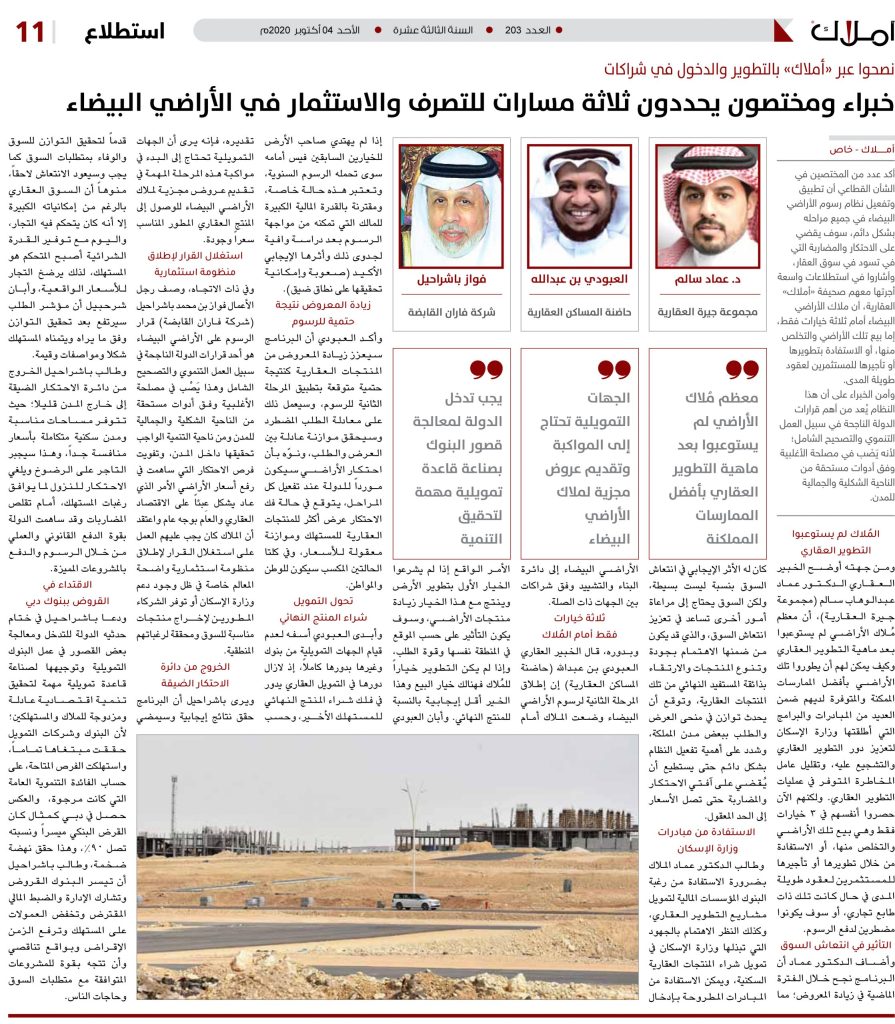

A number of experts in the sector have affirmed that the implementation and enforcement of the vacant land fee system in all its phases on a permanent basis will eliminate the monopoly and speculation that currently prevail in the real estate market, In extensive surveys conducted by the real estate newspaper «Amlak,» they noted that owners of undeveloped land face only three options: either sell the land and dispose of it, develop it, or lease it to investors for long-term contracts.
Experts affirmed that this system is one of the state’s most successful decisions in the pursuit of development and comprehensive reform, as it serves the interests of the majority while adhering to standards that are both functionally and aesthetically appropriate for cities.
Landowners Have Not Embraced Real Estate Development
For his part, real estate expert Dr. Emad Abdel Wahab Salem (Jira Real Estate Group) explained that most landowners have not yet grasped the nature of real estate development or how they can develop their land using the best available practices—which are accessible to them through numerous initiatives and programs launched by the Ministry of Housing to strengthen and encourage real estate development, and to minimize the risks involved in real estate development. However, they have now limited themselves to only three options: selling the land and disposing of it; benefiting from it by developing it or leasing it to investors on long-term contracts if the land is commercial in nature; or being forced to pay fees.
Impact on Market Recovery
Dr. Emad added that the program has succeeded in increasing supply over the past period, which has had a positive impact on Market Recovery by a significant margin; however, the market must take into account other factors that will help bolster this recovery, which may include a focus on the quality and diversity of products and the refinement of the end-user’s taste regarding these real estate products, He predicted that a balance between supply and demand would be achieved in some cities across the Kingdom and emphasized the importance of permanently enforcing the system so that it can eliminate the scourges of monopoly and speculation, thereby bringing prices down to reasonable levels.
Taking Advantage of the Ministry of Housing’s Initiatives
Dr. Emad Al-Malak called for taking advantage of the willingness of banks and financial institutions to finance real estate development projects, as well as paying attention to the efforts made by the Ministry of Housing to finance the purchase of residential real estate, and to take advantage of initiatives to incorporate undeveloped land into the construction sector through partnerships among relevant entities.
Only Three Options for Property Owners
In turn, real estate expert Al-Aboudi bin Abdullah (Real Estate Housing Incubator) said that the launch of the second phase of vacant land fees has presented property owners with a fait accompli: if they do not proceed with the first option of developing the land—which would result in an increase in land supply— the impact will depend on the location within the same area and the strength of demand. If development is not an option for landowners, there is the option to sell, though this is less favorable for the end user. Al-Aboudi explained that if a landowner does not opt for either of the two previous options, they have no choice but to bear the annual fees, This is considered a special case, contingent on the owner’s significant financial capacity, which enables them to cover the fees after a thorough study of the feasibility and the certain positive impact (the difficulty and feasibility of achieving this on a small scale).
Increased Supply: An Inevitable Result of the Fees
Al-Aboudi emphasized that the program will boost the supply of real estate products as an inevitable and expected result of implementing the second phase of the fees; this will help balance steady demand and achieve a fair equilibrium between supply and demand, He noted that the land monopoly will serve as a source of revenue for the state once all phases are implemented; it is expected that, if the monopoly is dismantled, there will be a greater supply of real estate products for consumers and a reasonable balance in prices, and in both cases, the benefit will be for the nation and its citizens.
Shift in Financing: Purchase of the Final Product
Al-Aboudi expressed regret that financing institutions—including banks and others—have not fully fulfilled their role, as their role in real estate financing still revolves around the purchase of the final product by the end consumer. In his view, financing institutions need to begin adapting to this critical phase by offering attractive terms to owners of undeveloped land to help them secure real estate developments that are appropriate in terms of both price and quality.
Leveraging the Decision to Launch an Investment System
In the same vein, businessman Fawaz bin Mohammed Bashrahil (Faran Holding Company) the decision to impose fees on undeveloped land as one of the government’s successful measures toward development and comprehensive reform. This serves the interests of the majority through measures that are appropriate in terms of the form and aesthetics of cities, as well as the development that must be achieved within them, and by eliminating opportunities for monopolies that contributed to rising land prices—a situation that had become a burden on the real estate sector and the economy as a whole. I believe that landowners should have worked to leverage this decision to launch a well-defined investment system, especially given the support of the Ministry of Housing or the availability of development partners to produce products suitable for the market and meeting their reasonable expectations.
Breaking Free from the Narrow Cycle of Monopoly
Bashraheil believes that the program has achieved positive results and will continue to bring balance to the market and meet market demands as required, and that a recovery will follow. He noted that, despite its great potential, the real estate market was previously controlled by merchants, but today, with increased purchasing power, the consumer has taken control; therefore, developers are yielding to realistic prices. Bashrahael explained that the demand index will rise once balance is achieved in line with what consumers envision and desire in terms of form, specifications, and value.
Sharhabil called for moving beyond the narrow confines of the monopoly to areas slightly outside the cities, where suitable spaces and integrated residential communities are available at very competitive prices, which will force developers to comply and break the monopoly by lowering prices to meet consumer demands, as speculation has diminished. The government has provided strong legal and practical impetus through fees and the promotion of distinctive projects.
Following Dubai Banks" Example in Lending
In conclusion, Bashrahael called on the government to intervene and address certain shortcomings in the operations of financial institutions, guiding them to establish a robust financial foundation to achieve equitable economic development that benefits both property owners and consumers; because banks and finance companies have fully achieved their objectives and exhausted available opportunities at the expense of the general developmental benefits that were hoped for, whereas the opposite occurred in Dubai—for example, bank loans were affordable, with interest rates as low as 90%, which spurred a massive boom. Bashrahael called on banks to facilitate loans, share responsibility for the borrower’s financial management and oversight, reduce fees for consumers, extend loan terms on a sliding scale, and strongly prioritize projects that align with market demands and the needs of the people.