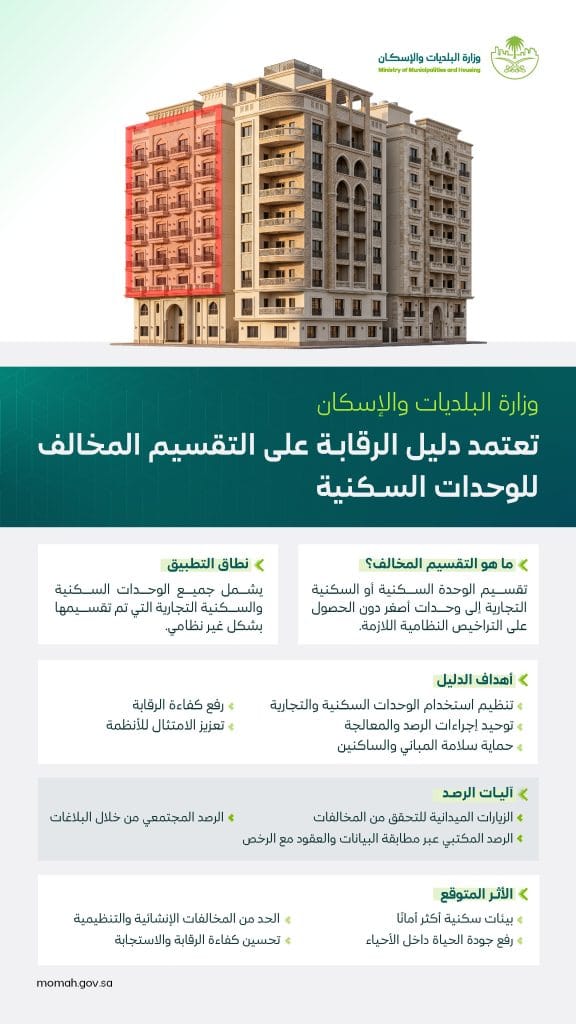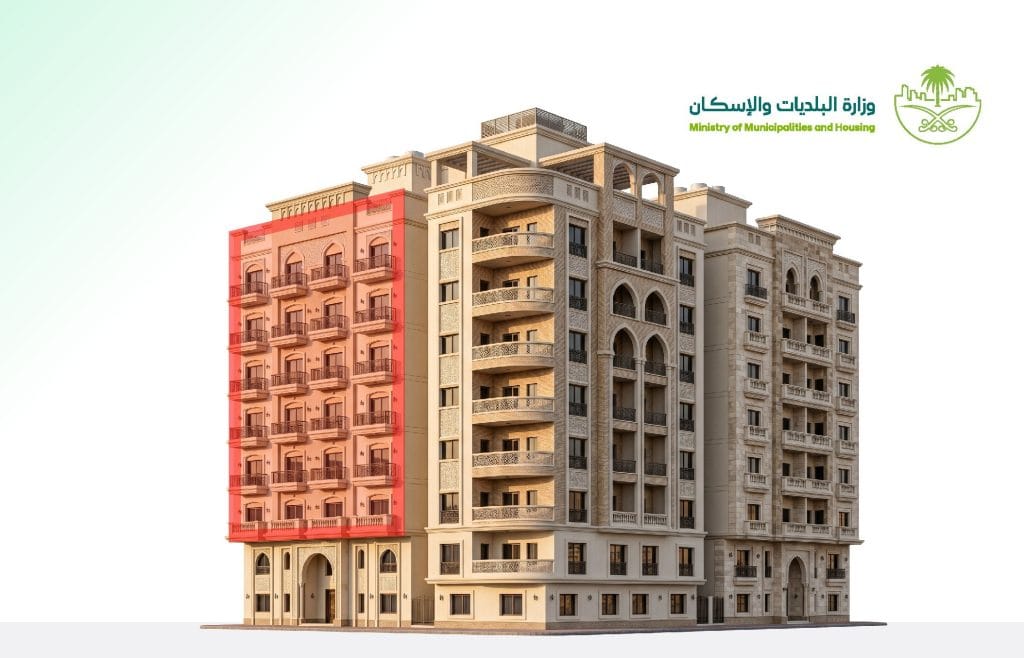

The Ministry of Municipalities and Housing has adopted the "Guide to Monitoring the Illegal Subdivision of Residential Units“ as part of its ongoing efforts to promote compliance with municipal regulations and requirements, and to curb the practice of unauthorized subdivision of residential units; thereby contributing to the preservation of building safety, the improvement of the quality of the residential environment, and the enhancement of municipal oversight efficiency across the Kingdom.
The guide aims to provide a unified regulatory and oversight framework to address the phenomenon of unauthorized subdivision by defining the roles, responsibilities, and oversight procedures for monitoring, verifying, and addressing violations in accordance with approved municipal regulations and bylaws.
Defining Regulatory
Requirements and Procedures The Ministry clarified that the guide defines unauthorized subdivision of residential units, and sets forth the regulatory, technical, and supervisory requirements and procedures for addressing these violations, thereby enhancing compliance and safeguarding the safety of structures and urban planning. It covers all residential and residential-commercial units that have been subdivided in violation of regulations.
It noted that the guide specifies the entities responsible for its implementation, including: the Ministry of Municipalities and Housing, municipal secretariats and municipalities, partner agencies, as well as property owners and tenants; thereby promoting coordination among relevant parties and enhancing the effectiveness of oversight and remediation.
The guide includes definitions of concepts and terms related to the monitoring of unauthorized subdivisions, as well as an integrated monitoring methodology based on proactive monitoring through cross-checking data and lease agreements against issued permits, utilizing community reports, and conducting field visits to verify suspected cases and detect violations.
It also outlines mechanisms for reporting violations
and defines the roles and responsibilities among the relevant authorities, with the Ministry of Municipalities and Housing responsible for developing regulations and regulatory guidelines, preparing oversight plans, and developing reporting mechanisms and technical linkages with partner agencies to enhance data exchange, while municipal secretariats and municipalities are responsible for conducting inspection tours, receiving reports, verifying violations, imposing statutory penalties, and following up to ensure violators rectify their situations.
The guide also addresses mechanisms for monitoring and identifying non-compliant units, field verification procedures, and the process for issuing citations in accordance with regulatory procedures, thereby contributing to the standardization of enforcement and remediation procedures and improving the efficiency of oversight efforts.
The Ministry emphasized that the adoption of the guide helps mitigate the negative effects of illegal subdivisions, including their impact on the safety of buildings and infrastructure and the quality of life in residential neighborhoods, It also supports more efficient utilization of the real estate stock and promotes more organized and sustainable urban environments.
The Ministry noted that the adoption of the guide is part of the regulatory and oversight framework implemented by the Ministry to enhance compliance with municipal regulations, raise safety and reliability standards in the sector, and improve the quality of services, in line with the objectives of the Kingdom’s Vision 2030. The guide can be accessed by visiting the following link: https://momah.gov.sa/ar/regulations