The unemployment rate for Saudis stood at 12.3% at the end of the fourth quarter of 2016, a slight increase compared to the third quarter of the same year, when it was 12.1%, while the unemployment rate for the total population—Saudis and non-Saudis—stood at 5.6%, a slight decrease compared to the unemployment rate for the third quarter of 2016.
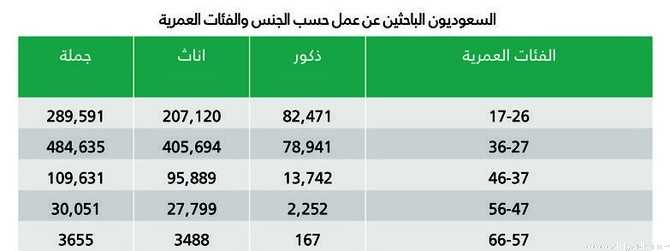
The General Authority for Statistics revealed that the number of Saudi men and women seeking employment at the end of last year reached 917,563, of whom 177,573 were male, according to the Labor Market Bulletin released by the Authority yesterday.
Dr. Fahad Al-Takhefi, President of the General Authority for Statistics, said that any government agency or other entity can access detailed statistics through the Authority’s website, and that the Authority will respond promptly to such requests, noting that every component of the figures can be discussed with any party that wishes to do so.
Al-Takheefi promised to publish the figures periodically and transparently for everyone to see, emphasizing that the published figures were subject to internationally recognized scientific standards in statistical work, which ensure a high degree of accuracy but cannot reach 100%.
The General Authority for Statistics has developed a bulletin on the results of the labor force survey, titled the “Labor Market Bulletin,” which, for the first time, includes the results of the labor force survey and labor market data based on administrative records from the relevant agencies: “the Ministry of Labor and Social Development, the Ministry of Civil Service, the General Organization for Social Insurance, the Human Resources Development Fund, and the National Information Center,” which include data on employed individuals and job seekers.
The results of the Labor Market Bulletin for the fourth quarter of 2016 showed an increase in the economic participation rate across the Kingdom to 56.5%, compared to the third quarter of 2016, which recorded a rate of 55.3%. The survey results also showed that the economic participation rate for Saudis was 42.2%, with a rate of 64.6% among Saudi males and 19.3% among Saudi females.
The results also indicated that the highest economic participation rate among Saudis was 63.7% among individuals aged 25–39, and that the economic participation rate was highest among Saudis holding a post-secondary diploma (below a university degree), at 83.5%, followed by those with a university degree or higher, at 78.2%.
With regard to the employment rate, it rose compared to the third quarter of 2016, reaching 94.4%, and the employment rate for Saudi workers was 87.7%, a slight decrease compared to the employment rate for Saudis in the third quarter of 2016.
For the first time, the bulletin included data on employed individuals and job seekers from administrative records, which showed that Saudi male job seekers accounted for 19.4% and that of female job seekers was 80.6% of the total Saudi job seekers for the fourth quarter of 2016. The highest proportion of Saudi job seekers was concentrated in the 27–36 age group, reaching 52.8%.
On the other hand, the General Authority for Statistics clarified in its detailed bulletin that the economic participation rate in the Labor Force Survey is an indicator that measures the participation of the working-age population (15 years and older) in the labor force as either employed or unemployed, which is defined as the ratio of the labor force to the population aged 15 and older. The unemployment rate is an indicator that measures the ratio of the unemployed to the total labor force, and the employment rate is an indicator that measures the ratio of the employed to the total labor force.
The results showed that the total number of employed persons in the Kingdom reached 13.94 million, of whom 11.94 million were males, representing 86% of the total employed, while females accounted for 2.01 million, or 14%.
The number of foreign workers stood at 10.88 million, representing 78% of the total workforce in the Kingdom, while the number of Saudi workers was 3.06 million, representing 22% of the total.
Most workers in the Kingdom are subject to social insurance regulations and laws, totaling 11.6 million workers, representing 73% of the total workforce, followed by those subject to civil service regulations at 11%, while domestic workers accounted for 16% of the total.