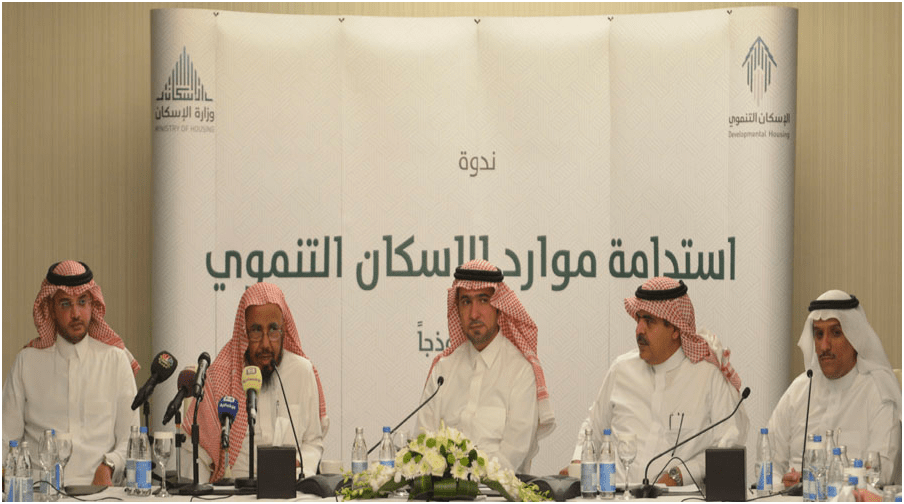

As part of its efforts to address the housing crisis, the Ministry of Housing, represented by the “Developmental Housing” initiative in Riyadh, organized a seminar titled “Sustainability of Developmental Housing Resources… Zakat as a Model,” attended by Sheikh Dr. Abdullah Al-Mutlaq, Advisor to the Royal Court and member of the Council of Senior Scholars, Dr. Saad Al-Khathlan, Minister of Housing Majid Al-Hogail, Dr. Fahd Al-Sukait, and Suhail Abanmi, Acting Governor of the General Authority for Zakat and Income
Addressing Housing Problems
The Minister of Housing emphasized the Ministry’s commitment to addressing all issues related to the housing sector, which has led to the proliferation and diversity of programs and initiatives designed to serve all segments of society.
Al-Hogail explained that through the programs and initiatives it offers, the Ministry of Housing works to serve all segments of society, including those employed in the government and private sectors who are able to pay and benefit from the Ministry’s housing projects—who constitute the majority of applicants for housing support— as well as low-income individuals, whom the Ministry prioritizes and takes into account through the developmental housing programs it launched earlier this year. Through such seminars and other initiatives, the Ministry is actively seeking the easiest and fastest ways to enable this group to obtain their right to housing. In addition, the Ministry has signed an agreement to establish an endowment fund to serve them in cooperation with the Endowments Committee of the Riyadh Chamber of Commerce, and the Islamic Development Bank in Jeddah.”
Social Security Beneficiaries
Abdullah Al-Namri, General Supervisor of Developmental Housing at the Ministry of Housing, confirmed that 338,000 social security beneficiaries do not own homes.
Al-Nimri said at the symposium that another 327,000 citizens live in substandard housing, including 5,000 living in tents, 3,000 in mud houses, and another 3,000 in tin shacks.He explained that the ministry is paying special attention to this issue through its Developmental Housing Initiative, under which it has signed agreements with the nonprofit sector to build 22,000 housing units in various neighborhoods in Jeddah, a large portion of which will be allocated to social security beneficiaries.
Al-Nimri noted that an agreement was signed with the Insan Association to provide housing for 4,621 of the association’s beneficiaries, and another agreement was signed with the Binyan Association to provide 108 housing units for its beneficiaries in the Airport Land project in northern Riyadh.
Endowment Fund for Housing
He also highlighted the establishment of an endowment fund for housing in cooperation with the Islamic Development Bank to use its proceeds to provide housing for social security beneficiaries, with an announcement expected next Sunday.Speaking about the first pillar, Sheikh Abdullah Al-Mutlaq said there is no objection to spending zakat on housing for the poor and using it to purchase homes for them, explaining that if the Ministry were able to allocate a portion of the zakat collected from merchants to provide housing for the poor, it would be a positive step toward housing this group of needy individuals, and that the Ministry of Housing, through these projects, is best positioned to take this step.Sheikh Al-Mutlaq added that he believes the homes should be built in the name of the Zakat Authority to benefit the poor through housing projects, and then, should the occupant become wealthy, the home should be left for someone even poorer among the other needy, rather than being transferred into outright ownership.
He noted that he believes Zakat housing projects for the poor should be located in rural centers and villages, as this would be more beneficial to those in need and less costly for the donors, and that he does not believe Zakat housing projects should be located in cities due to the high costs involved.Dr. Saad Al-Khathlan, in turn, expressed his gratitude to the Ministry of Housing and asked for God’s blessings on such efforts, which target the most needy among the nation’s citizens and beneficiaries, noting that housing is a necessity and that it is permissible to pay zakat to a poor person so they may acquire a home, but he believes that home ownership goes beyond the poor person’s needs, and there are several jurisprudential opinions on this matter.
Housing Support
For his part, Dr. Sulaiman Al-Majid said: “Providing housing support to the poor alleviates the burden on their families and lifts them from poverty and need to a state of stability. My fiqh opinion is that it is permissible to purchase a home for the poor using zakat funds, and zakat funds should continue to be allocated to essential needs.”Dr. Muhammad Al-Osaimi stated that housing does not refer solely to the home itself, but also includes the subsequent preparation and care of the poor so they can become self-sufficient, and that the Ministry can coordinate with the Zakat Authority to build homes for the poor and provide comprehensive services for them.