
Engineer Ziad Al-Qawasmi, a member of the Saudi Society for Urban Sciences and CEO of Maqam Al-Tamayuz Development and Investment Company, emphasized the Saudi market’s need for more training and educational centers specializing in various fields required by the market and the changing realities of life. He noted that achieving the goals of the Kingdom’s ambitious Vision 2030 requires expanded investment in human capital, as it is the cornerstone of sustainable development, especially given that the Kingdom’s population growth rate is estimated at approximately 2.52%, which will increase the number of job seekers—who, according to the latest statistics, total 10.2 million men and women seeking employment.
Al-Qawasmi explained that the Saudi market urgently needs to develop a scientific education and training system with parallel tracks for various specializations, especially since the size of the Saudi training market remains below the requirements needed to support the Kingdom’s strategy for achieving the Vision’s goals, as it has not yet exceeded 10 billion riyals. He added that many vital sectors—foremost among them engineering, health, and education—constitute the core for absorbing training programs, especially since the engineering sector—in which expatriates account for 92%—is considered one of the most promising sectors. The Saudi Ministry of Labor and Social Development aims to Saudize 35% of this sector, while Saudis currently make up 8% of the workforce.
Al-Qawasmi noted that the main focus of the Kingdom’s Vision 2030 is a thriving economy, which requires a commitment to education that contributes to continuous development by increasing investment in training, education, talent development, and job creation, The Vision also emphasized the importance of human capital development to provide skills training and education to individuals of both genders who are able to join the workforce, thereby reducing the unemployment rate among Saudis to 7% by 2030, compared to the current rate of 11.6%, by creating approximately 203,000 jobs for Saudis each year from now through 2030.
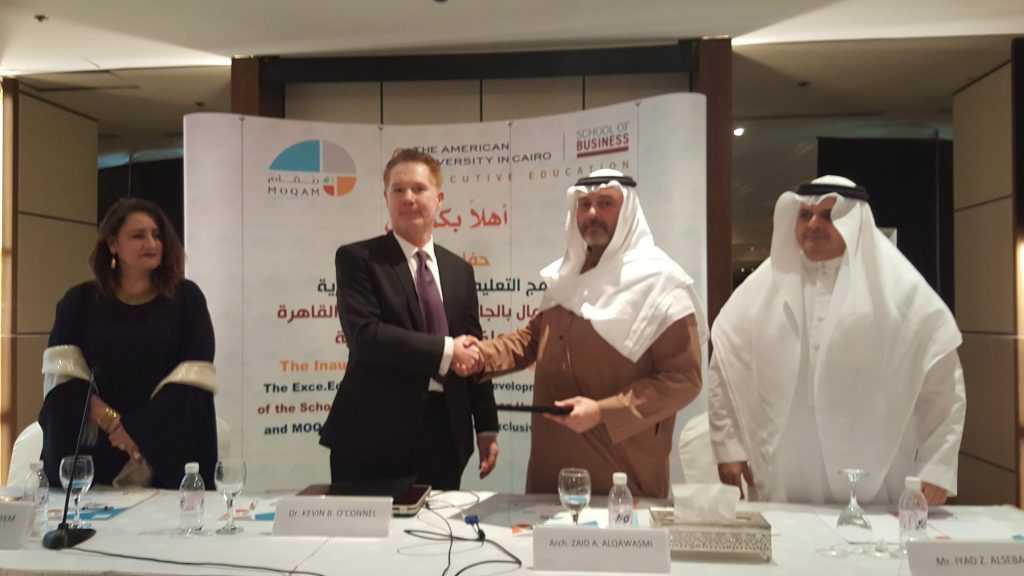
This announcement was made during a ceremony to launch an agreement for the organization and marketing of advanced executive education and training programs specializing in various fields between the American University in Cairo’s College of Business, the Real Estate Academy, and Makam Al-Tamayuz Development and Investment, at a ceremony held in Jeddah attended by Dr. Noha Karim, Director of Business Development at the American University in Cairo; Eng. Mustafa Al-Ashiri, Director of Executive Training at the university; the Consul General of the Republic of Egypt in Jeddah, Dr. Hazem Ramadan, and the Vice President of the Jeddah Chamber of Commerce, Eng. Mazen Batraji, as well as business leaders and representatives from both sides. Under this agreement, educational training programs and diploma courses will be implemented to develop the Saudi market in four different fields currently in high demand: medicine, management, engineering, and real estate.
The agreement aims to exchange and transfer expertise and develop specialized training programs in line with the Saudi market and its specific needs, based on the university’s internationally accredited academic standards. The training, which targets 300 trainees annually across the Kingdom, in three phases. The first phase will involve the implementation of educational and executive training programs, as well as short courses in the real estate, urban planning, management, and engineering fields, at an educational and executive training level, The second phase of the program includes advanced multidisciplinary professional diplomas across a wide range of fields, including medicine, engineering, and administration.
Engineer Ziad Al-Qawasmi stated: “The first phase was launched last month with a specialized course in ”Professional Facilities Management,” where graduates from the public and private sectors were honored and presented with their course completion certificates, which were issued by the American University in Cairo and the International Facility Management Association in collaboration with the Saudi Society for Urban Sciences, the Jeddah Chamber of Commerce, the Community Service Center at Jeddah International College, and the office of consulting engineer Hussein Sabour in the Arab Republic of Egypt,” emphasizing that the training courses will continue on an ongoing basis throughout this year.”
For his part, Dr. Kevin O’Connell, Associate Dean of the American University in Cairo, said: “We expect this agreement to yield fruitful results, especially as the Saudi market has begun to embrace training and educational programs due to its significant need, in line with the dynamic momentum generated by the Kingdom’s Vision 2030. There are promising prospects in the real estate market in line with the Ministry of Housing’s scheduled programs, as well as opportunities for investment in the fields of education and health. All these sectors require qualified national professionals to manage these future projects.”
Kevin pointed to the activities taking place in the Kingdom’s real estate market, the opening of opportunities for real estate investment funds, and other areas that are now attracting the private sector—which will become the main driver of the Kingdom’s economy— in line with available opportunities and the goal of reducing the state’s reliance on oil revenues, as outlined in the National Transformation Program. He noted that these packages of decisions regarding the Saudi market now represent a window of hope for attracting and strengthening investments economically, and he anticipated that this cooperation would fulfill the market’s desire to equip and prepare young Saudi men and women through qualification and training.
It is worth noting that the Kingdom’s strong political will has begun to drive the market by involving the private sector in development programs and expanding the scope of privatization; the number of private-sector establishments in Saudi Arabia stands at 919,000.
The Kingdom is considered the largest market for public-private partnership (PPP) projects in the Middle East and North Africa region, with airports topping the list in terms of the number of projects. PPPs in the fields of education, healthcare, and construction are expected to grow starting in 2018. Preparations have already begun for the privatization of the health and education sectors. There are approximately 5,920 healthcare facilities employing 90,000 foreign doctors compared to 24,000 Saudi doctors, which indicates a growing need for specialized professionals.