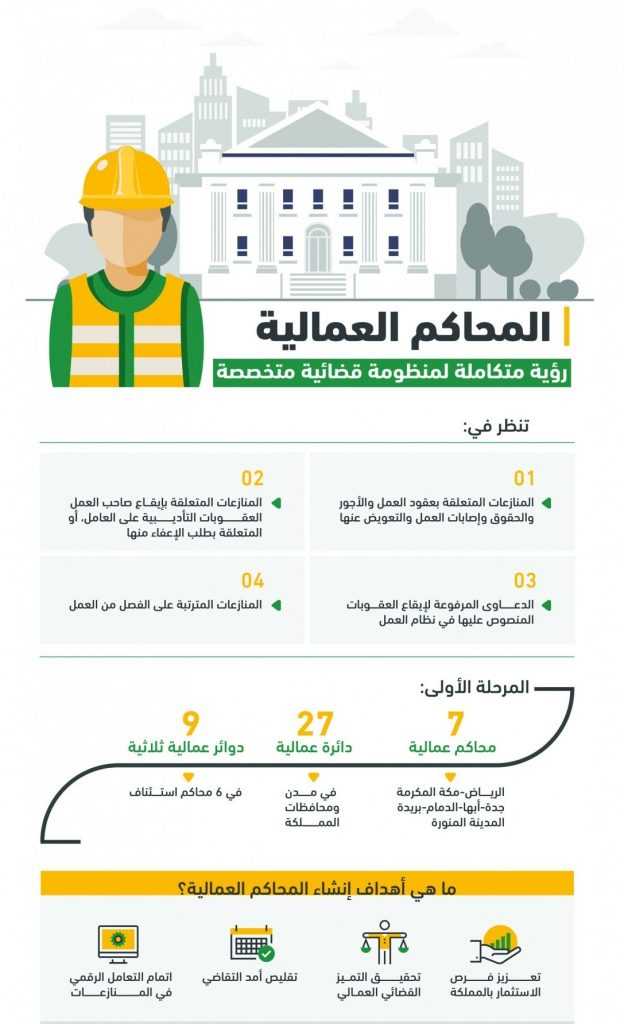

The digital environment and streamlined procedures in labor courts have helped raise the bar for efficiency and performance, positively impacting beneficiaries and saving them time and effort. This aligns with the goals of Vision 2030, aiming to protect workers' rights and create an attractive, distinguished, and safe working environment. The Ministry of Justice clarified that labor courts have held more than 86,000 sessions in 164 working days since their establishment in mid-Rabee' al-Awwal of this year, averaging 524 sessions per day. (Real Estate)
Labor court systems
The labor court regulations have set specific time limits for accepting claims for rights, including claims related to the labor system or domestic workers, which are subject to specific periods for amicable settlement before judicial consideration, in addition to complaints against the General Organization for Social Insurance regarding subscription, registration and compensation.
As for the duration of amicable settlement procedures before filing lawsuits subject to the Labor Law with the Labor Courts, it is 21 days. If the amicable settlement is not completed within that period, the dispute is filed with the Labor Courts electronically through the Ministry of Labor and Social Development.
Advanced digital environment
In this context, His Excellency the Minister of Justice and Chairman of the Supreme Judicial Council, Sheikh Dr. Walid bin Mohammed Al-Samaani, had affirmed during the inauguration of the labor courts the Ministry’s keenness to have a fully digital environment to serve as a cornerstone and a model to be emulated in the rest of the judiciary, noting that the selection of judges assigned to the labor judiciary by the Supreme Judicial Council came in accordance with precise criteria based on the necessary judicial and scientific competence, taking into account judicial experience.
Riyadh region topped the list of sessions with 27,953 sessions, followed by Makkah with 17,721 sessions, then the Eastern Province with 17,082 sessions, then Madinah with 8,095 sessions, then Qassim with 5,663 sessions, then Asir with 3,501 sessions.
Tabuk region came in seventh place with 2049 sessions, followed by Hail with 1236 sessions, then Jazan with 1161 sessions, then Al-Baha with 1089 sessions, then the Northern Borders with 474 sessions, then Najran with 339 sessions, then Al-Jawf with 293 sessions, recording the fewest regions in the same period.
Work environment improvement
The establishment of specialized financial courts for Saudi and non-Saudi workers aims to develop and improve the investment sector and enhance the private sector's work environment. The launch of the labor court also falls within the framework of providing confidence to local and foreign investors and safeguarding their rights, thereby creating an attractive, distinguished, and secure environment in the Kingdom, in line with Vision 2030.
Judge training
It is worth mentioning that the Ministry of Justice has qualified a large number of judges assigned to work in labor courts by providing them with a number of professional and personal skills that enable them to handle the scientific, applied and technical aspects in the field of labor judiciary, within an advanced training program, in which training was provided on the theory of contract and condition, provisions of guarantee and compensation regarding work risks and injuries, ministerial regulations, decisions and circulars related to labor systems, the social insurance system, the enforcement system and its regulations, methods of proof in labor disputes, arbitration and conciliation in labor cases, and collective disputes in labor judiciary.
Links to selected real estate news articles from issue 175 :
Real Estate – Contracting – Property – Property Inspection – Real Estate
The Sakani program announces more than 13,000 beneficiaries of housing and financing options.