
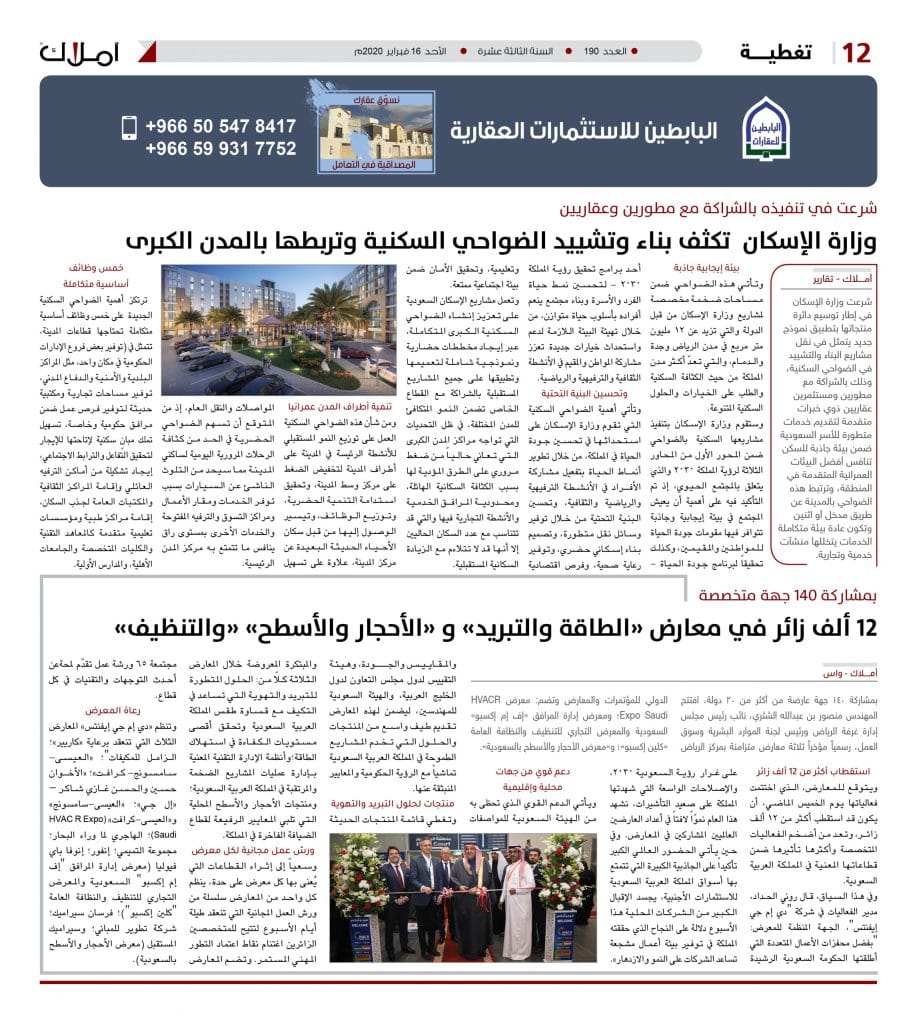

As part of its efforts to expand its product portfolio, the Ministry of Housing has launched a new model involving the relocation of construction projects to residential suburbs . This is being done in partnership with experienced real estate developers and investors to provide advanced services to Saudi families within an attractive residential environment that rivals the best urban developments in the region. These suburbs are connected to the city via one or two entrances and typically offer integrated services, including commercial and service facilities. (Residential Projects)
A positive and attractive environment
These suburbs are located within huge areas allocated for Ministry of Housing projects by the state, which exceed 12 million square meters in the cities of Riyadh, Jeddah and Dammam, which are the Kingdom’s most densely populated cities and demand for diverse housing options and solutions.
The Ministry of Housing will implement its suburban housing projects within the first of the three pillars of the Kingdom’s Vision 2030, which relates to a vibrant society. This pillar emphasizes the importance of society living in a positive and attractive environment that provides the elements of quality of life for citizens and residents. It also aims to achieve the Quality of Life Program – one of the programs for achieving the Kingdom’s Vision 2030 – to improve the lifestyle of individuals and families and build a society whose members enjoy a balanced lifestyle, by creating the necessary environment to support and develop new options that enhance the participation of citizens and residents in cultural, recreational and sports activities.
Infrastructure improvement
The importance of the residential suburbs that the Ministry of Housing is developing lies in improving the quality of life in the Kingdom, through developing lifestyles by activating the participation of individuals in recreational, sports and cultural activities, improving infrastructure by providing advanced means of transportation, designing urban housing buildings, providing health care, economic and educational opportunities, and achieving security within a pleasant social environment.
Saudi housing projects are working to promote the establishment of large integrated residential suburbs, through the creation of comprehensive urban and model plans to generalize and apply them to all future projects in partnership with the private sector, ensuring the equitable growth of different cities, in light of the challenges facing the centers of major cities, which currently suffer from traffic pressure on the roads leading to them due to the huge population density, and the limited service facilities and commercial activities in them, which may be suitable for the current population but may not be suitable for the future population increase.
Urban development on the outskirts of cities
These residential suburbs will serve the following purposes:
Distributing the future growth of major activities in the city to the outskirts of the city to reduce pressure on the city center.
Achieving sustainable urban development.
Job distribution.
Facilitating access to it for residents of modern neighborhoods far from the city center, in addition to facilitating transportation and public transport.
It is expected that urban suburbs will contribute to reducing the density of daily traffic trips for city residents, which will reduce pollution caused by cars due to the availability of services, business premises, open shopping and entertainment centers and other services at a high level that rivals what is enjoyed in the centers of major cities.
Five essential integrated functions
The importance of new residential suburbs rests on five essential, integrated functions needed by various sectors of the city, namely:
(Providing some branches of government departments in one place, such as municipal, security and civil defense centers.
Providing modern commercial and office spaces to create job opportunities within government and private facilities.
Facilitating the ownership of residential buildings to make them available for rent in order to achieve social interaction and cohesion.
Finding a variety of family entertainment venues and establishing cultural centers and public libraries to attract residents.
Establishing medical centers and advanced educational institutions such as technical institutes, specialized colleges, private universities, and primary schools.


