
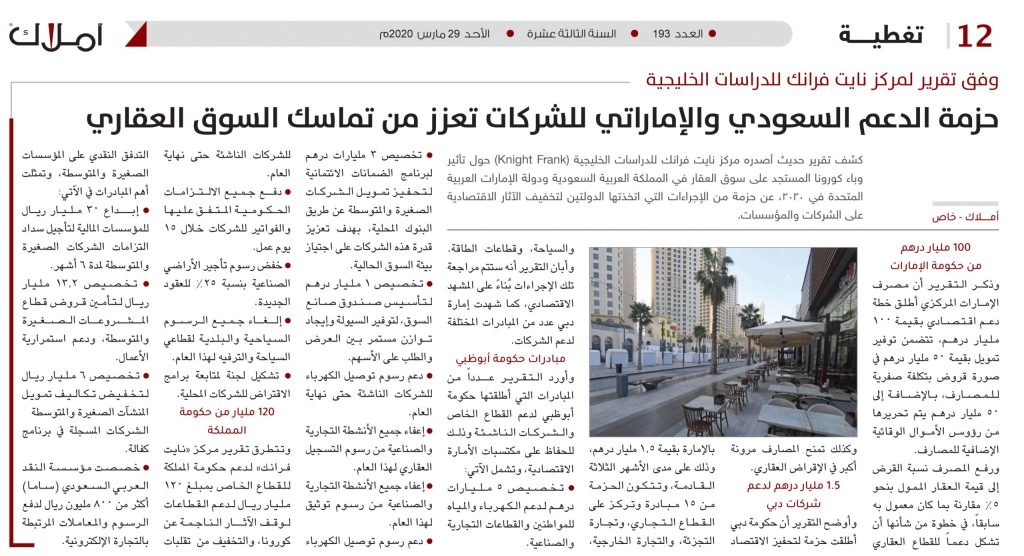

A recent report issued by the Knight Frank Center for Gulf Studies on the impact of the emerging coronavirus pandemic on the real estate market in Saudi Arabia and the United Arab Emirates in 2020 revealed a package of measures taken by the two countries to mitigate the economic effects on companies and institutions in various fields, especially the real estate and investment sector.
100 billion dirhams from the UAE government
The report stated that the Central Bank of the UAE launched an economic support plan worth 100 billion dirhams, which includes providing 50 billion dirhams in financing in the form of zero-cost loans to banks, in addition to 50 billion dirhams being released from banks’ additional precautionary capital.
The bank raised the loan-to-value ratio of the financed property by about 5% compared to what was previously in place, in a move that would support the real estate sector and also give banks greater flexibility in real estate lending.
1.5 billion dirhams to support Dubai companies
The report explained that the Dubai government launched a AED 1.5 billion economic stimulus package for the emirate over the next three months. The package comprises 15 initiatives focusing on the commercial, retail, foreign trade, tourism, and energy sectors. The report indicated that these measures will be reviewed based on the economic landscape, and that Dubai has also seen a number of other initiatives to support businesses.
Abu Dhabi Government Initiatives
The report listed a number of initiatives launched by the Abu Dhabi government to support the private sector and startups in order to preserve the emirate's economic gains, including the following:
5 billion dirhams allocated to support electricity and water for citizens and the commercial and industrial sectors.
AED 3 billion has been allocated to the credit guarantee program to stimulate financing for small and medium enterprises through local banks, with the aim of enhancing the ability of these companies to navigate the current market environment.
Allocating 1 billion dirhams to establish a market maker fund, to provide liquidity and create a continuous balance between supply and demand for stocks.
Support for electricity connection fees for startups until the end of the year.
All commercial and industrial activities are exempt from real estate registration fees for this year.
All commercial and industrial activities are exempt from documentation fees for this year.
Support for electricity connection fees for startups until the end of the year.
Payment of all agreed government obligations and invoices to companies within 15 working days.
Reduced industrial land lease fees by 25% for new contracts.
Cancellation of all tourist and municipal fees for the tourism and entertainment sectors for this year.
A committee was formed to monitor loan programs for local companies.
120 billion from the Kingdom's government
The Knight Frank report addressed the Saudi government's support of the private sector with 120 billion riyals to support sectors to mitigate the effects of the coronavirus and alleviate cash flow fluctuations for small and medium enterprises. The most important initiatives were as follows:
30 billion riyals allocated to financial institutions to postpone the repayment of small and medium-sized enterprises' obligations for 6 months.
13.2 billion riyals allocated to secure loans for the small and medium enterprises sector, and to support business continuity.
Allocating 6 billion riyals to reduce financing costs for small and medium enterprises (SMEs) registered in the Kafalah program.
The Saudi Arabian Monetary Authority (SAMA) has allocated more than 800 million riyals to pay fees and transactions related to e-commerce.


