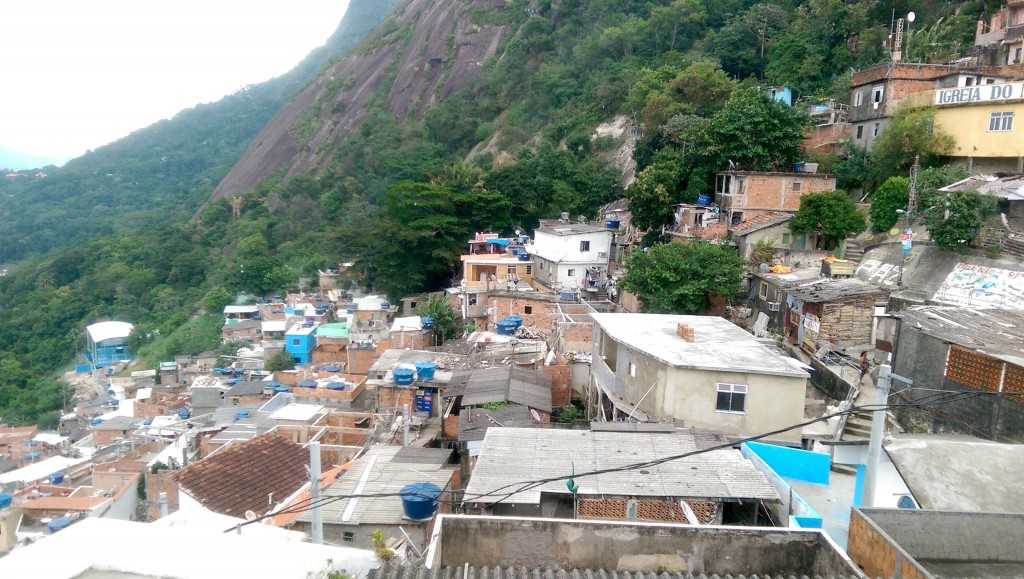

"Favela" is a Portuguese word referring to informal settlements that are widespread in many countries, including Brazil, Due to the poverty experienced by the residents of these shantytowns, they lack many of the necessities of modern life, and these shantytowns suffer from a lack of infrastructure. Homes are built on the slopes of mountains and hills on land not zoned by the government and subject to removal and expropriation whenever the government is able to do so; These shantytowns are built from stones, cement, pieces of wood, and scrap metal, and are widespread in large Brazilian cities and capitals, as well as in major cities with strong economies and warm climates. Most of the inhabitants of the favelas are poor or live below the poverty line.
The Origin of the Story
Due to the economic conditions Brazil experienced many citizens suffered from poverty and limited income, forcing them to adapt to their circumstances in various ways, leading to the proliferation of shantytowns and illegal housing settlements, with the number of shantytowns reaching more than 1,800, overcrowded with some having a population of around 70,000. Organized crime is rampant there, involving gangs, drug cartels, and illicit activities, consequently, they live in complete isolation from the outside world, and their only educational institutions are preschool programs, leading to widespread ignorance and illiteracy among the population.
The Brazilian city of Rio de Janeiro is considered one of the most beautiful cities in the world due to its enchanting natural beauty and the rivers that flow along its coastline, such as Leblon Beach and Ipanema Beach. It is one of Brazil’s most famous tourist destinations; however, on the other hand, it is overrun by theslums, which the residents cling to and consider a red line.
The Beginning of the Adventure
A delegation from the newspaper "Amlak," led by its editor-in-chief Mr. Abdulaziz Al-Issa, visited Brazil earlier this month to explore what these shantytowns are like and how people live there. And what role does the government play in addressing their circumstances and improving their housing conditions? The mission was extremely difficult, as it involved convincing officials because—in their words—it was a risky venture, and permission was granted to visit government-controlled slums, and the delegation was warned against any other movements...!!
The delegation headed to Santa Marta, the first government-controlled slum located near the capital, Brasília. It is an open area with significantly lower risk levels and a population of 7,000, Further warnings were issued not to speak with residents, to walk quickly, and to refrain from taking photos in certain areas, while being mindful of the delegation’s movements so that residents would not feel they were being spied on or feel uncomfortable in the presence of a stranger.
Government Efforts to Improve Slums
The delegation learned that the Brazilian government is making significant efforts to bring these shantytowns under control, and has succeeded in only 42 of them, It has worked to improve living conditions and relocate some residents to more suitable and safer areas, It connected water and electricity networks (60 amps per home) for a nominal fee and provided electric shuttles and elevators to transport residents free of charge from the foot of the hill to the top from 6:00 a.m. to midnight. It also installed cable car lines and provided residents with free Wi-Fi and a mobile phone network.
It encouraged children to study by providing them with 200 Brazilian reais, equivalent to $67. The government also deployed trains and buses to transport students from the top of the mountain to schools in other areas.
It prevented horizontal expansion in the slums under its control while encouraging vertical expansion in construction. In fact, the government’s efforts went even further by constructing free housing for them and relocating them to these new areas, away from the shantytowns. This is in addition to infrastructure such as sanitation and water systems.
Assimilation and Integration of the World’s Peoples
Brazil is home to a diverse array of nationalities from every country and continent; on any given street, one can see people of different backgrounds and diverse ethnicities from all corners of the world, thanks to the steady growth of Brazil’s economy, the ease of integration into society, and the flexible conditions for those wishing to invest and own property. Many foreigners residing in Brazil had originally intended to go to the United States or Canada, but the "Samba" country captivated them, and they found it pleasant to settle there. They later became investors and decision-makers in their own businesses, and the Brazilian government granted them the right to naturalization and entry into the political arena through parliament.
The Economics of Slums
Slums suffer from a clear lack of infrastructure, which has forced their residents to seek livelihoods elsewhere in neighboring cities for low wages, which has allowed gangs and the mafia to dominate the public sphere and engage in various forms of illicit trade, with drugs at the top of the list, followed by the arms trade, which is widespread among slum residents for protection and self-defense, as well as to protect their families.
There are no specific or well-known types of businesses in the slums, except for a few restaurants scattered here and there, barbershops, and food stalls. The wealthy among them—who make up 40% of the population—show compassion toward the rest of the residents and treat them with kindness, warmth, and friendliness; they consider themselves a state within a state, though without administrative organization or political authority. Their situation was unknown or virtually nonexistent until U.S. President Obama visited by plane, which drew the attention of the government and the media to them. They were also visited by Queen Elizabeth of Britain and Michael Jackson, not to mention the economic impact the recent World Cup in Brazil had on them, as visitors to Brazil at the time and top soccer players viewed the favelas as a tourist destination to see with their own eyes what they had heard about human beings living in isolation from civilization and urban life. Some favelas also served as fertile ground for American film productions.
Brazil’s Economy
Brazil’s economy is considered one of the fastest-growing in the world; it is the sixth-strongest economy globally and the seventh-largest in terms of nominal gross domestic product. Its economy relies on the industrial boom that has taken place over the past few decades, as well as oil extraction and the processing of oil products, in addition to the agricultural sector for which Brazil is renowned—particularly in coffee and fruit cultivation. and it has extensive investment activity in the livestock sector, which has increased its national income, not to mention the commercial sector, in which Brazil has excelled thanks to its multicultural and multinational population, which has provided it with numerous avenues for connecting with the countries of its emigrant citizens. The active labor force comprises more than 100 million Brazilians who work in various sectors of the Brazilian economy—agriculture, industry, commerce, and services.
Arabs in Brazil
South America in general, and Brazil in particular, have seen large-scale Arab migration that began long ago but increased between the two world wars in the 1930s and 1940s. The periods of civil war in Lebanon also saw large influxes of Lebanese to Brazil, and the Arab population in Brazil exceeds 10 million, They represent a powerful and influential economic force in Brazil, and have played important and influential roles in South American life, ranging from former Argentine President Carlos Mounim to the popular singer Shakira.
Carlos Slim (the son of a Lebanese immigrant) is considered the richest man in Latin America and the founder of Mexico’s telecommunications revolution. Meanwhile, Lebanese-born Joseph Safra, owner of Brazil’s ninth-largest bank, ranks second on the list of wealthy Arabs, with a fortune estimated at more than $11.4 billion. The Al-Mufarrij family owns the elegant Sheraton Hotel in São Paulo, where more Arabs live according to their customs and traditions than in Beirut itself. The prominent businessman Paulo Maalouf was a former mayor of the city.
Posts by the "Amlak" team
Money alone does not give life...!!
This is the case for some of the residents who welcomed the newspaper’s delegation; despite the modesty of the place where they live, they love it with a love buried deep in their hearts—a love we can see in their facial expressions and that shines through their eyes. They tend to write on walls and draw their satirical and expressive sketches, just as the artist "Yanski" does —an anonymous artist—who gives voice to thousands of people through his satirical art as he paints at night, surprising passersby with his murals in the morning.
The residents of the slums have a strong sense of belonging to their neighborhoods, and a feeling of warmth and intimacy characterizes their relationships with one another, despite the scarcity of resources and the poverty that pervades the area.
Passersby are struck by the orderly and disciplined sight of students in their uniforms leaving school in silence, which suggests their love for and adherence to school rules.
There is a heavy police presence in the streets of the Saint-Martina slum we visited, aimed at curbing crime and clearing the area of suspects. Despite this, people hear gunfire intermittently, and the presence of a body lying on the ground is not considered an event worth noting or reporting to the police. Amid all this, the delegation—driven by a spirit of adventure that grew more thrilling the deeper we delved into the facts —visited some of the sites of the shootings, and observe the marks on the walls and the remnants of gunfire.
The residents of Saint Martina say that the shantytowns here are more than eighty years old; we build our homes with great difficulty and hardship, carrying building materials, rebar, and cement from the bottom of the mountain to the top, climbing up via carved staircases that can have as many as 200 steps. Dogs are everywhere—in the streets and on top of buildings—and there are basketball courts on the mountaintop.
During one of the “Amlak Team” mobile patrols through a shantytown, they found themselves caught between two demonstrations, so they made their way through the crowds of people who had packed the streets, and were only able to leave the demonstration after traveling a considerable distance, at which point one of the demonstrations dispersed.