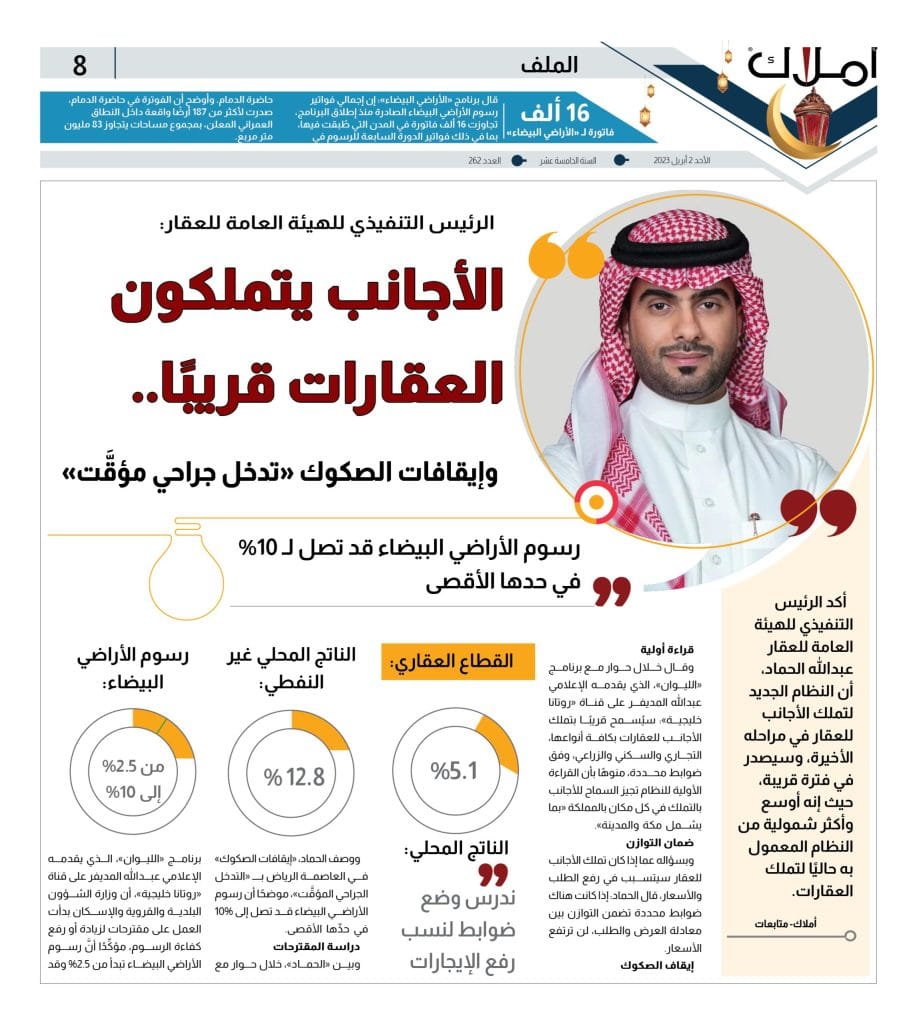


– White land fees can reach a maximum of 10%
We are working to reduce prices to narrow the gap between supply and demand.
Injecting units at prices that match purchasing power to achieve balance
The CEO of the General Authority for Real Estate, Abdullah Al-Hammad, confirmed that the new system for foreign ownership of real estate is in its final stages and will be issued soon, as it is broader and more comprehensive than the system currently in place for real estate ownership.
Initial reading
During an interview with the “Al-Liwan” program, presented by journalist Abdullah Al-Mudayfer on “Rotana Khalijia” channel, he said: “Foreigners will soon be allowed to own real estate of all kinds, commercial, residential and agricultural, according to specific regulations,” noting that the initial reading of the system allows foreigners to own property everywhere in the Kingdom, “including Mecca and Medina.”
Ensuring balance
When asked whether foreign ownership of real estate would cause demand and prices to rise, Al-Hammad said: If there are specific controls that ensure a balance between the supply and demand equation, prices will not rise.
Stopping the instruments
Al-Hammad described the “suspension of deeds” in the capital, Riyadh, as a “temporary surgical intervention,” explaining that the fees for white land could reach a maximum of 10%.
Studying the proposals
Al-Hammad explained that the Ministry of Municipal and Rural Affairs and Housing has begun working on proposals to increase or improve the efficiency of fees, stressing that fees for white land start from 2.5% and may reach a maximum of 10%.
Incentive fees
He pointed out that the white fees are not aimed at collecting money, but rather at stimulating development, and that if the investor or landowner finishes developing it, the fee is cancelled, but if he leaves it as a “monopoly”, the fees are gradually imposed.
Negative effects
Regarding the suspension of sukuk in Riyadh, he said that several suspensions were issued during a specific period, targeting specific projects, and that this step will have negative effects, noting that the main goal is for Riyadh to be among the top 10 cities in terms of economic size, with an ambitious strategy in place for that.
Price increases
Regarding real estate prices, he indicated that they are high and unhealthy, that there is a gap between supply and demand in the market, and that the state is not satisfied with this increase due to its negative impact on the sector as a whole.
Shrinking slices
He added that the majority of property seekers are unable to afford it because prices are higher than their purchasing power, and it is not easy for them to find suitable property, which negatively affects real estate investors, as the target segments for those investors’ projects are shrinking.
Achieving balance
He added that prices are supposed to decline, which is what the state is working on, by enabling demand and achieving economic balance in the real estate sector, by supplying real estate units at prices that match purchasing power and supporting supply, by providing government lands and establishing partnerships with the private sector.
Increased supply
Regarding his expectations about the rise or fall of real estate prices in the coming period, he said: A fair price for real estate is reached through increasing the supply of real estate, or more precisely, through governmental and semi-governmental intervention.
Regulatory list
He added: Real estate analysis in the market currently lacks a proper foundation, and there is a lack of accurate information; therefore, we are working on issuing a regulatory framework for real estate consultations and analyses, as is the practice of the Capital Market Authority.
Accurate reading
He revealed that the authority is studying setting controls for rent increase rates, saying: “We have reviewed a number of experiences and are studying experiences that set a certain limit for rent increases, whether over a certain period of time or a certain percentage. These have their advantages and disadvantages, and the biggest challenge in them is that they require accurate data in order to give a healthy reading of the market.”
GDP
He confirmed that the real estate sector constitutes approximately 5.1% of the overall GDP and 12.8% of the non-oil GDP, and that the number of housing units in Riyadh reaches about 1.4 million units.