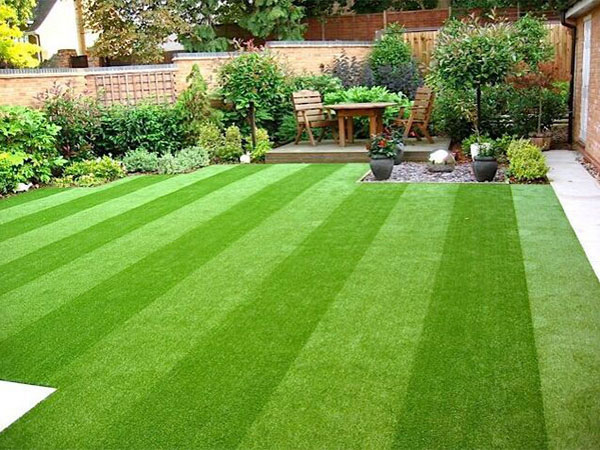

Many villa owners prefer to hire artificial turf to decorate their gardens, instead of natural grass, which requires constant care—such as continuous watering and the use of pesticides to get rid of insects, among other things— and yet it can still be damaged over short periods of time. Therefore, in the following lines, we present a comprehensive guide to this product, covering its advantages, as well as how to select and install it without the help of a specialist technician.
What is artificial grass, and what are its most important features?
Artificial turf is a type of synthetic fiber that resembles natural grass in appearance. It is used in sports fields, parks, residential complexes, shopping centers, and government facilities. The advantages of artificial turf are as follows:
- It does not require watering or the waste of large amounts of water.
- It can be installed at any time and on all types of surfaces.
- It does not require constant maintenance or regular mowing.
- It does not provide a suitable environment for flying or crawling insects.
- It withstands heavy use better than natural grass.
- It is not affected by weather conditions, so its lifespan can exceed 15 years.
- Its maintenance costs are much lower than those of natural grass.
How to Install Artificial Turf
Tools and Materials Needed Before installation, you will need the following tools and materials:
- Rolls of turf.
- A vibrating compactor.
- A leaf blower.
- Adhesives.
- Anchoring nails.
- Lawn trimmer.
Installation Steps
It is essential that artificial turf be installed properly and in accordance with applicable specifications and standards; in this case, it will not require regular maintenance. The installation process consists of the following steps:
- Determine the area where the artificial turf will be installed by calculating its area and ordering rolls of artificial turf according to those measurements.
- Prepare the site by removing any remaining natural vegetation and roots, leveling the ground, and compacting it to create a solid surface.
- You can also apply certain chemicals to prevent natural grass from growing back.
- Build barriers around the area where the artificial turf will be installed to prevent soil and tree debris from entering.
- Apply a layer of black sand and compact it using a vibrating compactor to ensure the site is firm and ready for installation.
- Cut the turf rolls and lay them out over the prepared area, ensuring the rolls are oriented in the same direction.
- After the rolls have been laid out and the entire area is covered, they are bonded together using an adhesive, which specialists apply in a special, even manner between the rolls.
- Drive 4- to 6-inch-long nails into the ground to secure the turf rolls.
- Apply a layer of silica sand or rubber granules and distribute it using a spreader.
- After the installation is complete, a leaf blower can be used to remove any remaining debris from the turf surface.
- The turf can then be washed with soap and water periodically to remove stains, dust, and dirt.
Tips for Choosing and Installing Artificial Turf
- Be sure to choose the type of artificial grass that is appropriate for the location where it will be installed; for example, the type suitable for sports fields and parks is different from that used for decorative purposes, home gardens, and playgrounds.
- Make sure to lay the grass blades in the same direction so that it looks exactly like natural grass.
- Ensure you choose turf that is safe for use by selecting a reputable company that consistently tests its products to verify their safety.
- Maintain the turf regularly by combing the fibers to clean and lift them.