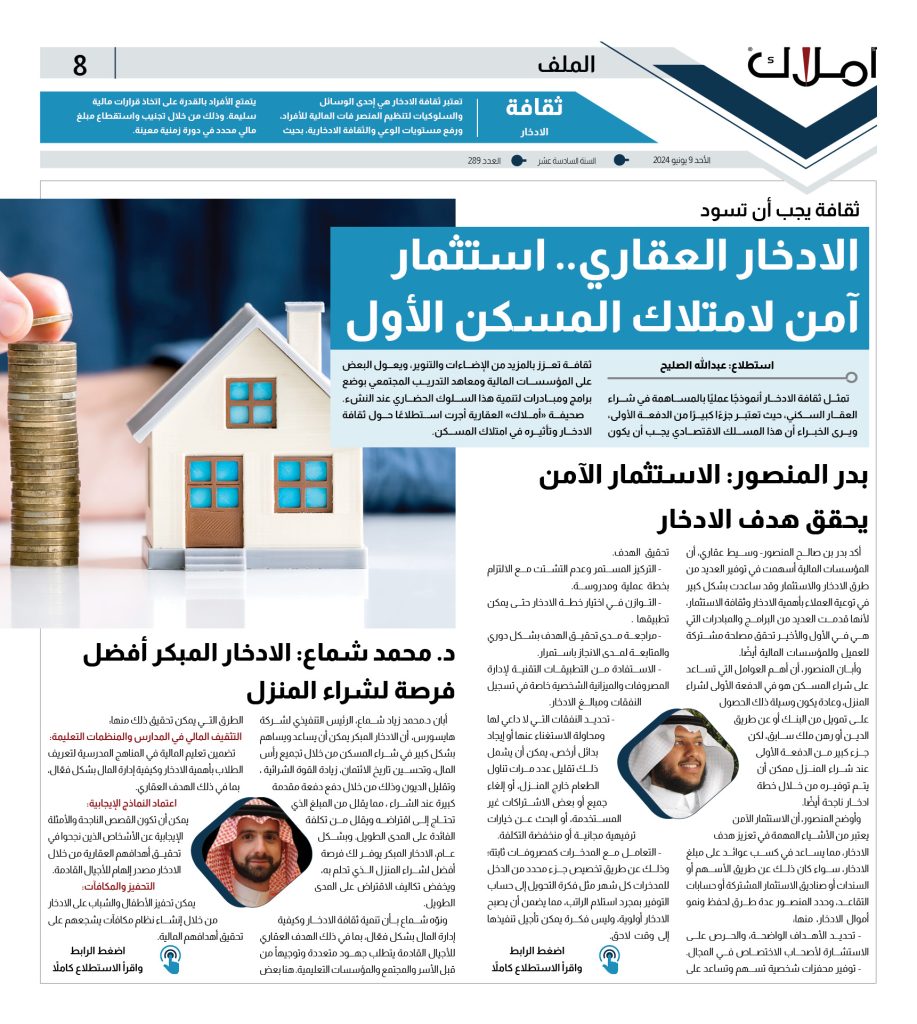

Abdullah Al-Salih’s survey: The culture of saving represents a practical model by contributing to the purchase of residential property, as it is considered a large part of the first payment. Experts believe that this economic approach should be a culture that promotes the culture of real estate savings, which should prevail in order to own the first home with more enlightenment and awareness. Some rely on financial institutions and community training institutes to develop programs and initiatives to cultivate this civilized behavior among the youth.
The real estate newspaper "Amlak" conducted a survey on the culture of saving and its impact on homeownership.
==== =
Badr Al-Mansour: Safe investment achieves the goal of saving

Badr bin Saleh Al Mansour, a real estate broker, confirmed that financial institutions have contributed to providing many ways to save and invest and have greatly helped in raising customer awareness of the importance of saving and investment culture, because they have provided many programs and initiatives that ultimately achieve a common interest for the customer and for the financial institutions as well.
Al-Mansour explained that the most important factor that helps in buying a home is the first payment for the purchase of the house, and this is usually done by obtaining financing from the bank, or through debt or a previous mortgage, but a large part of the first payment when buying a house can be provided through a successful savings plan as well.
Al-Mansour explained that safe investment is important in promoting the goal of saving, as it helps in earning returns on savings, whether through stocks, bonds, mutual funds, or retirement accounts. Al-Mansour identified several ways to preserve and grow savings, including:
- Setting clear goals, and making sure to consult with experts in the field.
- Providing personal incentives that contribute to and help achieve the goal.
- Continuous focus and avoidance of distractions, along with adherence to a practical and well-thought-out plan.
- Balance in choosing a savings plan so that it can be implemented.
- Reviewing the extent to which the goal has been achieved periodically and continuously monitoring the progress.
- Utilizing technological applications to manage expenses and personal budgets, especially in recording expenses and savings amounts.
– Identify unnecessary expenses and try to eliminate them or find cheaper alternatives. This can include reducing the number of times you eat out, canceling all or some unused subscriptions, or looking for free or low-cost entertainment options.
- Treat savings as a fixed expense by allocating a specific portion of income to savings each month, such as the idea of transferring funds to a savings account as soon as the salary is received. This ensures that saving becomes a priority, and not an idea that can be postponed to a later time.
Al-Mansour mentioned that there are techniques that can be used in saving, such as the 50/30/20 rule (allocating 50% of income to needs, 30% to wants, and 20% to savings), the five-envelope technique (allocating the salary to different spending categories), or the snowball method (paying off debts starting from the smallest balance).
Al-Mansour explained that experts emphasize the importance of starting to educate children about the concept of money from the age of four. This helps build and develop their financial awareness from a young age, enabling them to plan effectively and make better financial decisions as adults. Open and open dialogue about money, speaking with children regularly and naturally about money, how to earn it, and how to spend it, and involving them in related activities, all have a significant impact on developing their understanding of the concept of money and its role in our lives.
Al-Mansour pointed out that many parents hesitate to set a regular allowance for their child, as they may not realize the value of the allowance in motivating and supporting the child's self-esteem. In addition, it is a good opportunity to teach children the basics of simple budgeting. The child should start receiving a small and regular allowance according to his age and the family's financial ability. This helps him appreciate the value of money according to the things he can get in return. It is important if the child is interested in a particular toy, for example, we as parents should help him to make a financial plan to save in order to buy it, and remind him that "if he wants to spend all his allowance instead of saving part of it, this will delay his getting that toy." From here, he will learn the meaning of responsibility and how to postpone immediate desires in order to achieve bigger goals later. He will also start to think about the value of his savings in the long term.
The importance of good role models should not be overlooked, as children tend to imitate their parents and instinctively adopt their behavior patterns.
= = ==
Dr. Mohammed Shamaa: Saving early is the best opportunity to buy a house

Dr. Mohammed Ziad Shamaa, CEO of High Source, explained that early saving can significantly contribute to homeownership by accumulating capital, improving credit history, increasing purchasing power, and reducing debt. This is achieved by making a larger down payment, which lowers the amount you need to borrow and reduces long-term interest costs. Overall, early saving gives you a better chance of buying your dream home and reduces your long-term borrowing costs.
He noted that developing a culture of saving and effective money management, including the goal of securing property for future generations, requires multifaceted efforts and guidance from families, communities, and educational institutions. Here are some ways this can be achieved:
- Financial education in schools and educational organizations: Incorporating financial education into school curricula to familiarize students with the importance of saving and how to manage money effectively, including for real estate purposes.
- Adopting positive role models: Success stories and positive examples of people who have succeeded in achieving their real estate goals through saving can be a source of inspiration for future generations.
- Motivation and rewards: Children and young people can be motivated to save by creating a reward system that encourages them to achieve their financial goals.
Dr. Shamaa listed several ideal ways to save and grow savings. Here are some tips to achieve this, such as:
- Set specific goals: Before you start saving, you should set a specific and clear goal for why you want to save and what goals you want to achieve, such as buying a house or securing a stable financial future.
- Setting up a budget : Establish a monthly budget that specifies the amount of money you will allocate to savings. Absolutely try to stick to this budget and only deviate from it in absolutely necessary circumstances.
- Choosing a suitable savings account : Look for a savings account through some banks and some digital platforms that provide services with fair returns in accordance with Islamic Sharia while maintaining ease of access to them when needed.
- Smart investing : After accumulating a certain amount of savings, you can consider investing your money in a way that suits your goals and risk tolerance. Consult a qualified financial advisor for appropriate advice based on your financial situation and objectives, as investing your savings can significantly contribute to owning property without resorting to borrowing.
- Commit to regular savings: Maintain your commitment to regular savings without gaps. Even small, regular deposits can add up over time and help you reach your goal.
- Review and evaluate : Regularly review your progress and evaluate your savings strategy, adjusting it if necessary based on changes in goals or financial circumstances.
Omran Al-Omran: Reducing reliance on loans

Imran bin Mohammed Al-Omran, who is interested in real estate matters, stressed that the process of saving early helps in buying a home through several ways, explaining the possibility of increasing the down payment by saving a larger amount; this in turn can reduce the size of the loan required and lower the interest paid in the long term.
Al-Omran explained that spreading the culture of early saving helps to reduce dependence on loans and lower their amount, which means that you will pay less in interest and fees over the loan period, noting that having good savings increases the chances of obtaining a loan with better terms.
Al-Omran explained that early saving provides the beneficiary with greater financial comfort and reduces the psychological and financial stress associated with the need to quickly raise funds when finding suitable housing. Therefore, early saving is an effective strategy for achieving the goal of purchasing a home at the lowest possible cost and with minimal financial strain.
Al-Omran concluded his remarks to “Amlak” by saying that one of the advantages of a savings culture is the ability to cope with unexpected expenses and cover sudden costs associated with buying a home, such as repair expenses or administrative fees.
@ask_aqary
Abdulmajid Al-Jarallah: Programs aimed at promoting savings for housing

For his part, Abdulmajid bin Abdulmohsen Al-Jarallah, Head of the Quality and Governance Department at Al-Birr Association in Riyadh, explained that saving is a means of building a lifelong home, but it requires good planning and serious commitment. He pointed out that having a specific and clear goal for saving, such as buying a home, and not being distracted or preoccupied with luxuries, has proven its success with experience and the existence of successful models.
Al-Jarallah explained that there are many programs offered by a number of specialists in the field of savings, and the options available for this in a flexible manner. He emphasized that some financial institutions have an impact on raising awareness of the concept of saving and increasing financial awareness among members of society. Some institutions have created programs aimed at saving for housing and the home of a lifetime specifically, which is the application of the role that these institutions play in serving the common interests of the client and the institutions. Al-Jarallah pointed out the importance of developing a culture of saving for the purpose of real estate among future generations, through designing initiatives, plans, programs, training and practical application.
Al-Jarallah called on the community to own temporary or shared housing that suits their financial capabilities, while enlightening people that the benefits of owning housing that suits their financial ability help reduce costs and thus the ability to save for permanent housing.
Regarding the investment of savings funds, Al-Jarallah said: “The culture of saving or increasing financial awareness among members of society is one of the positive aspects that will benefit investment, as the number of investors will increase and this awareness will result in an expansion of investment, whether in real estate portfolios or other sources of investment, as they will benefit from the existence of a higher culture and awareness among members of society.”
Saad Al-Omari: Financial institutions should encourage a culture of saving.

Saad Al-Omari, a real estate consultant at Basma Company, emphasized that early saving is an important factor that greatly helps in buying a home and saves a lot of time in reaching the goal, through good planning and starting early, even with small amounts. This comes with rationalizing and organizing expenses, and one can consult savings specialists and attend awareness seminars. He pointed out that the National Center for Social Responsibility, in strategic partnership with the Ministry of Municipal and Rural Affairs and Housing, launched the “Saving for Housing” initiative in 2021, with the aim of raising awareness and educating about the importance of real estate savings.
Al-Omari stressed the important role of financial institutions in encouraging a culture of saving by providing financial services through savings accounts that provide financial returns and offering educational materials through the channels of these institutions, noting that setting goals and planning an appropriate budget are ideal means of preserving and growing savings, in addition to setting priorities and investing savings.
The real estate consultant pointed to a number of risks that may occur during the construction and development phases, delivery time and quality problems, and of course the delay in issuing licenses, in addition to price fluctuations in the market, but real estate portfolios remain a suitable solution to support a culture of saving.
Al-Omari concluded his speech by stressing the need to develop a culture of saving among future generations by educating children in simple ways, hoping that awareness would start from the school by introducing educational materials that develop in them the importance of saving.