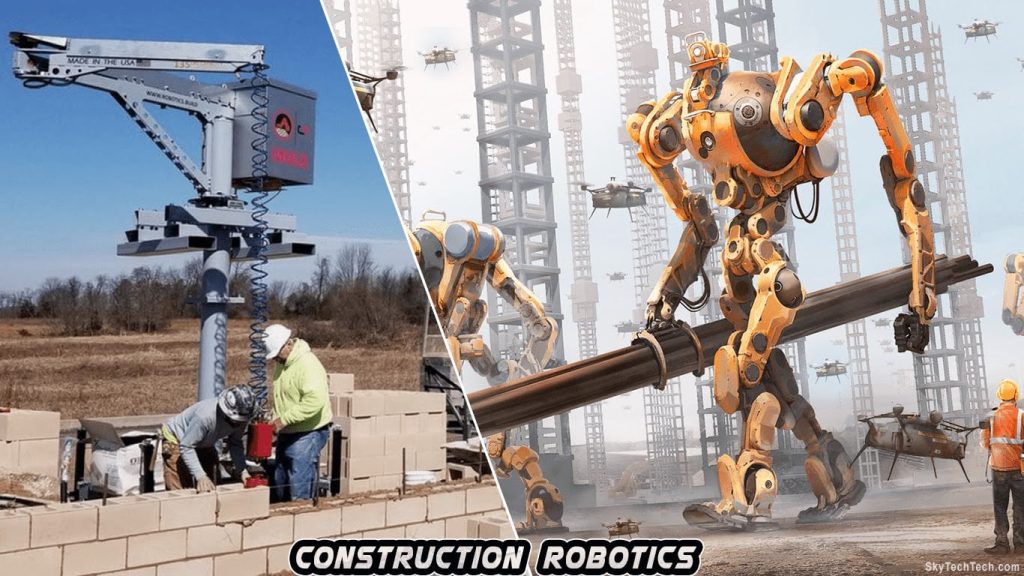

The construction industry is undergoing a radical transformation thanks to recent technological developments, perhaps most notably the introduction of robotics into various stages of the construction process. Robots are improving efficiency, reducing costs, and enhancing safety on construction sites.
Robots are the future of Robotics.
Robotics are the future of the construction industry, improving efficiency, reducing costs, and enhancing safety. Developments in the field promise further innovations, such as autonomous robots and collaborative robots, that will revolutionize how construction projects are carried out. With the expected growth in market size and increased demand for advanced technological solutions, robotics is sure to become an integral part of the future of the construction industry.
Robotics is set to become an integral part of the future of the construction industry. <The robotics market in the construction industry is expected to witness significant growth in the coming years. According to a report by MarketsandMarkets, the construction robotics market size is expected to grow from about $95 million in 2020 to more than $420 million by 2025, at a CAGR of about 35%. In this report, we review current and future developments and applications of robotics in the construction industry, with actual examples of robotics applications in this field.
In this report, we review current and future developments and applications of robotics in the construction industry.
3D printing
One notable development in the use of robotics in construction is 3D printing. This technology allows complex structures to be built faster and more efficiently than traditional methods. 3D printer robots are used in the construction of homes, bridges, and commercial buildings, reducing labor costs and minimizing the waste generated by traditional construction.
Installation and construction
Robots are also used to install parts and build walls and columns. These robots are equipped with advanced sensing and guidance systems that help them execute tasks with high precision. For example, the SAM robot, which was developed for brick installation, can install bricks with speed and accuracy beyond the ability of human workers.
H4>.
Robots are also used in demolition and recycling operations. Robots like the Husqvarna DXR are equipped with specialized tools that enable them to demolish buildings and recycle materials efficiently and safely. This use not only improves safety at demolition sites, but also helps reduce the environmental impact by recycling materials.
In the future, autonomous robots are expected to become an essential part of construction sites. These robots will be able to autonomously navigate the site, perform various tasks such as transporting materials, assembling parts, and even monitoring the progress of construction. Autonomous robots will minimize the need for direct human intervention, increasing efficiency and reducing human error.
Collaborative robots or "cobots" will be able to work alongside human workers. These robots will help with tedious and repetitive tasks, allowing human workers to focus on jobs that require advanced human skills. This collaboration between humans and robots will improve the quality of work and increase productivity on construction sites.
Demolition and recycling
Autonomous robots
Cooperative Robots
Improvements in safety
<An important future application is the use of robotics to improve safety on construction sites. Robots can be used to monitor site conditions, such as structural stability and fire safety, as well as perform dangerous tasks such as working at high altitudes or in hazardous environments.
Robots can be used to monitor site conditions, such as the stability of structures and fire safety, as well as to perform dangerous tasks such as working at high altitudes or in hazardous environments.
Highlights of the use of robots in the construction industry
SAM for wall construction
<The SAM (Semi-Automated Mason) robot is one of the most prominent examples of the use of robotics in construction. This robot is dedicated to laying bricks, and can lay about 3,000 bricks per day, compared to a human worker's capacity of 300 to 500 bricks. "SAM uses a combination of hydraulic systems, sensors and software to ensure accurate installation.”Contour Crafting“ for 3D printing
”Contour Crafting“ is a robotics-based 3D printing technology used in the construction of homes and large structures. This technology enables super-fast and low-cost construction of homes, with an average-sized home being built in 24 hours. These robots sequentially print concrete layers until the structure is complete.
Husqvarna DXR demolition robot
The Husqvarna DXR robot is used for demolition operations and is an excellent example of specialized robots in this field. "Equipped with advanced cutting and crushing tools, the DXR can reach tight and difficult spaces that may be dangerous for human workers. This robot helps carry out demolition operations with high efficiency and safety.