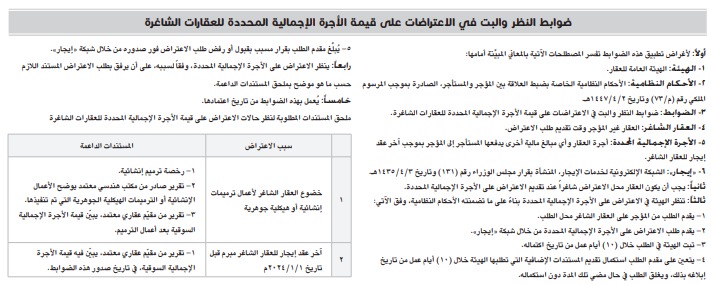

The official gazette “Umm Al-Qura” published in its issue issued yesterday, Friday, December 26, 2025, the regulations for considering and deciding on objections to the total rent value set for vacant properties , in addition to the regulations for correcting violations of the regulatory provisions governing the relationship between the landlord and the tenant , after the approval of the Board of Directors of the General Authority for Real Estate, provided that it will be implemented as of the date of its adoption.
The regulations governing objections to the total rent for vacant properties consist of five articles and aim to establish clear and fair standards for addressing objections submitted by landlords. In this context, the relevant regulations refer to those issued under Royal Decree No. (M/73) dated 14/4/1447 AH, which regulate the relationship between landlords and tenants. A vacant property is defined as a property that is not rented at the time the objection is submitted, while the total rent is defined as the rent amount plus any other payments made by the tenant to the landlord according to the last lease agreement for the property.
According to the regulations, the General Authority for Real Estate is responsible for reviewing objections to the total rent amount, based on the applicable legal provisions, upon a request submitted by the landlord through the "Ejar" network regarding the vacant property in question. The Authority is obligated to decide on the request within a period not exceeding ten working days from the date of its completion.
The applicant must submit any additional documents requested by the authority within ten working days of being notified. Failure to do so within this timeframe will result in the application being closed. The applicant will also be notified of the reasoned decision (acceptance or rejection) immediately upon its issuance through the "Ejar" network.
Objections will be considered based on their grounds, provided that the necessary supporting documents are attached for each case. If the objection is based on the vacant property undergoing substantial structural or structural renovations, a structural renovation permit, a report from a certified engineering office detailing the nature of the work being carried out, and a report from a certified real estate appraiser specifying the total market rent after completion of the renovations must be submitted. If the objection relates to the last lease agreement concluded before January 1, 2024, a report from a certified real estate appraiser showing the total market rent as of the date these regulations were issued is required.
Regarding the regulations for rectifying violations of the provisions governing the relationship between landlords and tenants, these are outlined in eight articles and come into effect upon their adoption. A violation is defined as any act or omission that contravenes clauses (2), (4), or (7) of the provisions, provided that such contravention is established by a decision issued by the competent committee within the Authority, in accordance with Article 20 of the Real Estate Mediation Law.
Correcting a violation means taking the necessary action to remove the violation and address its consequences within the specified timeframe, ensuring the situation is restored to compliance with regulations. The regulations stipulate that the violator must correct the violation within the period specified in the committee's decision, and no later than ten working days from the date of notification of the decision.
The mechanisms for rectifying violations include several cases, such as a landlord increasing the total rent for a property in Riyadh, or raising the total rent for a vacant property above the value of the last lease agreement. In these cases, the rent must be adjusted to comply with regulations within a specified period. Landlords who have not registered their lease agreements on the "Ejar" electronic rental services platform are also obligated to register them promptly. Furthermore, if a landlord in Riyadh refuses to renew a lease and forces a tenant to vacate outside of legally permissible circumstances, the landlord must renew the lease once the tenant expresses a desire to remain.
The regulations stipulate that if the deadline for rectifying the violation expires without the necessary action being taken, the General Authority for Real Estate has the right to intervene and adjust the total rent or renew the lease agreement, as appropriate, to ensure compliance with the applicable regulations. They also emphasize that the application of these regulations does not prejudice the right of the affected party to seek compensation before the competent court.