
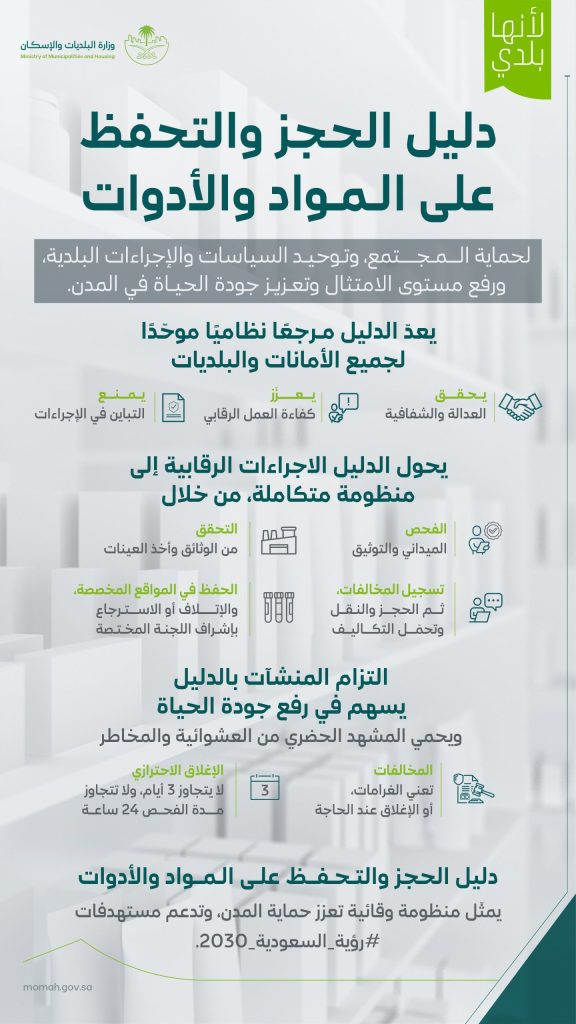

The Ministry of Municipalities and Housing has adopted a guide for the reservation and seizure of materials and tools, in an organizational step aimed at unifying municipal policies and procedures, and raising the level of compliance with regulations and bylaws, in order to preserve public safety and health, and enhance the quality of life in cities.
The ministry explained that the adoption of the guide is based on the regulations for penalties for municipal violations and the related executive rules, to be a unified regulatory reference to be applied in all secretariats and municipalities, which enhances the efficiency of supervisory work, prevents discrepancies in procedures, and achieves justice and transparency in the enforcement of regulations.
The ministry explained that the guide regulates the procedures for seizing materials and tools that violate regulations, and specifies the mechanisms for transporting and storing them in designated locations that meet the necessary technical requirements, while charging the violator the costs of transport and security, and ensuring that they are not used during the seizure period, in addition to identifying the cases that require the temporary precautionary closure of facilities in order to preserve public safety and health.
The ministry also indicated that the guide includes procedures for destroying materials and tools that are unfit or dangerous to public safety and health, under the supervision of specialized technical committees, with the violator bearing the resulting costs. It also regulates the mechanisms for their return after paying fines and fulfilling regulatory requirements, and allows for the sale of seized items at public auction if their owners do not come forward.
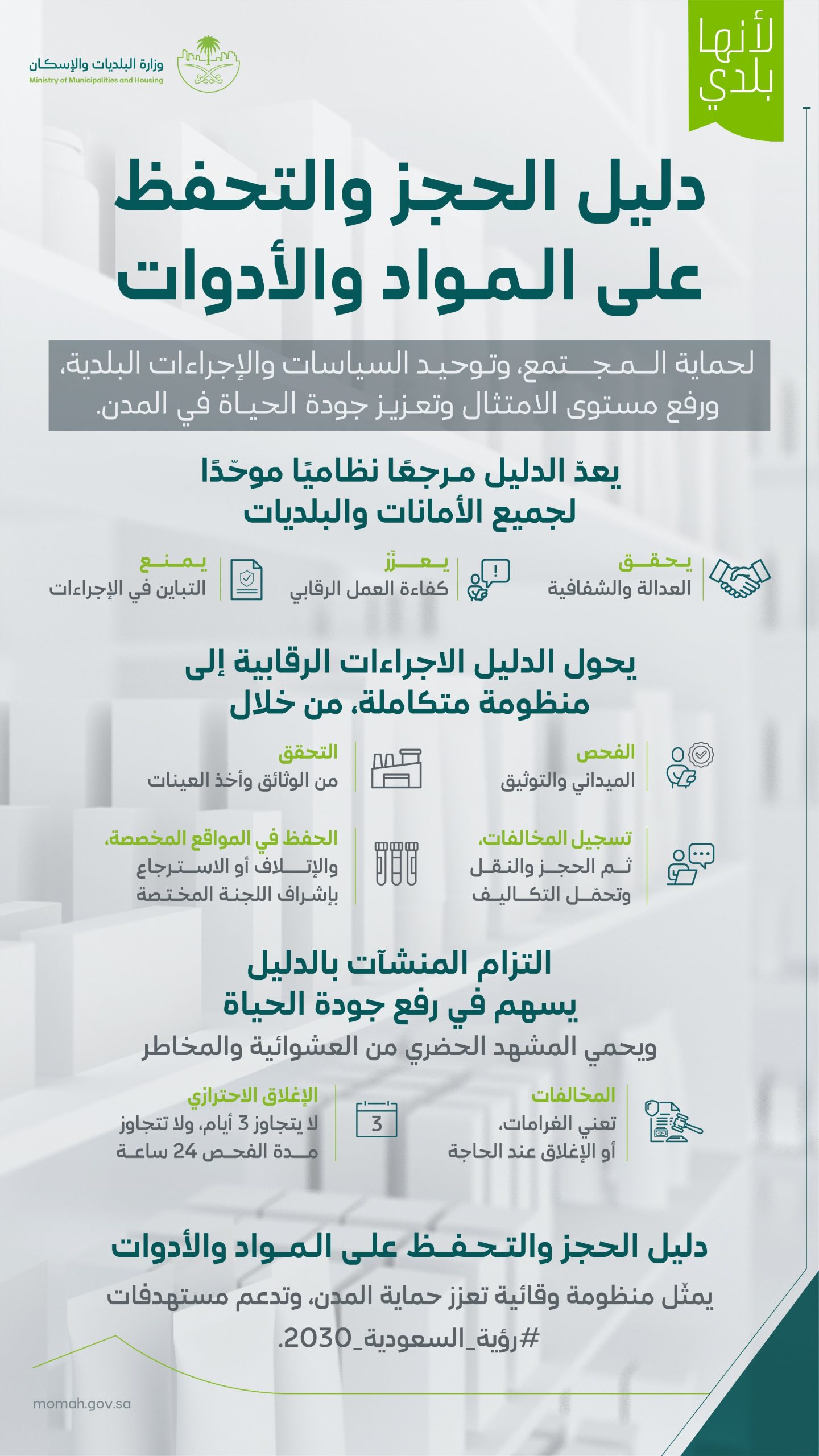
The guide includes detailed mechanisms that take into account the different cases, such as large materials and tools that are difficult to transport, where it is sufficient to take samples of them for examination within the site or facility as the case may be.
He stressed the need to deal immediately with perishable materials by transferring their samples directly to the competent authority within a period not exceeding (24) hours from the date of their seizure, while setting time periods for examination not exceeding three days, and allocating suitable places to store materials and tools until the necessary tests are completed.
The guide explained that the precautionary closure of a shop or establishment may not exceed three consecutive days, and may not be extended under any circumstances, so that the site may be reopened if there is no evidence to warrant the continuation of the closure, in order to ensure the safety of procedures and protect public health.
This approach comes as part of the Ministry of Municipalities and Housing’s efforts to enhance the implementation of regulations and bylaws, and to develop its regulatory and supervisory tools, in support of the Kingdom’s Vision 2030 goals of improving the urban landscape, enhancing compliance, and achieving higher standards of safety and quality of life.


