
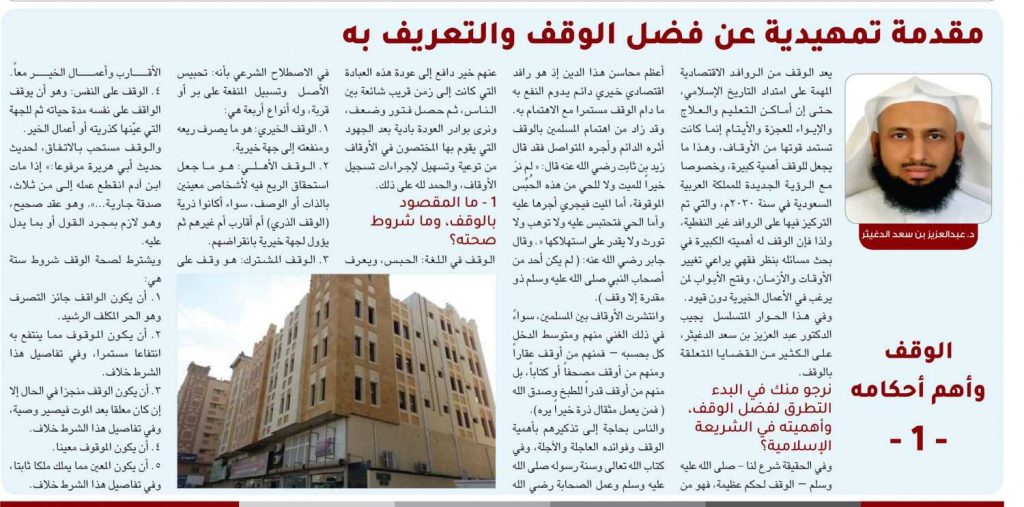

Waqf is one of the important economic tributaries throughout Islamic history, even places of education, treatment and shelter for the elderly and orphans derived their strength from endowments, and this makes the waqf of great importance, especially with the new vision of the Kingdom of Saudi Arabia in 2030, in which the focus is on non-oil tributaries, and therefore <a href="https://www.amlak.net.sa/home/-----1TP3" target="_blank" href="https://www.amlak.net.sa/home/-----1TP3
In this sequential interview, Dr. Abdulaziz bin Saad Al-Dughaythir answers many issues related to Waqf.
Please start by addressing the virtue of Waqf and its importance in Islamic law?
In fact, the Prophet (peace and blessings of Allah be upon him) legalized the Waqf for great wisdom, as it is one of the greatest virtues of this religion, as it is a permanent charitable economic tributary that continues to benefit as long as the Waqf continues with attention to it. Zayd ibn Thabit (may Allah be pleased with him) said, "We have never seen anything better for the dead or the living than these endowed endowments, but the dead will receive their reward, and the living will not be able to consume them." Jabir (may Allah be pleased with him) said, "The endowment is not to be donated, nor inherited, nor is it able to be consumed. Jabir (may Allah be pleased with him) said: "None of the companions of the Prophet (peace and blessings of Allah be upon him) had the ability to endow.
And endowments spread among Muslims, whether rich or middle-income, each according to his own ability - some of them endowed a real estate, some of them endowed a Qur'an or a book, and even some of them endowed a cooking pot, and God's truth (whoever does something good will see it).
People need to be reminded of the importance of endowment and its immediate and long-term benefits, and the Book of Allah, the Sunnah of His Messenger (peace be upon him) and the work of the Companions (may Allah be pleased with them) are the best motivation for the return of this worship, which was until recently common among people, then there was a lull and weakness, and we see signs of return after the efforts made by the specialists in the endowments of awareness and facilitating the procedures for registering endowments, thank God for that.
.
1 – ما المقصود بالوقف، وما شروط صحته؟
Waqf in language: It is defined in the legal terminology as: It has four types:
Waqf has four types:
Waqf has four types:
Waqf has four types:
1. Charitable endowment:
It is that which disburses its revenue and benefit to a charitable organization.
2. Community endowment:
It is the one in which the entitlement to the rent is made to specific persons, whether they are descendants, relatives or others, and then passed on to a charitable entity upon their extinction.
2.
3. Joint Waqf:
It is an endowment for the relatives of the beneficiaries together.
4. Self-restraint:
This is where the endowment is for himself for the duration of his life and then for the entity designated by him, such as his descendants or charity.
Waqf is desirable by agreement, due to Abu Huraira's hadith: "When the son of Adam dies, his work will cease except for three things, a running charity...".
Waqf is desirable by agreement.
It is a valid contract, and it is obligatory just by saying it or by what it implies.
Six conditions are required for a valid waqf:
1. The waqf must be free, responsible and rational.
2. The endowment must be of continuous use, and the details of this condition are subject to disagreement.
2.
3. The endowment must be completed immediately unless it is suspended after death, then it becomes a will, and in the details of this condition there is disagreement.
3.
4. The endowment must be specific.
4.
5. The specific property must be a fixed property, and the details of this condition are subject to dispute.
5.


