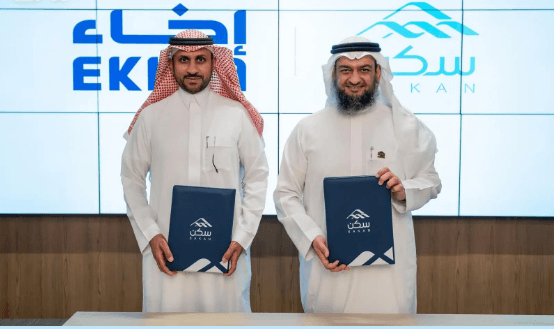

The National Housing Development Foundation (Sakan) renewed its cooperation agreement with the National Foundation (Ikhaa), aiming to support eligible beneficiaries from among Ikhaa's orphaned sons and daughters and their families, enabling them to own suitable housing and thus enhancing their residential and social stability. This partnership builds upon the existing collaboration between the two foundations in providing housing solutions tailored to beneficiaries' needs, supporting their transition to a more stable life. This stems from the understanding that housing plays a crucial role in strengthening family security, fostering a sense of belonging, and providing a suitable environment for building a future.
The agreement includes cooperation through the “Waad” program, which allows access to housing units up to ownership in accordance with approved regulations, and the purchase route from the market through licensed off-plan sales projects, thus diversifying the ownership options available to beneficiaries and taking into account their needs.
The National Housing Development Foundation “Sakan” in the Kingdom of Saudi Arabia works to provide housing and financing solutions for the most needy families, aiming to improve their quality of life and enhance the role of the non-profit sector in sustainable housing development.
The organization has an independent legal personality and is supervised by the Ministry of Human Resources and Social Development, with which it is registered under number 215. It focuses on enabling the non-profit sector to develop housing solutions that meet the needs of eligible groups.
Objectives of the "Sakan" Foundation
The organization seeks to consolidate sustainable improvement in the housing sector, develop innovative partnerships, raise the efficiency of service delivery, and stimulate investments aimed at providing housing units through the third housing sector.
It also works to develop effective solutions for the system, raise awareness of the non-profit housing sector, ensure the sustainability of cash and in-kind donations, improve the quality of services and the level of institutional maturity of civil society organizations, while continuing to innovate and develop housing-related concepts.
"Sakan" initiatives to support beneficiaries
The “ Jood Housing ” initiative is at the forefront of the initiatives launched by the Foundation. It is a national project that aims to involve individuals and organizations in supporting families eligible for housing through an electronic platform.
The support pathways provided by the initiative vary between contributing to the payment of housing rent for needy and low-income families, supporting homeownership by providing housing units for the most needy families, in addition to providing land or a housing unit, and making public contributions available that are allocated to beneficiaries according to the cases determined by the platform’s management.
The foundation also launched the “Major Donors” initiative, which aims to provide sustainable housing solutions by sharing the cost of a housing unit between two or more parties, through partnerships that bring together the Ministry of Municipalities and Housing and the “Sakan” Foundation on one hand, and civil society organizations and major donors on the other.
Read also:
“Sakan” signs a number of agreements to support housing solutions and enhance family solidarity