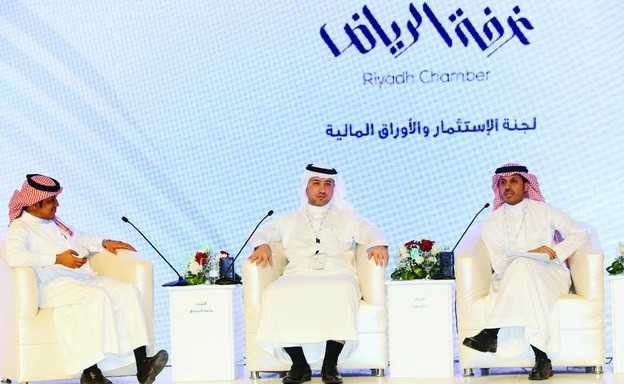
The Third Saudi Investment and Securities Conference concluded its work last week, which was organized by the Riyadh Chamber, represented by the Investment and Securities Committee, in cooperation with the Saudi Capital Market Authority and held under the patronage of His Royal Highness Prince Faisal bin Bandar bin Abdulaziz, Governor of Riyadh Region.
Success and wide participation of experts
The success of the conference was the wide participation of a group of economic and financial experts, investors and businessmen, and the participants were optimistic about the honorable results of the conference in the near future, hoping that it will have a constructive fruit that contributes to achieving more developmental steps that support deepening the mechanisms of transparency and governance of the market, in line with and support the economic transformation phase launched by the Kingdom under the leadership of the Custodian of the Two Holy Mosques King Salman bin Abdulaziz - may God protect him - by announcing Vision 2030 and the National Transformation Program 2020.For his part, Board Member and Chairman of the Investment and Securities Committee Mohammed Al-Sayer thanked the patron and honorary chairman of the conference, His Royal Highness Prince Faisal bin Bandar bin Abdulaziz, Emir of Riyadh, whose patronage and honor at the opening of the conference had the strongest support and success factors for its work.
The proliferation of litigation committees hinders investment
<The discussion sessions focused on a number of important financial and economic axes such as the second day's session on a number of discussion sessions in which a group of specialists and experts participated, and the first session was entitled “Capital Market Regulations and their impact on the private sector,” during which lawyer Dr. Fahad Al-Arfaj stressed that one of the most important obstacles to investment in the Kingdom is the multiplicity of litigation bodies, including the General Court and the Board of Grievances and 100 specialized committees for litigation such as securities and customs committees, pointing out that this multiplicity creates a kind of conflict of jurisdiction, which causes an impediment to local or foreign investment because the jurisdictional authorities are not clearThe CMA system encourages investment
For his part, M. Mohammed Al-Aqeel from Jarir Company praised the mechanisms of the Capital Market Authority's management of the market with good and strict regulations, which he considered attractive for investment in the Saudi market, which he said is seven times larger than the size of the Egyptian market and four times larger than the UAE market, but he complained about some difficulties related to the authority's regulations and large penalties against companies, and gave examples of imposing penalties if the company concludes any contract without the approval of the general assembly, and complained about the new version of the governance system, considering it very expensive for the company.
The CMA's system is attractive for investment in the Saudi market.
Weakness of funds
For his part, Mohammed bin Sulaiman Al-Rumaih, Director of the General Sales and Marketing Department at the Capital Market Company (Tadawul), stressed the importance of launching the parallel securities market to activate the market movement, saying that it attracts a new type of companies that were unable to list on the main market, and said that the National Transformation Program 2020 focuses on giving small and medium-sized companies the opportunity to join the parallel market.
Speaker Mohammed bin Sulaiman Al-Rumaih, Director of the General Department of Sales and Marketing at the Capital Market Company (Tadawul).
Weak savings culture in the Kingdom
<Wael Mirza from Al-Ahli Capital and Badr Al-Jard from the Social Development Bank, moderated by Asim Al-Rahili, Regional Director of Sidra Financial, emphasized the weak culture of saving and financial planning in Saudi society and the prevalence of the culture of excessive spending. Al-Jard said that the Social Development Bank adopts a special strategy to spread and encourage the culture of saving and financial balance, consistent with the environment and culture of Saudi society and Islamic law, pointing out that the savings rate in the Kingdom does not exceed 16% of the total population while the rate in the Gulf countries reaches 29% and the countries of the United States and the United Arab Emirates.Wael Marza suggested establishing a fund to finance from savings funds to achieve two dual benefits: encouraging the culture of savings and helping citizens obtain easy loans. He said that banks should participate in creating savings products that encourage society to save, pointing out that banks tend to focus on what brings them interest, and that they focus on loans and credit cards.
Investment in technology Valuation of technology companies
Participants in the panel discussion "Investing in Technology and How to Evaluate Technology Companies" agreed on the promising future of investment in technology and information technology, but emphasized that poor knowledge transfer remains one of the shortcomings of technical investment in the Kingdom.
Participants in the panel discussion "Investing in Technology and How to Evaluate Technology Companies
M. Mazen Al-Dawood, advisor to the Minister of Trade and Investment, emphasized the escalating growth in the technology industry and its employment, pointing out that the current growth of technology companies confirms that within ten years there will be companies capable of regional competition, pointing out that the competition until now is local competition.
Al-Dawood did not hide the impact of technology on jobs and some businesses, and said that there are technology companies that had a global impact years ago but disappeared, stressing that the technical reality has life cycles that urge renewal and innovation for continuity, stressing that the ministry supports both foreign and local investors when providing a technological investment with quality value as well as supporting knowledge transfer industries.
Dawood did not hide the impact of technology on jobs and some businesses, saying that there are technology companies that had a global impact years ago but disappeared.