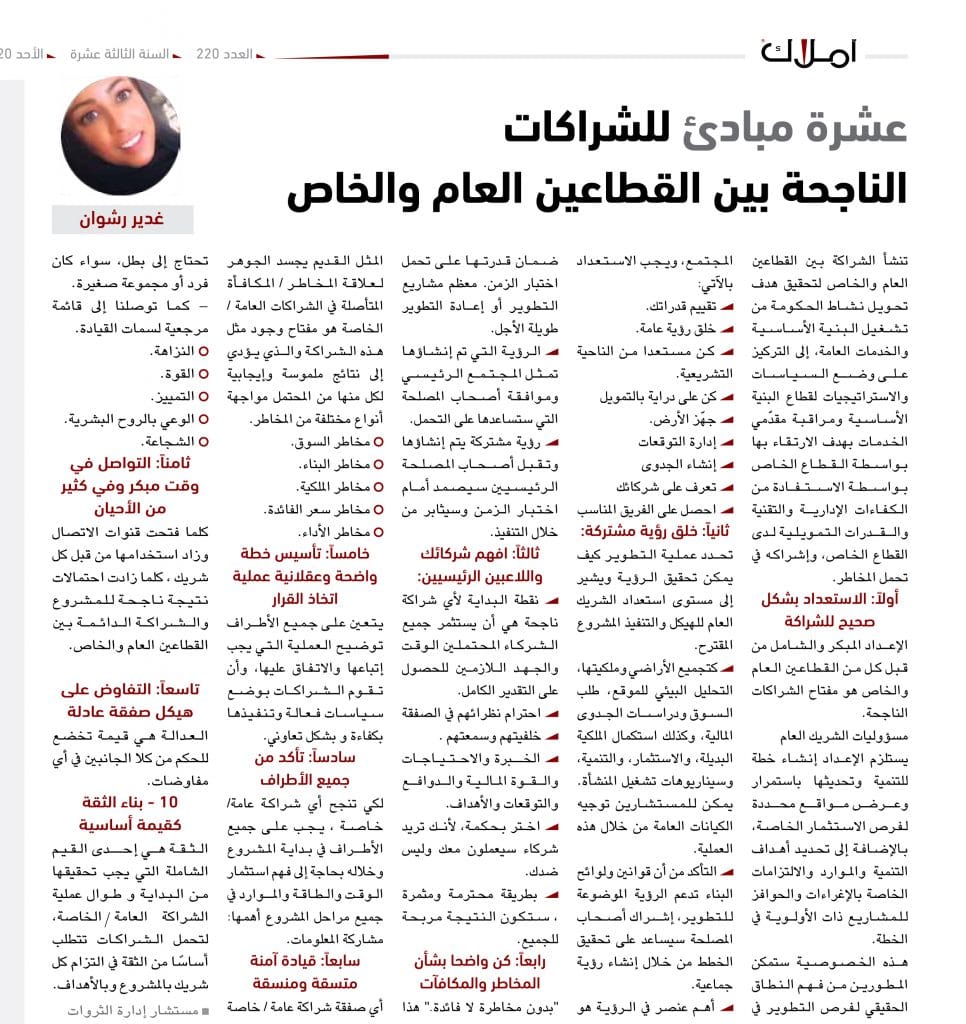

PPPs are established to achieve the goal of shifting government activity from operating infrastructure and public services to focus on setting policies and strategies for the infrastructure sector and monitoring service providers with the aim of upgrading them through companies by utilizing the management and technical competencies and financing capabilities of the private sector, and involving it in taking risks.
.PPPs are established to achieve the goal of shifting government activity from operating infrastructure and public services
First: Prepare properly for the partnership
Early and thorough preparation by both the public and private sectors is the key to successful partnerships.
Responsibilities of the general partner
Preparation entails creating and continuously updating a development plan and presenting specific locations for private investment opportunities, as well as identifying development goals, resources and commitments for incentives and inducements for projects prioritized in the plan.
Preparation entails creating a development plan and keeping it up to date.
This specificity will enable developers to understand the true scope of development opportunities in the community, and should be prepared with the following:
Evaluate your capabilities.
Create an overall vision.
Be legislatively prepared.
Be familiar with financing
Prepare the ground.
Manage expectations
Creating a business case
Get to know your partners
Get the right team
Second: Create a shared vision:
The development process determines how the vision can be realized and indicates the general partner's level of readiness to structure and execute the proposed project.
Land assembly and ownership, site environmental analysis, market demand and financial feasibility studies, as well as completing alternative ownership, investment, development, and facility operation scenarios. Consultants can guide public entities through this process.
Ensure that building codes and regulations support the vision set for the development, engaging stakeholders will help realize plans by creating a collective vision.
The most important element of a vision is ensuring it can stand the test of time. Most development or redevelopment projects are long-term.
The vision created represents the key community and stakeholder buy-in that will help it endure.
A shared vision that is created and accepted by key stakeholders will stand the test of time and persevere through implementation.
Third: Understand your partners and key players:
The starting point for any successful partnership is for all potential partners to invest the time and effort necessary to be fully appreciated.
The starting point for any successful partnership is for all potential partners to invest the time and effort necessary to be fully appreciated.
Respect their deal counterparts" background and reputation.
Experience, needs, financial strength, motivations, expectations and goals.
Choose wisely, because you want partners who will work with you, not against you.
In a respectful and productive way, the result will be a win-win for everyone.
Fourth: Be clear about risks and rewards
"No risk, no reward." This ancient proverb captures the essence of the risk/reward relationship inherent in public/private partnerships and is key to having such a partnership that leads to tangible and positive outcomes for both potentially facing different types of risks.
Risks of the following:
Market.
Construction.
Property risk.
Interest rate.
Performance risk.
V: Establish a clear plan and rationalize the decision-making process
All parties should clarify and agree on the process to be followed, and partnerships should develop effective policies and implement them efficiently and collaboratively.
Partnerships should develop effective policies and implement them efficiently and collaboratively.
V.
Sixth: Make sure
VI.
All parties
For any public/private partnership to be successful, all parties at the beginning and during the project need to understand the investment of time, energy and resources in all phases of the project: Information sharing.
VII: Consistent and coordinated safe driving
Every public/private partnership deal needs a champion, be it an individual or a small group.
We also came up with a checklist of leadership traits.
Integrity.
Strength.
Discrimination.
Awareness of the human spirit.
Courage.
VIII: Communicate early and often
The more communication channels are opened and utilized by each partner, the more likely a successful project outcome and lasting public-private partnership will be.
Ninth: Negotiating a fair deal structure
Fairness is a value that is judged by both sides in any negotiation.
Fairness is a value that is judged by both sides in any negotiation.
X: Building trust as a core value
Trust is one of the overarching values that must be realized from the beginning and throughout the public/private partnership process, as endurance partnerships require a foundation of trust in each partner's commitment to the project and goals.
Trust is one of the overarching values that must be realized from the beginning and throughout the public/private partnership process.