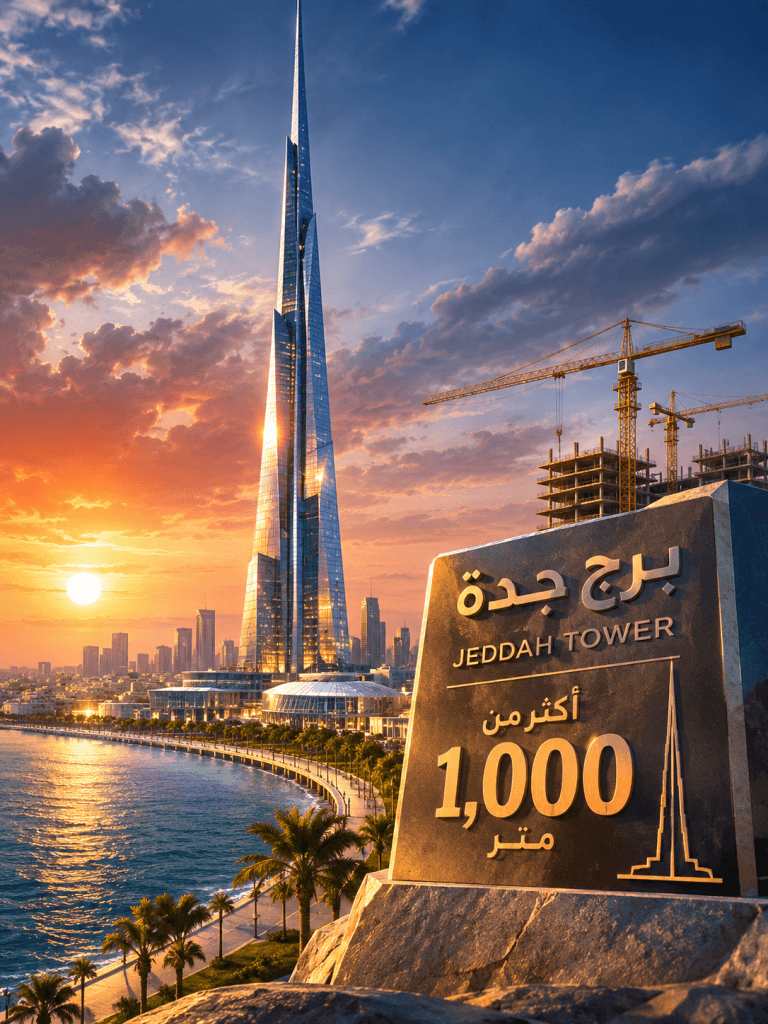

In northern Jeddah, near the Red Sea coast, rises a project that not only rivals existing skyscrapers for the top spot but also seeks to surpass a limit that for decades seemed more like engineering fantasy: a height exceeding 1,000 meters. This is the Jeddah Tower, a project that began as an exceptional architectural ambition, then transformed into one of the most complex mega-construction stories in the region, after a long period of inactivity before resuming and reclaiming its place in the global skyscraper race.
From a global idea to a Saudi project
The architectural roots of the idea go back to 2009, when the architectural firm Adrian Smith and Gordon Gill began studying concepts for an exceptionally tall building. The goal was to develop a model that went beyond the limits of known towers and tested the possibilities of building at an unprecedented height, with the structural solutions, vertical transport systems, and design required to cope with wind and loads. In August 2011, the project was officially announced as the “Kingdom Tower,” before later becoming known as the “Jeddah Tower.”
From the beginning, the project was associated with the name of Prince Alwaleed bin Talal, Chairman of the Board of Directors of Kingdom Holding Company, and with Jeddah Economic Company, which is developing the tower. The vision was for the building to become the centerpiece of the Jeddah Economic Project, with its residential, commercial and hotel uses, and what it could attract in terms of businesses, investments and visitors.
The tower was designed by Adrian Smith and Gordon Gill, the firm also associated with the design of the Burj Khalifa when Adrian Smith worked at Skidmore, Owings & Merrill. The structural design was handled by Thornton Tomasetti, as part of a team that included consulting firms specializing in geotechnical, engineering and building systems aspects.
Design: Why does the tower need different engineering?
The tower was designed to exceed 1,000 meters in height, with a total built-up area of approximately 530,000 square meters. Its slender, stepped architectural mass aims to reduce the impact of the wind, while its facades include curves and setbacks that create shaded areas and external balconies at different levels.
The difficulty of this design stems from the fact that the challenge lies not only in raising the building to a great height, but also in ensuring the stability of the structure, transferring loads to the foundations, controlling vibrations, and providing an interior environment suitable for daily use, while ensuring the movement of thousands of people between hundreds of levels.
The difficulty increases as the tower rises. Pumping concrete to such heights requires equipment, pressure systems, and careful monitoring of the mix's quality, transport time, and properties. Execution at this height also presents challenges related to safety, the speed of transporting workers and equipment, and synchronizing structural work with electrical, mechanical, and facade installations.
Data published by the developer in its 2026 results presentation indicates that the amount of concrete poured exceeded 274,000 cubic meters in April, before rising to more than 300,000 cubic meters in the second quarter update of the year, reflecting the volume of work completed on the concrete structure.
Where does the tower stand now?
Construction of the tower began in 2013, after years of conceptualization, planning, and design. At that stage, the project was presented as a direct contender for the title of the world's tallest building, with the ambition of surpassing the height of Dubai's Burj Khalifa, which stands at 828 meters.
By 2018, construction of the tower had stalled at 63 floors out of the 157 planned by the developer. This wasn't just a brief delay; it had dragged on for years. On October 2, 2024, Kingdom Holding Company announced that Jeddah Economic Company had signed an agreement with the Saudi Binladin Group to complete the tower's construction. According to the official announcement, the total value of the agreement was SAR 7.2 billion, of which approximately SAR 1.1 billion had already been paid for work completed on the tower. The announcement specified an expected completion period of 42 months, with Jeddah Economic Company to finance the remaining work through its internal resources, including bank facilities.
On January 20, 2025, the resumption of construction and concrete pouring was announced, marking the beginning of a new phase of progress after years of stagnation. Progress in the number of floors became a key indicator of the project's return to its implementation path, and at this time the structure was at approximately 63 floors.
In March 2026, Kingdom Holding Company reported that the tower had reached the 91st floor, at a height of approximately 370 meters, with the facades and mechanical, electrical and plumbing systems works completed. Subsequent data during 2026 showed that the building had exceeded the 100-story mark.
In October 2026, the Jeddah Tower reached the 116th floor, at a height of approximately 466 meters, according to statements made to the press by the CEO of Jeddah Economic Company, Fabian Toscano. This made the tower taller than the Petronas Towers in Malaysia, which are 452 meters high.
1000 meters... What does competing with Burj Khalifa mean?
The Burj Khalifa in Dubai is 828 meters high, a figure that has cemented its position as the tallest building in the world since its opening in 2010. As for the Jeddah Tower, it aims to exceed the thousand-meter barrier, with a planned architectural height approaching 1008 meters according to project reports. If the target height is achieved, the tower will exceed the height of the Burj Khalifa by about 180 meters, meaning that it will not achieve a limited symbolic superiority, but will move the competition to a new level of vertical construction.
How much does the Jeddah Tower cost?
Here, three different figures, often confused in media coverage, must be distinguished. The first is an older estimate published by the architectural firm and Thornton Tomasetti, placing the cost of constructing the tower at approximately $1.2 billion. This estimate is based on published data about the project and should not be treated as the final, confirmed cost after years of construction halts and resumptions, and changing market conditions.
The second is the value of the agreement to complete the tower works, which was announced by Kingdom Holding Company in October 2024, amounting to 7.2 billion riyals, equivalent to about 1.92 billion dollars. The figure includes about 1.1 billion riyals that were previously paid for work carried out. The third figure is related to the broader urban project that houses the tower. Architectural data mentions an estimate of nearly 20 billion dollars for the development of the city or the surrounding mixed-use project, which is a different range from the cost of constructing the tower itself.
Jeddah Economic City: What Lies Behind the Giant Building
The tower represents the most prominent element in the Jeddah Economic Project, whose data speaks of a total area of approximately 5.3 million square meters. The project aims to establish an urban destination that includes residential, commercial, office activities and public facilities, linking the tower to a wider urban fabric.
Kingdom Holding Company announced in October 2024 that the first phase of the Jeddah Economic Project covers approximately 1.3 million square meters, and that the infrastructure works for this phase have been completed, including electricity, water, sewage, stormwater drainage and high-speed communications.
This structure is of greater importance than the tower's service, because the success of the destination requires a network of roads, services and facilities capable of accommodating the movement of residents, workers and visitors, while providing an urban environment that continues to function after the construction phase is completed.
When will Jeddah Tower be completed?
The project is expected to be completed in 2028. Kingdom Holding Company CEO Talal Al-Maiman spoke in January 2026 about expecting the project to be completed during that year, and other reports quoted the CEO of Jeddah Economic Company as targeting completion in late 2028.
Read also:
King Salman Gate: An architectural masterpiece adorning the minarets of Mecca