
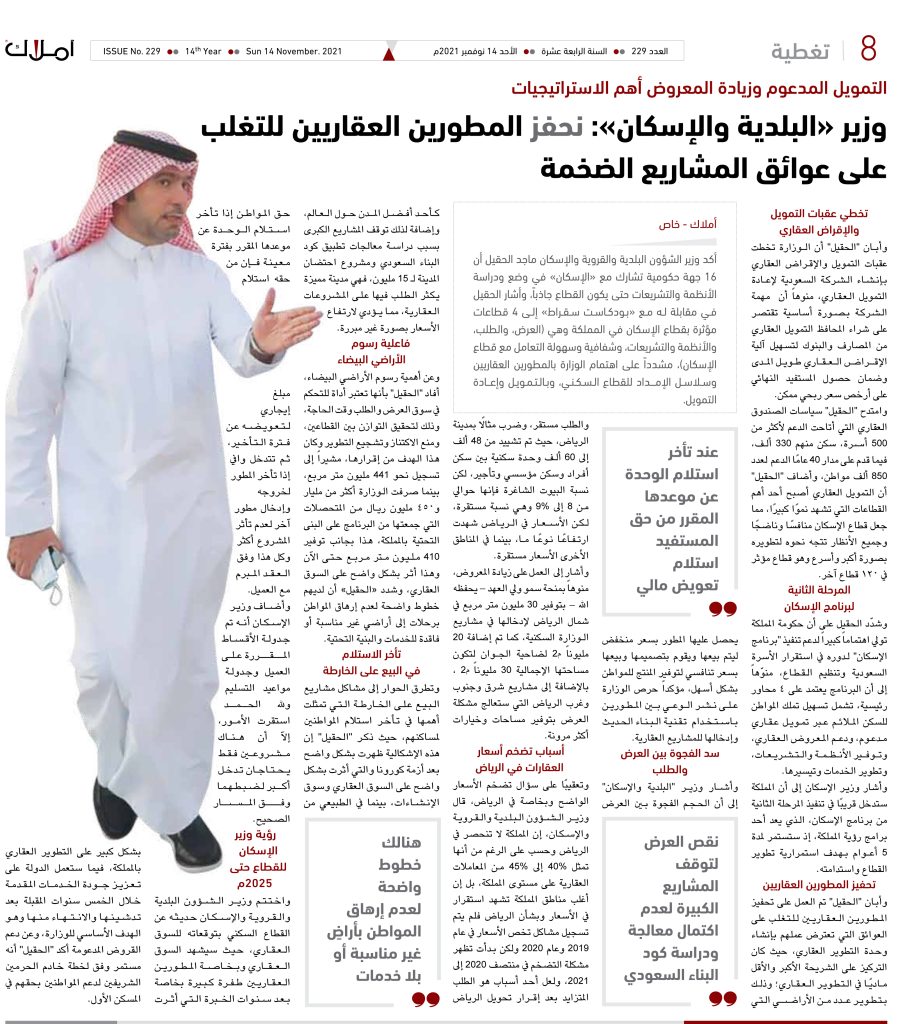

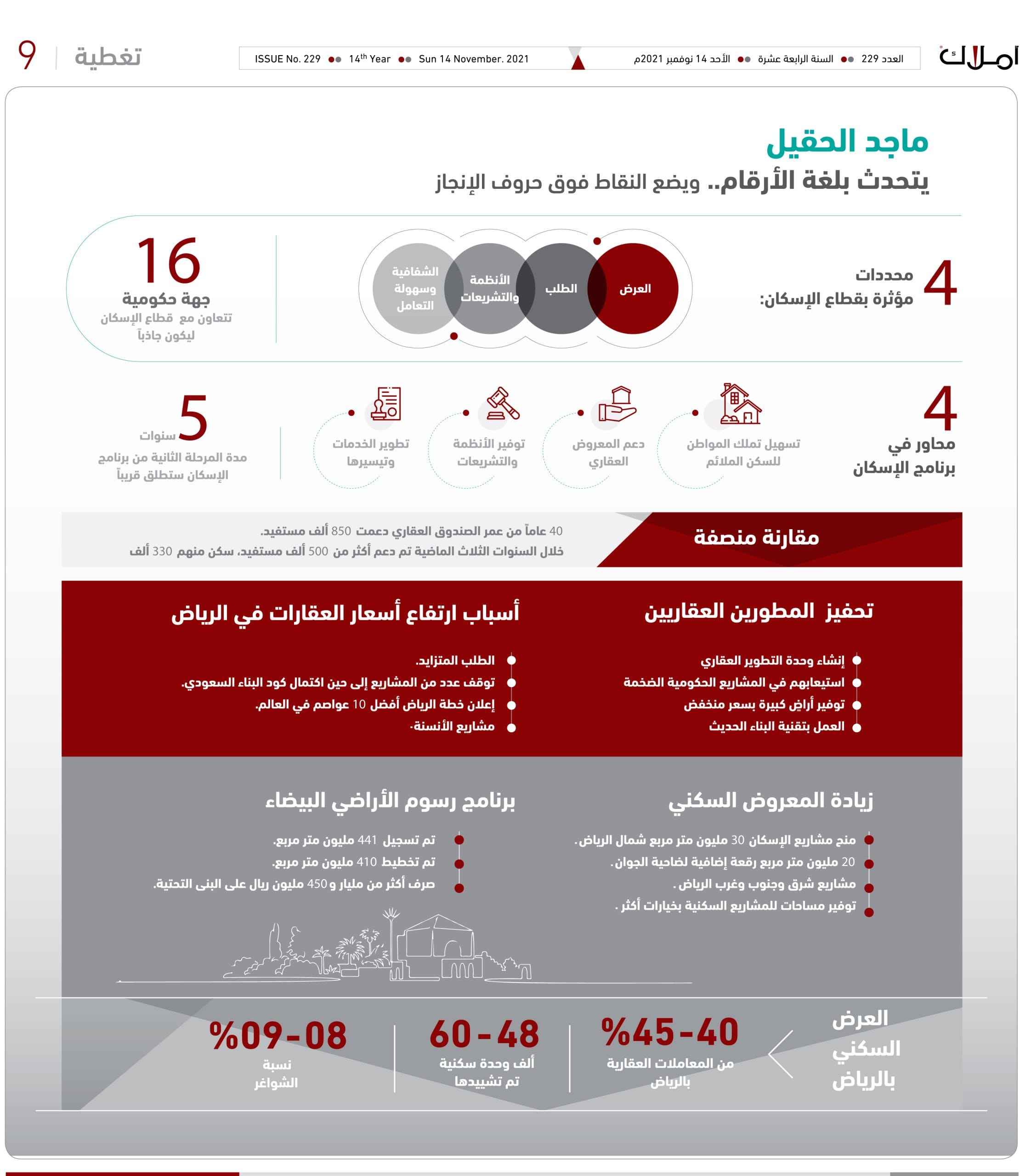
Minister of Municipal and Rural Affairs and Housing Majid Al-Hogail confirmed that 16 government agencies are participating with the Ministry of Housing in developing and studying regulations and legislation to make the sector attractive. In a previous interview with the “Socrates Podcast”, Al-Hogail pointed to 4 influential sectors in the housing sector in the Kingdom, which are (supply, demand, regulations and legislation, and finally transparency and ease of dealing with the housing sector), stressing the Ministry’s interest in real estate developers and supply chains for the housing sector, and in financing and refinancing.
Overcoming the obstacles of mortgage financing and lending
Al-Haqil explained that the ministry overcame the obstacles of real estate financing and lending by establishing the Saudi Real Estate Refinancing Company, noting that the company’s main task is limited to purchasing real estate financing portfolios from banks to facilitate the mechanism of long-term real estate lending and to ensure that the end beneficiary gets the cheapest possible profit rate.
Al-Haqil praised the policies of the Real Estate Development Fund, which provided support to more than 500 families, 330,000 of whom were housed, while over the course of 40 years it provided support to 850,000 citizens. Al-Haqil added that real estate financing has become one of the most important sectors that are witnessing great growth, which has made the housing sector competitive and mature, and all eyes are turning towards it to develop it further and faster, and it is an influential sector in 120 other sectors.
The second phase of the housing program
Al-Haqil stressed that the Kingdom’s government pays great attention to supporting the implementation of the “Housing Program” for its role in stabilizing the Saudi family and regulating the sector, noting that the program is based on 4 main pillars, including facilitating the citizen’s ownership of suitable housing through subsidized real estate financing, supporting the real estate supply, providing regulations and legislation, and developing and facilitating services.
The Minister of Housing indicated that the Kingdom will soon enter into the implementation of the second phase of the housing program, which is one of the Kingdom’s Vision programs, and will continue for 5 years with the aim of continuing the development and sustainability of the sector.
Incentivizing real estate developers
Al-Haqil explained that work was done to motivate real estate developers to overcome the obstacles that hinder their work by establishing a real estate development unit, where the focus was on the largest and least financially involved segment in real estate development, by developing a number of lands that the developer obtains at a low price to sell, and he designs and sells them at a competitive price to provide the product to the citizen more easily, stressing the ministry’s keenness to spread awareness among developers about using modern building technology and introducing it into real estate projects.
The Minister of Municipalities and Housing indicated that the gap between supply and demand is stable, and gave the example of the city of Riyadh, where 48,000 to 60,000 housing units were built, including individual, institutional, and rental housing. However, the vacancy rate is around 8 to 91 TP3T, which is a stable rate. Prices in Riyadh have risen somewhat, while in other regions, prices are stable.
Bridging the gap between supply and demand
He pointed to the work on increasing the supply, noting the grant of His Highness the Crown Prince - may God protect him - to provide 30 million square meters in northern Riyadh to be included in the Ministry’s housing projects. 20 million square meters were also added to Al-Jawan suburb to bring its total area to 30 million square meters, in addition to the projects in eastern, southern and western Riyadh that will address the supply problem by providing more flexible spaces and options.
Reasons for the inflation of real estate prices in Riyadh
In response to a question about the apparent price inflation, especially in Riyadh, the Minister of Municipal and Rural Affairs and Housing said that the Kingdom is not limited to Riyadh alone, even though it represents 40% to 45% of real estate transactions at the Kingdom level. Rather, most regions of the Kingdom are witnessing price stability. Regarding Riyadh, no problems related to prices were recorded in 2019 and 2020, but the problem of inflation began to appear in the middle of 2020 to 2021. Perhaps one of the reasons is the increased demand after the approval of transforming Riyadh into one of the best cities around the world. In addition, there is the suspension of major projects due to studying the solutions for implementing the Saudi Building Code and the project to accommodate 15 million people in the city. It is a distinguished city where there is a high demand for real estate projects, which leads to an unjustified rise in prices.
Effectiveness of white land fees
Regarding the importance of the white land fees, Al-Haqil stated that they are considered a tool to control the supply and demand market when needed, in order to achieve a balance between the two sectors, prevent hoarding and encourage development, and this was the goal of its approval. He pointed out that about 441 million square meters were registered, while the ministry spent more than 1.45 billion riyals of the proceeds it collected from the program on infrastructure in the Kingdom. This is in addition to providing 410 million square meters so far, and this has clearly affected the real estate market. Al-Haqil stressed that they have clear guidelines to avoid burdening citizens with trips to unsuitable lands or lands lacking services and infrastructure.
Delivery delays in off-plan sales
The dialogue touched on the problems of off-plan sales projects, the most important of which was the delay in citizens receiving their homes. Al-Haqil stated that this problem appeared clearly after the Corona crisis, which clearly affected the real estate and construction markets. Normally, if a citizen is delayed in receiving the unit beyond its scheduled date by a certain period, he has the right to receive a rental amount to compensate him for the delay period. Then, Wafi intervenes if the developer delays his exit and brings in another developer so that the project is not affected further, and all of this is in accordance with the contract concluded with the client.
The Minister of Housing added that the installments due from the client have been scheduled and the delivery dates have been scheduled, and thank God things have stabilized, except that there are only two projects that need greater intervention to put them on the right track.
The Minister of Housing's vision for the sector until 2025
The Minister of Municipal and Rural Affairs and Housing concluded his remarks on the housing sector with his expectations for the real estate market, stating that the real estate market, and especially real estate developers, will witness a significant boom, particularly after years of experience that have greatly influenced real estate development in the Kingdom. He added that the state will work to enhance the quality of services provided during the next five years after their launch and completion, which is the ministry's primary goal. Regarding support for subsidized loans, Al-Haqil confirmed that it will continue in accordance with the plan of the Custodian of the Two Holy Mosques to support citizens in their right to their first home.


