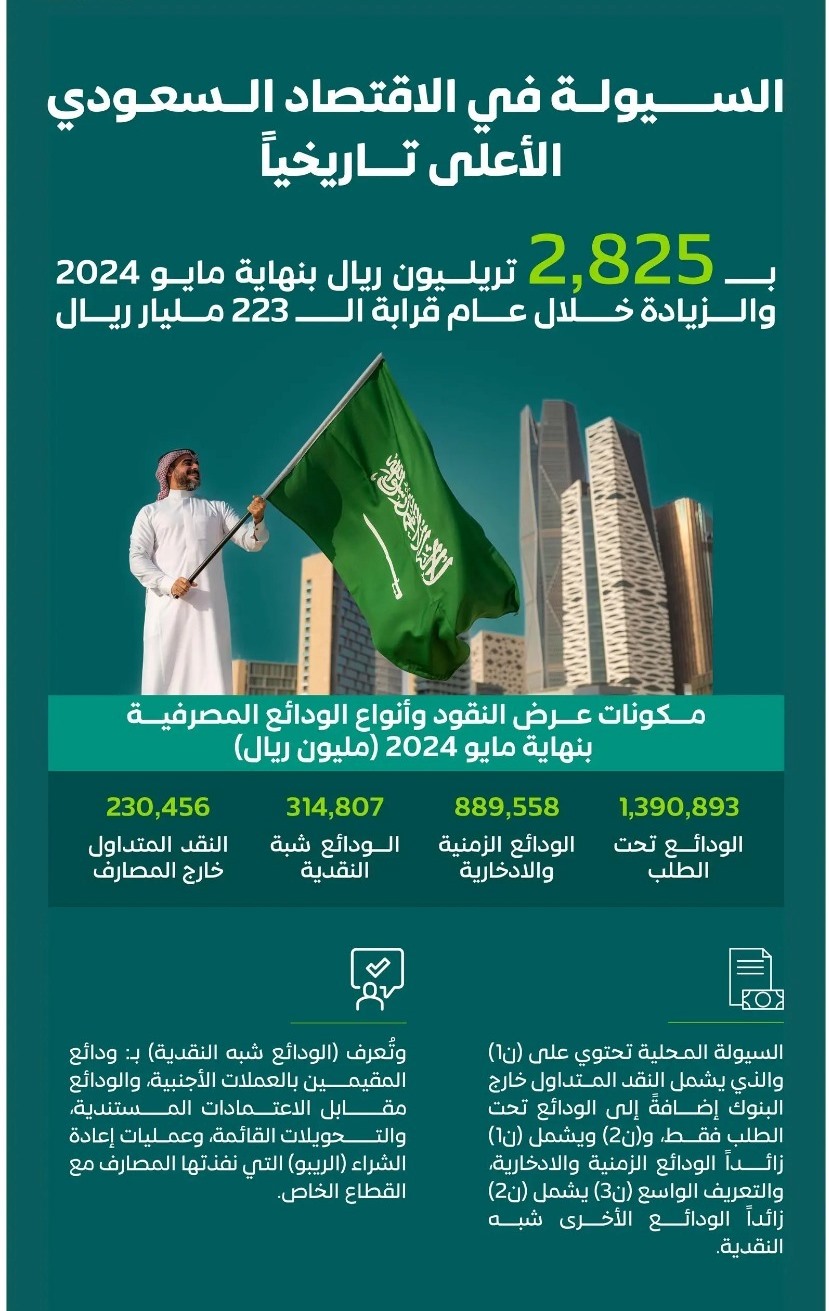

The levels of liquidity (available money) in the Saudi economic system recorded its strong growth to reach its peak at the end of May 2024, at the level of 2,825,715 million riyals, achieving an annual growth rate of 8.6% and an increase of more than SAR 222.928 billion, compared to the end of the corresponding period of 2023, which was at SAR 2,602.786 million, as its levels reflect the money supply in its broad and comprehensive sense (N3), according to the data of the monthly statistical bulletin of the Saudi Central Bank for May 2024.
May 2024. Since the beginning of the year, liquidity has grown by 4%, an increase of more than 104.757 billion riyals, from 2,720,957 million riyals at the end of January.
Liquidity has grown by 4%, an increase of more than 104.757 billion riyals. Liquidity also achieved a monthly growth of 1.2%, an increase of about 32,402 billion riyals, compared to the end of April of the same year at the level of 2,793,313 million riyals. These levels of liquidity support economic and commercial activity and mobility, contribute effectively to the march of economic development, and enable the realization of the objectives of the Kingdom's Vision 2030, reflecting the solidity and robustness of the banking and financial sector.
Reviewing the four components of the banking and financial sector.
Reviewing the four components of the money supply (n3) in its broad and comprehensive concept as follows;
“Demand deposits”, the largest contributor to the total money supply (n3) at 49.2%, recorded SAR 1,390,893 million at the end of May 2024, while “time and savings deposits” recorded SAR 889,558 million, the second largest contributor to the total money supply (n3) at 31.5%.
Money supply (n3) is the second largest contributor to the total money supply (n3) at 31.5%. <“Other quasi-monetary deposits” reached the level of 314,807 million riyals with an estimated contribution of 11.1% to the total money supply (n3), making it the third largest contributor. “Cash in circulation outside banks” came fourth, with a value of 230,456 million riyals, with a contribution of about 8.2% to the total money supply (n3).
It is noteworthy that Deposits Quasi-money consists of residents" deposits in foreign currencies, deposits against letters of credit, outstanding transfers, and repo operations carried out by banks with the private sector.
Domestic liquidity includes (n1) which includes cash in circulation outside banks, plus demand deposits only, (n2) which includes (n1) plus time and savings deposits, and the broader definition (n3) which includes (n2) plus other quasi-monetary deposits.
Domestic liquidity includes (n1) plus time and savings deposits, and (n2) plus other quasi-monetary deposits.