

The Hajj season of 1446 AH was a resounding success, reflecting meticulous planning, integrated efforts, and efficient execution among various Saudi government agencies. The well-structured operational plans of ministries and official bodies resulted in an exceptional season free of setbacks, demonstrating the Kingdom's readiness and commitment to dedicating all resources to serving the pilgrims.
From transportation and electricity to water, health, and communications, the figures and results demonstrated the scale of the undertaking and the Kingdom's ability to manage crowds professionally and efficiently. The Hajj season is no longer just a major religious event; it has become a global model of management in organization, safety, service, and hospitality.
= =
Infographic
Efforts of the municipalities and housing system
Hygiene and environmental sanitation
428,000 tons of waste removed
Sanitation work carried out in 7,524 locations
Use of 1,355 liters of concentrated liquids
384 kg of insecticides
Control and inspection
More than 34,000 inspection visits
4,848 field visits to the holy sites
Handling 2,159 reports (+40% compared to last year)
Food control
3,453 visits to 384 kitchens and catering companies
Capacity to prepare 15 million meals
Capabilities and equipment
More than 2,800 pieces of equipment and machinery
Distribution of 87,000 waste containers and 1,235 compactor boxes
5 laboratories to analyze up to 1,300 samples per day
Municipal services
Operation of 28 municipal service centers
95 emergency teams
Preparing 177 accommodation halls for 15,000 pilgrims
Human resources
More than 22,000 personnel, including employees, engineers, supervisors, and trained workers.
= = ==
The Saudi Electricity Company announced the completion of its operational plan for the Hajj season of 1446 AH, coinciding with the announcement of the success of this year’s Hajj season. This was achieved through the provision of a highly reliable and efficient electricity service, under the direct supervision of the Ministry of Energy and the monitoring of the Saudi Electricity Regulatory Authority. Thanks be to God, no outages were recorded in the public network in the holy sites, and historical peak loads were recorded in Mina, with an increase of 4% compared to last year’s Hajj.
The Acting CEO of the Saudi Electricity Company, Engineer Khalid bin Salem Al-Ghamdi, expressed his deep gratitude and appreciation to the wise leadership - may God protect them - for the support and empowerment they provide to the electricity sector system under the leadership of the Ministry of Energy.
Al-Ghamdi praised the support of the company’s board of directors and the efforts of more than 2,200 engineers and technicians from the company’s staff who worked throughout the season, explaining that the success of the operational plan came as a result of implementing a package of development projects that strengthened the infrastructure of the electrical system in the holy sites and contributed to raising the capacity of the electrical network in the holy sites area by more than 75% compared to last season.
======= =====
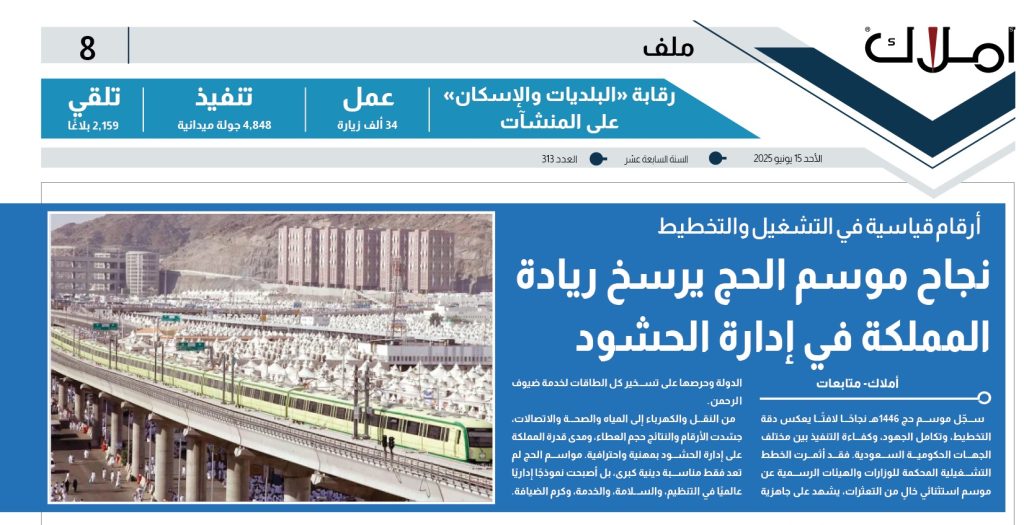
The Holy Sites train transports 1.87 million passengers
Saudi Railways (SAR) transported approximately 1.87 million passengers between the Holy Sites stations in Mina, Muzdalifah and Arafat via the Holy Sites train, during the period of operation that extended from the seventh day of Dhul-Hijjah until the end of the days of Tashreeq, through 2154 trips amidst high coordination with various relevant authorities.
The operational plan for the Holy Sites Train during the Hajj season of 1446 AH included five main movements. The first movement began between all stations on the seventh and continued until sunset on the eighth of Dhu al-Hijjah, during which more than 27,000 passengers were transported. The second movement included transporting 282,000 pilgrims from Mina to Arafat. The third movement saw the transport of 294,000 pilgrims from Arafat to Muzdalifah. In the fourth movement, more than 349,000 pilgrims were transported from Muzdalifah to Mina. The last movement, which continued until sunset on the last day of Tashreeq, recorded the transport of more than 920,000 passengers to and from Mina 3 station “Jamarat”.
The CEO of Saudi Railways, Dr. Bashar bin Khalid Al-Malik, appreciated the support and empowerment provided by the wise leadership, which contributed to the integration of efforts and services provided to the guests of God, including transportation services via the Holy Sites Train.
===== ======
National Water Company distributes more than 45 million cubic meters
The National Water Company announced the distribution of more than 45 million cubic meters of water to pilgrims in the city of Makkah and the holy sites during this year’s Hajj season 1446 AH.
She explained that the rate of water pumping that was distributed during the Hajj season, starting from 1 Dhu al-Qi’dah 1446 AH, reaches 24 hours in the area of the Grand Mosque in Mecca and the holy sites, noting that the quantities of water that were treated exceeded 33.4 million cubic meters, in addition to conducting more than 100,000 laboratory tests during the Hajj season.
The National Water Company noted that it did not record any obstacles in managing its operations in the city of Makkah and the Holy Sites, as it was able to provide the appropriate quantities of water that it distributed to the public networks, toilets, and networks designated for tent air conditioning units in Mina, in addition to the fire extinguishing networks and tanks for the use of the Civil Defense.
= = =====
Hajj Communications Index
181.2 million
Local and international voice calls.
= = =
+155 million
local voice call
= = =
+25 million
International voice call
= = = = =
Record figures reflect operational and planning efficiency
State Properties hosts 59 government entities
The General Authority for State Properties announced that it will host 59 government agencies and their affiliated sectors participating in organizing this year’s Hajj 1446 AH, in the government offices complex in the Holy Sites. This is the largest number that the Authority has hosted in the complex since its establishment.
The complex includes 65 buildings, including residential, administrative, health, security and operational buildings, in addition to comprehensive facilities and services, and it is distinguished by its advanced infrastructure, as well as its geographical location close to the holy sites.
The complex has demonstrated a high capacity for continuous responsiveness to the requirements of government agencies, through the application of best technical and administrative practices, including the allocation of residential and office floors, in addition to a central meeting room in each building, in order to achieve complete independence for the beneficiary agencies.
===== == ====
“Two-story tents”
A modern residential environment welcomes pilgrims in Mina.
Kadana Development and Investment Company (the main developer of the Holy Sites) launched the two-story tent project, which represents a series of qualitative transformations in the accommodation of pilgrims in the Holy Sites, by providing distinguished accommodation that ensures pilgrims a suitable atmosphere, with permanent solutions and high-quality operational efficiency, which contributes to the comfort and peace of mind of the pilgrims.
Kadana confirmed that the two-story tent project was implemented in partnership with the private sector, representing 75% of the total project, with an accommodation area exceeding 20,000 square meters consisting of more than 40 buildings, equipped with more than 550 toilets. Its implementation took approximately 100 days, and it aims to accommodate approximately 8,000 pilgrims from inside and outside the Kingdom.
==== ======
Providing 234 million items for pilgrims in the holy sites
The Ministry of Commerce clarified that the total number of food and supply products provided to the pilgrims in the holy sites amounted to more than 234 million goods and products during this year’s Hajj season 1446 AH, in coordination with government agencies and in partnership with the private sector.
The most consumed goods included: juices and soft drinks, dairy products, drinking water, baked goods, canned goods, and various food products and goods.
The Ministry of Commerce's inspection teams began covering the supply situation for the pilgrims by checking on sales outlets and ensuring the availability of goods and products that meet the needs of the pilgrims of the Sacred House of God.
It oversaw food supply chains, in addition to its supervisory roles over commercial establishments, retail outlets and stalls to verify their compliance with consumer protection regulations.
====== ====
Providing 200,000 health services to pilgrims
The Hajj season of 1446 AH witnessed the provision of 200,000 health services by the health system to the pilgrims, with high quality and easy means that enhance access to health care for the pilgrims, in line with the objectives of the “Health Sector Transformation” program and the “Serving the Pilgrims” program emanating from the Kingdom’s Vision 2030, which seeks to enable pilgrims to perform their rituals in the spaciousness of safety and efficient health care.
The total number of visitors to health centers during the Hajj season reached more than 109,511 visitors, and 29 open-heart surgeries and 311 cardiac catheterizations were performed. The emergency departments received 42,949 cases, and the number of beneficiaries of the virtual health hospital reached 10,430 pilgrims, in addition to providing 9,001 telephone medical consultations, and the unified call center 937 received more than 27,784 incoming calls, and 1.47 million preventive services were implemented through the ports around the Kingdom.
==== =====
Preparing air-conditioned mobile sites on the migration route
The General Authority for Roads provided the “mobile sites” service for the pilgrims on the Hijra Road, with the aim of providing designated sites for pilgrims in case their buses break down - God forbid - in order to ensure the highest levels of comfort and safety for them during their journey.
This initiative was implemented on the Makkah-Madinah Expressway (Al-Hijrah), and operates 24 hours a day throughout the Hajj season. Each unit can accommodate about 40 pilgrims and is equipped with air conditioning, rest areas, toilets, cold drinks, and hospitality meals.
This initiative stems from the General Authority for Roads’ keenness to provide the highest levels of comfort and safety for the pilgrims, and to ensure the quality of their experience while traveling between Makkah, Madinah and the holy sites.
===== ====
Hajj System 1446 AH: Numbers that embody generosity
staff
More than 94,000 individuals participated in serving the pilgrims.
Direct supervision from specialized operational centers affiliated with the ministry
Inspection tours
More than 70,000 inspection tours were carried out through the "Compliance" center.
This included: pilgrim accommodations, camps, central kitchens, and operational facilities.
Awareness and guidance
Production of over 1.2 million awareness materials in multiple languages
Launch of the smart digital assistant "Nusk AI" with 30 digital services across 25 government entities
Safety and technical intelligence
Over 6 million readings recorded for the "Nusk" smart card to enhance field safety
Support and assistance
“Nusk Enaya” initiative: +845,000 direct services (health, psychological, linguistic, humanitarian)
Field teams working 24/7 to serve pilgrims
volunteer work
More than 3,000 volunteers participated in 6 tracks.
Presence in more than 107 field contact points


