More than 70 percent of the work on Riyadh’s largest financial complex has been completed
Riyadh—Follow-up
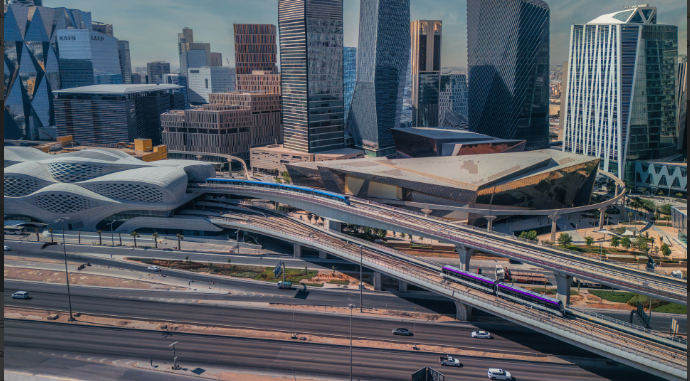
The King Abdullah Financial District project is considered a major economic hub and the largest financial complex in the region. 71% of the project’s construction has been completed; the project, which began seven years ago, covers an area of 1.6 million square meters north of Riyadh, making it the largest financial complex in the Middle East, comparable to its global counterparts, foremost among them the “London Canary Wharf Financial Center,” which was built on an area of 345,000 square meters.
Economic Complex
The center is designed as an integrated economic system comprising 127 investment towers, including a 385-meter-tall tower serving as the headquarters of the Capital Market Authority and a stock exchange building. The King Abdullah Financial District works through the establishment of the “Financial Academy” to meet local and global demand for qualified professionals in the fields of finance and modern investment management, It also aims to train Saudi university graduates, as well as graduates of the Custodian of the Two Holy Mosques Scholarship Program—who are Saudi nationals specializing in management, economics, and finance programs at the world’s most prestigious universities.
The Center, estimated to cost 28 billion riyals, is considered a powerful boost to the national economy, as it is designed to be a specialized hub where major global financial firms converge in a cultural project that incorporates the latest advancements in modern architecture and design, making Riyadh a focal point for real estate investors.
The information and communications technology systems at the King Abdullah Financial Center are based on next-generation (NGN), and utilize Internet protocols. All of the center’s technical services operate via unified networks and highly precise, intelligent systems, which are managed and controlled from high-security information control centers.
The Center’s Networks
We are currently implementing the first phase, in which the center features a number of attractions and recreational areas carefully and skillfully designed to serve as a respite and a recreational and educational hub for the complex’s residents and visitors; such as Al-Wadi Park, the Water Museum, the Conference Center, the Built Environment Museum, the Earth Climate Center, the Science Museum, the Wellness and Recreation Club, the Interactive Children’s Museum, and other educational and recreational facilities.
The center’s services also include dedicated networks for drinking water, fire protection (21,000 meters), irrigation (17,000 meters), and sewage (11,000 meters), as well as a 15,600-meter stormwater drainage network, 25,000 meters of cooling pipes, and 12,600 meters of automated waste management system pipes.
The project includes a network of electrical works comprising a medium-voltage network 116,000 meters long, a street lighting network 18,800 meters long, and a monorail running on a circular track around the project with a total length of 3.6 kilometers, passing through six stations located within the attraction complexes. It consists of six trains, each comprising two cars with a capacity of 172 passengers per car, transporting 3,000 passengers per hour.
The Center’s Towers
The project also includes a number of pedestrian bridges totaling 11,400 meters in length to connect the towers, allowing all users to move between them, as well as two central cooling stations with a capacity of 100,000 metric tons, which are among the largest cooling plants in the world, along with the creation of walking paths and parks—known as “Al-Wadi”—covering an area of 67,500 square meters.
The King Abdullah Financial District project continues to set new standards of excellence, as waste is collected via an automatic vacuum system with a capacity of 145 metric tons per day, and recycled using one of the most advanced and modern waste disposal systems currently in use. Additionally, four substations have been built to supply the center with 480 megawatts of electricity and provide services to the project, such as “the National Water Company, the Saudi Electricity Company, and telecommunications companies.”
The center features an estimated 1,660,000 square meters of office space, 153,000 square meters of hotel space, 310,000 square meters for commercial use, and approximately 240,000 square meters for investment attractions.