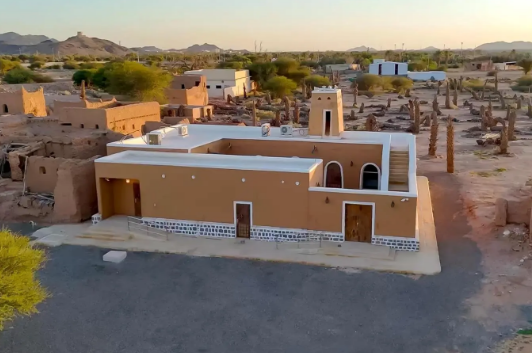

The “Shaar” Castle is one of the most prominent historical landmarks in the Asir region, and an architectural landmark that embodies the ancient mountain building arts and methods of choosing defensive sites in the southern highlands of the Kingdom.
The castle is located in an area known as “Bahat Shaar”, about 33 kilometers north of the city of Abha, near the intersection of latitude (18/26) north and longitude (42/27) east, and it was built on a semi-flat area that rises between (2400 and 2800) meters above sea level.

The castle overlooks the “Tih” valley from its western side, and is surrounded from the eastern, northeastern and southeastern sides by a series of hills and branching valleys, which gives the site a unique natural character and highlights the accuracy of choosing its location as a point of observation and monitoring that extends over wide distances of mountains and plains.
In his book “Abha.. The Capital of Asir,” published in 2009, researcher Dr. Ghaithan bin Jaris suggests that the construction of the fortress went through several historical stages that began in the late thirteenth century AH, and continued with fortification and expansion works until the early fourteenth century AH, to become one of the most important fortresses of a military and defensive nature, as it controlled the routes of passers-by through the Shaar Pass - formerly known as “Tih Pass” - and secured the communication routes between the Sarawat Mountains and Tihama.

The castle consists of a group of adjacent stone buildings arranged according to an architectural design that takes into account the mountain's topography. It includes watchtowers and spacious courtyards that were used for training, as well as interior rooms with narrow windows for observation and defense. Its walls were constructed from local stone mixed with lime clay, giving it exceptional durability that enabled it to withstand the test of time for many decades.
Despite the effects of erosion and time, Shaar Castle still retains its historical splendor and architectural grandeur, and constitutes a destination for history lovers and those searching for archaeological landmarks in Asir.

The Heritage Commission is currently undertaking a comprehensive project to restore and rehabilitate the Shaar Castle archaeological site in the Asir region. The project aims to preserve its historical and architectural value and highlight its role in the region's local history. It includes meticulous restoration work on damaged sections of the castle's buildings and stone towers, rehabilitation of internal corridors, courtyards, and access paths, and improvements to infrastructure and services in accordance with standards for the preservation of archaeological sites. This will ensure the site's sustainability and its ability to welcome visitors in a manner befitting its significance.

This project represents one of the main initiatives - within the program for the care of archaeological and heritage sites that can be visited - implemented by the Heritage Authority to prepare sites of historical value to receive visitors, and to develop them in ways that respect authenticity and keep pace with the requirements of modern display.

These efforts contribute to enhancing the presence of national heritage in the cultural and tourism landscape, and supporting the sustainable development of the region in protecting, developing and highlighting heritage as one of the components of the Kingdom’s cultural identity.