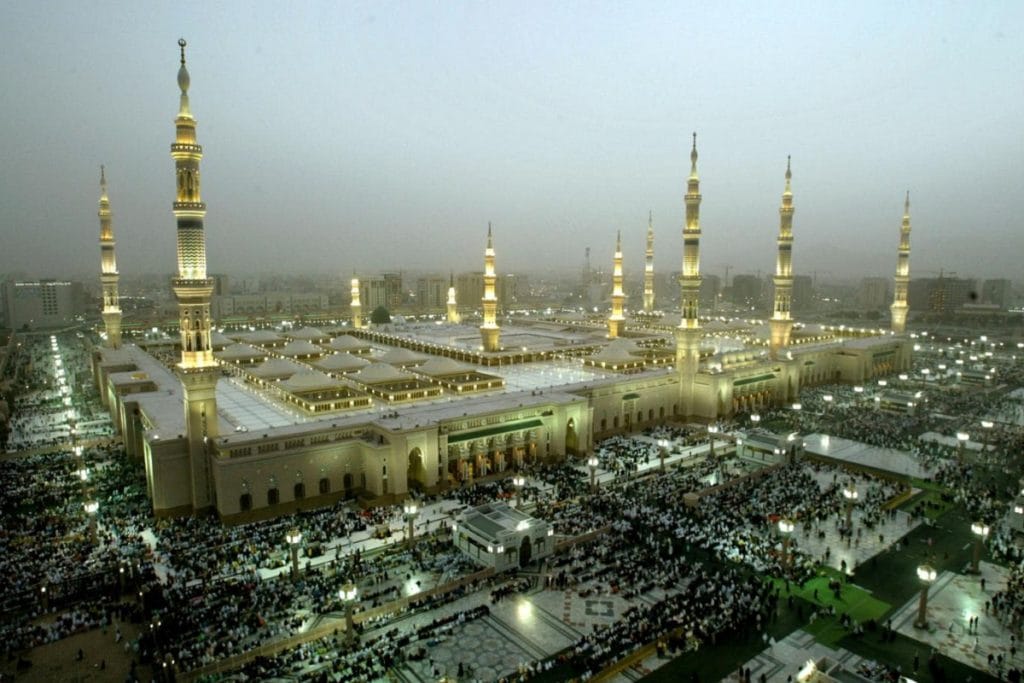

The minarets of the Prophet’s Mosque constitute one of the most prominent architectural landmarks and a distinctive feature of its visual identity throughout successive Islamic eras, as their presence is linked to the history of the expansions that the mosque has witnessed, and their designs reflect the development of Islamic architecture and its artistic richness.
The mosque during the time of the Prophet - may God bless him and grant him peace - did not have minarets in the architectural sense known today, as the call to prayer was raised from a high place inside the mosque, or from a nearby roof, before the actual construction of minarets began in the late first century AH.
The mosque witnessed the first official construction of minarets during the reign of the Umayyad Caliph Al-Walid bin Abdul-Malik, who ordered the expansion of the mosque between 88 and 91 AH, and assigned the governor of the city at that time, Omar bin Abdul-Aziz, to implement it, as four minarets were built in the corners of the mosque, which are considered among the first minarets in Islamic architecture, and their height at that time reached about 27 meters, according to what the historical sources mention.
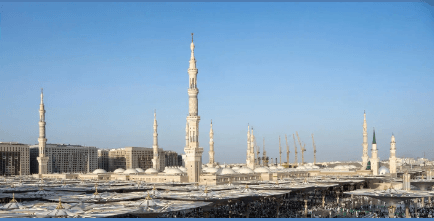
During later periods, particularly in the Mamluk and Ottoman eras, some minarets were rebuilt, and others were added in line with successive expansions. Among the most prominent is the Bab al-Salam minaret, whose name is associated with one of the most important gates of the mosque on the western side, and which has witnessed successive renovation works over the centuries.
During the Saudi era, the minarets of the Prophet’s Mosque received special attention within the modern expansion projects. In the first Saudi expansion (1370-1375 AH / 1951-1955 AD), some of the old minarets were removed, and two new minarets were built on the northern side with a height of approximately 70 meters. Then, six more minarets were added within the major Saudi expansion during the reign of King Fahd bin Abdulaziz between 1406 and 1414 AH (1985-1994 AD), bringing the total number of minarets to ten.
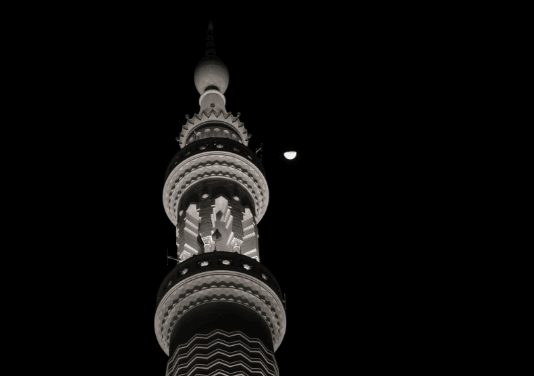
Each minaret, in its current design, is about 104 meters high and consists of five main stepped parts, including a square base, an octagonal floor, a cylindrical section, topped by the muezzin's balcony, and ending with a dome surmounted by a metal crescent. The design takes into account the classical Islamic style while employing modern technologies in construction and lighting.
The ten minarets are distributed harmoniously around the edges of the mosque, four of them on the northern side, two on the southern side, and four at the corners, thus achieving a visual and architectural balance that is appropriate to the vast area that the mosque has reached after successive expansions, and embodies the continued care given to it throughout the ages.