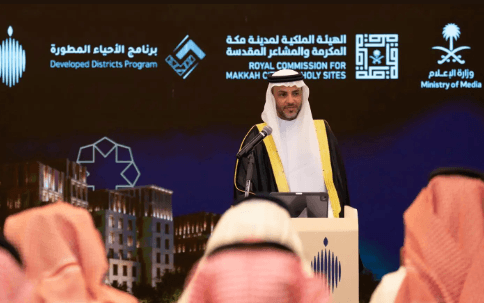
The CEO of of the Royal Commission for Makkah City and the Holy Sites, Engineer Saleh bin Ibrahim Al-Rashid, confirmed that the awarding of contracts for the development of seven sites within the second phase of the Developed Neighborhoods Program represents a pivotal milestone in the urban development journey in Makkah, and marks the launch of a new phase in the program’s implementation through development partnerships and strategic investments that contribute to enhancing quality of life, improving the urban environment, and achieving sustainable development.
This was announced yesterday during his participation in a press briefing in Makkah, where he outlined the program’s pillars and objectives and highlighted the latest developments in the second phase, which included the awarding of contracts for the development of the following sites: South Jarham, Al-Khalidiyah, Al-Hajlah, Eastern Al-Hindawiyah, Southern Al-Hindawiyah, Western Al-Hindawiyah, and Al-Zuhur, with development investments exceeding 16.3 billion riyals, through five development consortia comprising more than 10 national companies, covering an area of over 4.4 million square meters.
Improving Infrastructure and Enhancing Land Use Efficiency
Engineer Al-Rashid explained that the Developed Neighborhoods Program is one of the strategic programs led by the Royal Commission, and aims to reshape the urban environment in the targeted neighborhoods according to an integrated urban vision, focused on improving infrastructure, enhancing land-use efficiency, and enhancing the urban landscape, and attracting high-quality investments, in line with the objectives of the Kingdom’s Vision 2030, while preserving the uniqueness and status of Makkah.
He noted that these contract awards are an extension of the development process underway in Makkah Al-Mukarramah with the support of the wise leadership—may God support them— and embody the Kingdom’s commitment to the development of Makkah and to improving the services provided to its residents, visitors, and pilgrims through development projects that achieve sustainable economic and social impact.
He explained that the Royal Commission is leading development efforts in Makkah and the Holy Sites through an integrated system that combines strategic planning, project facilitation, infrastructure development, and service quality improvement, thereby contributing to the creation of a more efficient and sustainable city and enriching the experience of everyone in Makkah—residents, visitors, and pilgrims alike.
Urban Development in Makkah
He noted that the Developed Neighborhoods Program represents one of the most prominent urban development initiatives in Makkah, as it is based on two complementary pillars: a human-centered pillar focused on improving quality of life and enhancing transparency, and an urban development pillar concerned with reshaping the urban environment, increasing land-use efficiency, and strengthening urban identity—all of which support sustainable development and keep pace with the city’s future growth.
The CEO emphasized that the awarding of the seven sites strengthens the partnership with the private sector, opens up broader investment opportunities, contributes to stimulating economic activity, and enables national developers to participate in development, thereby creating new business and job opportunities, strengthens the local economy, and delivers a direct developmental impact for the residents of Makkah Al-Mukarramah. He emphasized that these awards represent a practical transition from the planning phase to implementation, and usher in a new phase in the Neighborhood Development Program, thereby contributing to the construction of higher-quality neighborhoods and a more sustainable urban environment that enhances Makkah’s standing and meets the aspirations of future generations, while preserving its unique character and status.

Covering an area of more than 4.4 million square meters, the development of seven sites marks a new phase in the Makkah Neighborhood Development Program
Investments totaling more than 16.3 billion riyals to develop seven neighborhoods in Mecca through five national consortia, with the aim of promoting sustainable urban development.