
The Saudi Road Code contributes to achieving the strategy of the General Authority for Roads, which aims to build a unified legislative and regulatory system for the roads sector in the Kingdom, by unifying technical and operational standards at the Kingdom level, enabling road owners to raise the quality of their work systematically and sustainably, through comprehensive standards that cover the road lifecycle in all its stages, from design and construction to operation and continuous maintenance, within a unified regulatory framework that achieves the highest levels of efficiency and safety.
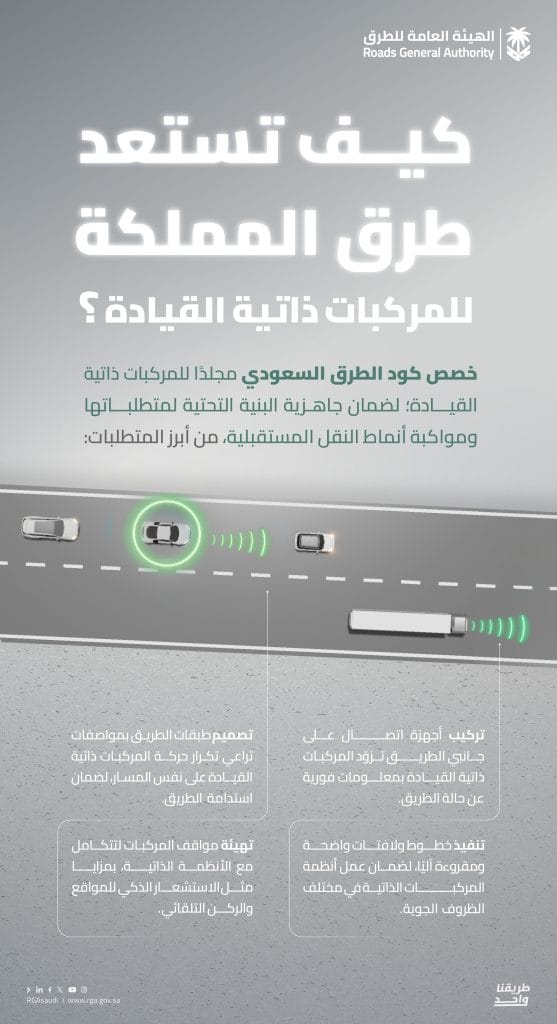
The General Authority for Roads explained that the road code enhances the readiness of the infrastructure for self-driving vehicles through technical requirements that contribute to keeping pace with future transportation patterns and ensuring the efficient operation of smart systems in various conditions. It indicated that these requirements include the installation of communication devices on both sides of the road to provide self-driving vehicles with immediate information about their condition, which enhances their ability to respond to surrounding changes and supports the safety of mobility.
The authority stated that the requirements also include designing road layers according to specifications that take into account the development of self-driving vehicle traffic on the same route, ensuring the sustainability of roads and their ability to accommodate modern technologies, in addition to implementing clear and machine-readable traffic lines and signs to ensure the efficient operation of self-driving systems in various weather conditions.
The authority explained that the road code takes into account vehicle parking to be integrated with autonomous systems, through features that include smart location sensing and automatic parking, which supports the development of a smarter road system that is ready for future transformations in the transport sector, and raises the levels of safety and operational efficiency on the Kingdom’s roads.
She pointed out that the code represents a comprehensive technical reference for all entities responsible for the roads sector in the Kingdom, from ministries and city development authorities to regional secretariats and municipalities of cities and governorates, as it enables them to access the information, guidelines, technical drawings, procedures and checklists necessary for planning, designing, implementing, operating and maintaining roads of all types, taking into account environmental requirements and safety requirements, in order to reach the minimum acceptable standards of quality, safety, security, economic efficiency and sustainability.
The Authority affirmed its commitment to providing a unified and transparent legislative and regulatory system that ensures policy integration and regulatory compliance, through the application of flexible and robust oversight mechanisms that guarantee compliance with regulations and legislation, based on its assigned tasks of supervising and regulating the roads sector, through the development of necessary policies and legislation, including the launch of the Saudi Roads Code. It noted its continued expansion in the application of modern technical standards with the aim of improving the experience of road users, and ensuring the achievement of the highest levels of safety, efficiency and sustainability, in order to achieve the objectives of the Roads Sector Program.