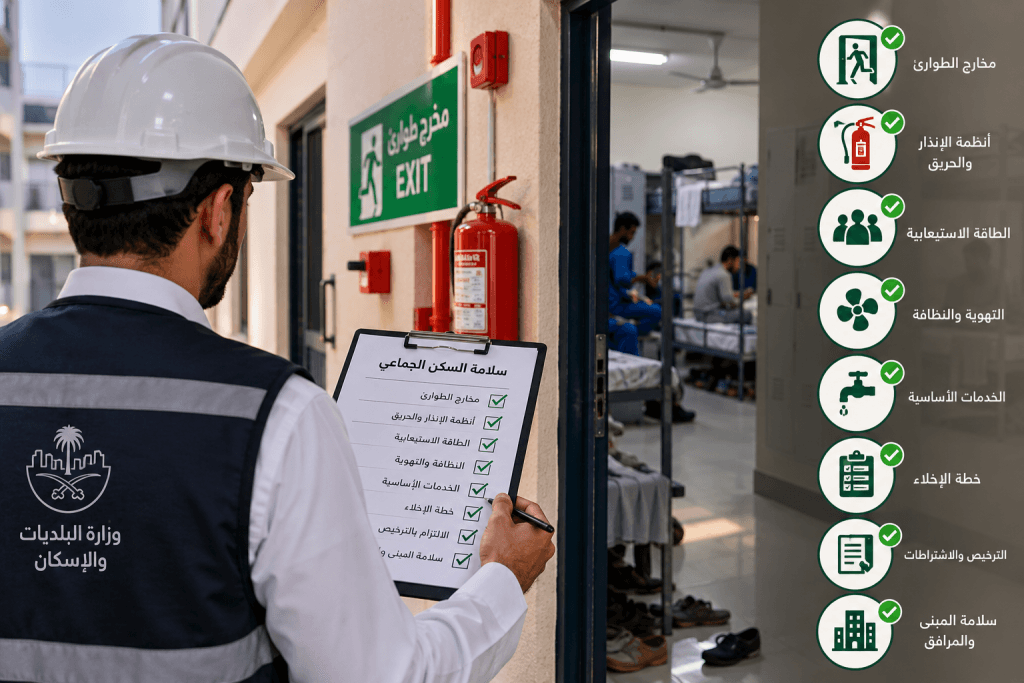

The Ministry of Municipalities and Housing has reaffirmed the importance of the safety of collective housing for individuals, stressing that compliance with health and technical requirements and fire prevention requirements is a cornerstone for protecting lives and property and raising the readiness of facilities to deal with emergencies.
In a statement released yesterday, the ministry stressed the need to keep emergency exits and evacuation routes clear of obstructions, ensure the efficiency of fire alarm and protection systems, adhere to approved capacity limits, provide clear evacuation plans, and train residents on emergency procedures.
These guidelines put the responsibilities of owners and operators to a practical test that goes beyond providing places to live, as the safety of housing is linked to the safety of the building and its equipment, the way it is managed, and the ability of residents to act correctly in the event of an accident.
Emergency exits: details that can make all the difference in times of danger
The ministry placed the readiness of evacuation routes among the essential elements for the safety of collective housing, noting the importance of providing clear and illuminated directional signs, emergency lighting that works when the electricity is cut off, and doors that are easy to open towards the exit.
The requirements also include not using corridors and emergency exits for storage, ensuring the efficiency of fire alarm and protection systems, and providing approved guidance plans and evacuation plans in clear locations within the facility.
The importance of these facilities is not limited to their presence during inspection, but is related to their ability to function when needed. An exit blocked by objects, faulty backup lighting, or an alarm system that has not been maintained may limit the residents' ability to respond quickly during emergencies.
What are the owner's responsibilities? Building and equipment safety
The safety review begins with the property itself, its conformity to its intended use and compliance with relevant licenses and requirements. The owner, according to his role and the obligations applicable to the facility, must monitor the safety of the building, facilities and equipment, and address deficiencies that may threaten the residents.
The checklist includes: verifying the validity of the license and compliance with the regulatory requirements for communal housing, ensuring the suitability of the building and its facilities for their intended use, reviewing the readiness of emergency exits and evacuation routes, ensuring the efficiency of fire alarm and protection systems, carrying out required maintenance, and addressing malfunctions that affect the safety of residents or the readiness of facilities.
The Ministry of Municipalities and Housing provides a service for issuing group housing licenses to individuals through approved channels, linking the license to meeting health, technical and safety requirements and standards.
What does the operator need to do? From licensing to daily operation
If the owner is responsible for aspects related to the property and its equipment according to his regulatory and contractual obligations, then daily operation requires continuous monitoring that cannot be reduced to obtaining a license. The operational priorities are to keep corridors and exits free of obstacles, to follow up on malfunctions, to ensure that emergency instructions are clear, to update the facility's capacity data, and not to exceed the approved number of residents.
The ministry stressed the importance of preparing approved evacuation plans, placing guidelines and emergency manuals in clear locations, conducting periodic drills that simulate emergency situations, and training residents on the correct use of firefighting equipment.
These guidelines mean that housing readiness is not measured by the number of fire extinguishers or the presence of a sign, but by the existence of operational procedures that ensure the safety of the equipment, the residents’ knowledge of the exit routes, and their ability to deal with the danger without confusion.
Capacity... why can't it be ignored?
Adherence to the approved capacity is one of the points emphasized by the Ministry, and its importance is highlighted by the fact that increasing the number of residents beyond the approved limit may affect the efficiency of facilities and services, and increase the difficulty of organizing evacuation in emergency situations.
Therefore, the population should not be determined based on a personal estimate of the area or number of rooms, but rather by referring to the approved capacity of the facility and the licensing requirements applied to it. The ministry also stressed the importance of continuously updating capacity data.
Establishments that change the number of residents or the way facilities are used need to verify that their actual situation continues to comply with the relevant requirements, rather than assuming that the initial license covers any subsequent change.
Hygiene, ventilation, and basic services: the other side of safety.
The safety of collective housing is not limited to fire prevention, as health and technical requirements also include the components of a suitable residential environment, such as ventilation, cleanliness and the availability of basic services, in addition to site, design and implementation requirements.
The ministry had explained when launching the updated version of the health, technical and safety requirements guide that the guide addresses three main tracks: health requirements, technical requirements, and safety and risk protection standards.
For the owner and operator, treating these elements as a single system helps to detect shortcomings early, whether they relate to the cleanliness of the facilities, ventilation, the safety of the equipment, or the ease of evacuation.
Practical guide: 8 points to check in shared accommodation
Prior to moving in or when reviewing the accommodation status, the following list can be used as a preliminary check, with reference to official requirements to determine the exact requirements of each facility:
- Licensing: Is the accommodation licensed and compliant with regulatory requirements?
- Capacity: Does the number of residents match the approved number?
- Emergency exits: Are they clear, easily accessible, and free of obstructions?
- Exit doors: Can they be easily opened from the inside towards the exit?
- Fire alarm and protection: Are the equipment available, functional, and have they undergone the required maintenance?
- Emergency lighting and directions: Are there backup lights and clear signs indicating evacuation routes?
- Emergency plan: Are there clear plans and guidelines, and do residents know what to do in the event of an accident?
- Hygiene and ventilation: Are the sanitary facilities, basic services, and ventilation suitable for actual use?
This list does not replace official inspection, safety certification, or licensing requirements, but it helps to detect indicators that warrant attention or inquiry from the relevant authority.
How do you report violations?
If residents or those in the vicinity of the residence notice practices that may threaten safety, such as blocked emergency exits, overcrowding, or violations in the facilities, they can use the official municipal reporting channels.
The Ministry of Municipalities and Housing explained that reports received through the “Baladi” platform or the unified number 940 contribute to monitoring and addressing violations of collective housing, and support monitoring and follow-up work.
When reporting, it is advisable to specify the location of the residence and accurately describe the observation, and to attach any available information that helps identify the violation, without endangering the reporter or others.
Who bears the responsibility when a defect is discovered?
Liability cannot be determined in every case simply by labeling someone as an owner or operator, as it depends on the nature of the violation, the obligations of each party, and the applicable licenses, contracts, and regulations. However, in practice, a defect should not be left unaddressed, nor should it be assumed that having a license exempts one from ensuring safety.
The owner needs to check the safety of the building and equipment under his responsibility, the operator needs to ensure the safety of daily practices and continued compliance with requirements, while residents should be aware of emergency exits and report any hazards they observe.
Read also:
Will the property arrive as advertised? Amlak monitors the risk points from contract to handover.
Before paying the deposit: 5 steps to protect property buyers from fake advertisements
15 minutes free and 4 occasions free of charge: Draft of new regulations for paid parking