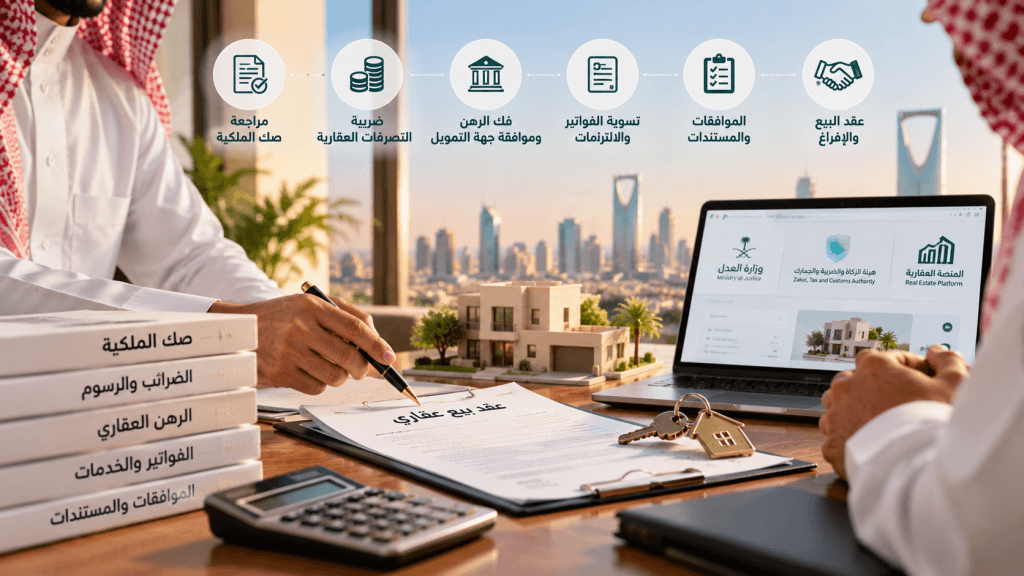

The property owner's responsibilities don't end once the buyer agrees on a price and signs the sales contract. Completing the transfer of ownership requires a series of legal and financial procedures that vary depending on the property's condition and the nature of the transaction. Failure to prepare the necessary documents or address any encumbrances on the property can delay the transfer, even after all commercial details have been agreed upon by both parties.
In the Saudi real estate market, the most prominent files that the seller should review before the date set for transferring ownership are the real estate transaction tax, registered mortgages, the validity of the title deed, and the completeness of the data of the parties to the transaction, in addition to settling the financial obligations related to the property according to existing contracts and agreements.
First: Real estate transaction tax... verification before transfer
The real estate transaction tax is one of the most important requirements that must be dealt with before completing the sale of the property. The basic tax rate is 5% of the value of the real estate transaction subject to it, according to the applicable system, taking into account the exceptions and special provisions that may apply to some transactions.
The transaction must be registered through the Zakat, Tax and Customs Authority portal, entering the property data, the parties to the transaction and the sale value, then verifying whether the transaction is subject to tax or exempt from it. If tax is due, the payment procedures must be completed according to the Authority’s requirements before completing the transfer or documenting the contract. If the transaction is exempt, the registration procedure must be completed and proof of the exemption must be submitted when needed.
The Authority explains that the tax obligation falls on the disposer, i.e. the seller in the case of a sale, even if the two parties agree that the buyer will pay the tax amount. Therefore, a distinction should be made between the regulatory responsibility before the Authority and the private financial agreement between the seller and the buyer.
The seller can view the details and make the registration through the Real Estate Transactions Registration Service , and review the Real Estate Transactions Tax System to check the provisions and exceptions relevant to the transaction.
Second: Mortgaged property... approval from the financing entity before transferring ownership
If the property is encumbered by a mortgage in favor of a bank or financing entity, the seller should not assume that the transfer can be completed in the same manner as for an unmortgaged property.
The Ministry of Justice clarifies that releasing a mortgaged property requires the mortgagee's consent, in addition to the standard release requirements. Accordingly, the seller must consult with the lender to determine the remaining balance, the procedures required to address the mortgage, and whether the transaction will proceed after the obligation is settled and the mortgage released, or according to another arrangement approved by the lender.
It is best to start this step early, especially if the completion of the sale depends on using part of the deal value to pay off existing financing, as the process may require coordination between the seller, the buyer and the financing entity before setting the final date for the transfer. The requirements for transferring the property can be reviewed with the Ministry of Justice to find out the documents required in the case of a mortgaged property.
Third: Title deed and property details
Before completing the sale, the seller should review the electronic title deed and ensure that its data matches the property in question, including the owner's identity, property description, and relevant registered data. This review is especially important in cases involving an inherited property, joint ownership between several people, a property where part of it is to be sold, or a property with rights or restrictions that require additional processing or approvals.
The requirements published by the Ministry of Justice include the presence of the contracting parties with their identities or the presence of their representatives with an official document, and the provision of the electronic title deed and the registered payment method. If the sale includes a part of the property, the subdivision document may be required. The transfer of agricultural property also requires the approval of the Agricultural Development Fund in cases to which these requirements apply.
Therefore, it is advisable not to wait until the day of vacating to discover a lack of documents or a discrepancy in data, but rather to review them in advance and check the requirements specific to the property and the transaction.
Fourth: Utilities, bills, and contractual obligations
In practice, the seller should review the bills and obligations associated with the property, including electricity and water services, property management or owners' association fees if applicable, and any other dues arising under existing contracts.
The existence of an invoice or financial obligation does not necessarily mean that it prevents the transfer of ownership in all cases, because that depends on the nature of the obligation, the party entitled to it, the contract regulating it, and whether there is a restriction or condition that affects the transfer of ownership.
Therefore, it is best to prepare a clear statement of outstanding obligations, specifying what the seller will pay and what the buyer will bear according to a written agreement, while documenting meter readings and the date of transfer of use of the property upon delivery, to reduce disputes related to periods before and after the sale.
If the property is rented, the buyer should also be informed of the lease status, the lease term, and the associated obligations and rights, and the property should not be presented as free of occupants or obligations if it is not.
Fifth: A written agreement on price, payments, and delivery date
Even when all regulatory requirements are met, disputes may arise due to ambiguity in the financial agreement or the delivery schedule. Therefore, the sales contract or notarized agreement should clearly state the transaction value, the payment method, the agreed-upon dates, the responsibilities related to fees and obligations, and the agreed-upon terms for property delivery.
It is also advisable to verify the approved payment method before the scheduled handover date and ensure that all parties to the transaction, or their representatives, are prepared to attend and complete the process. If the property is jointly owned, it is essential to ensure that all necessary representation and approvals are in place, depending on the ownership structure.
It is not advisable to rely solely on verbal agreements, especially with regard to the distribution of financial obligations, mortgage handling, or setting a delivery date, as clear writing helps to reduce the chances of dispute after the transfer of ownership.
Seller checklist before completing the sale
Before setting a deadline for vacating the premises, the seller can review the following list:
- Verify the title deed and property details.
- Registering the real estate transaction with the Zakat, Tax and Customs Authority.
- Checking eligibility for real estate transaction tax or the applicability of a regulatory exemption.
- Prepare the payment or tax exemption requirements according to the status of the transaction.
- Review the mortgage and obtain approval from the mortgagee when necessary.
- Complete the retail documentation or additional approvals if required.
- Reviewing invoices, fees, and contractual obligations related to the property.
- The agreement should include a written statement regarding payments, delivery dates, and financial responsibilities.
- Ensure that the identities of the parties or official agencies and the approved payment method are ready.
Read also:
I bought a property in Saudi Arabia... How do I transfer the electricity meter to my name?
Want to convert an apartment into an office or business? 7 things to check before you begin
Will the property arrive as advertised? Amlak monitors the risk points from contract to handover.