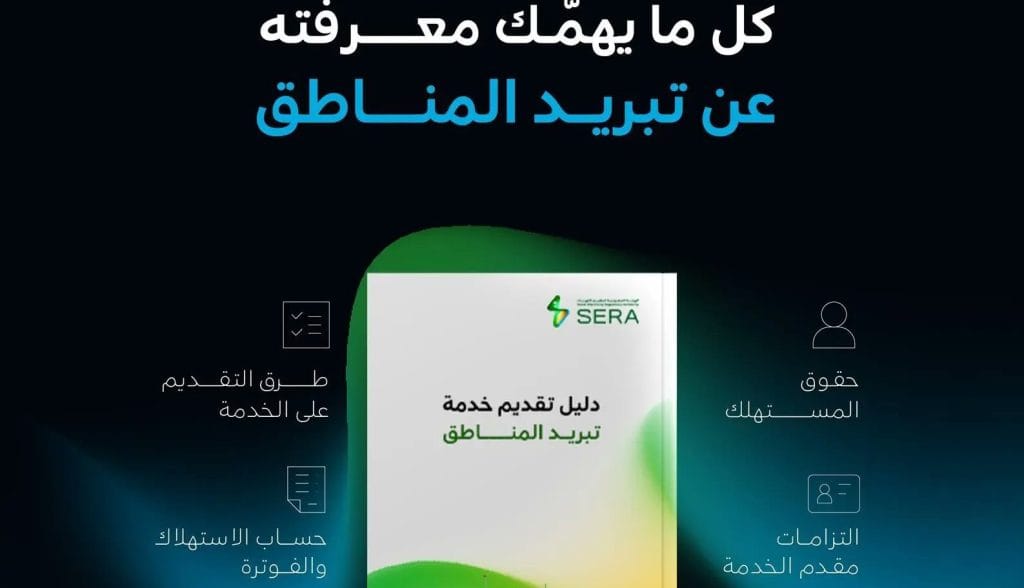

The Saudi Electricity Regulatory Authority (SERA) has issued the “District Cooling Service Provision Guide” with the aim of regulating the relationship between beneficiaries and service providers, clarifying the roles and obligations of both parties, defining their duties, protecting their rights, raising the quality and reliability of the service, and enhancing clarity and transparency.
District cooling relies on producing cooling energy in dedicated central stations, and transferring this energy, via chilled water, through an insulated pipe network, to the buildings and associated facilities, for use in air conditioning and cooling systems for indoor spaces.
Terms and conditions for providing district cooling services
The guide includes detailed provisions and controls that regulate the provision of district cooling services in its various stages, most notably; controls for delivering and activating the service, and providing the service applicant with the delivery and consumption agreements.
Regarding reliability and capacity, the guidelines stipulate verifying sufficient cooling capacity before accepting any new connection request, to ensure that the service provided to existing customers or the system's efficiency is not negatively impacted. The guidelines also outline the procedures for meter installation, the rules for calculating actual cooling energy consumption, and clear billing mechanisms.
The guide established controls and procedures for disconnecting, restoring, or suspending the service. The guide also obligated service providers to provide appropriate channels for receiving complaints and to protect the privacy and confidentiality of consumer data.
The Authority called on all those interested in the “district cooling” activity to review the “District Cooling Service Provision Guide” published on its official website (sera.gov.sa).
The Saudi Electricity Regulatory Authority also announced the issuance of the updated version of the Renewable Energy Regulation for Self-Consumption, in order to improve installation, connection and operation procedures, and to clarify the requirements for consumers, thereby enhancing safety and efficiency and preserving their rights.
The update aims to regulate electricity generation systems from renewable energy sources to meet the needs of homes and various facilities for self-consumption, and their operation and maintenance requirements. It also clarifies consumer rights and the mechanism for implementing net billing, ensuring transparency of requirements and the safety and reliability of the electricity service.
Electricity generation technologies
The regulation includes several technologies for generating electricity, including solar energy, wind energy, biofuels, and energy resulting from waste treatment, in addition to energy storage systems. The regulation also applies to systems connected to the electricity grid and those isolated from it.
The updated version comes three years after the regulatory framework was issued in 2023. The most prominent updates included unifying the “Regulatory Framework for Renewable Energy for Self-Consumption” with the “Regulatory Framework for Small Photovoltaic Solar Energy Systems” within one comprehensive document, in addition to raising the maximum capacity of the generation systems covered by the framework to 50 megawatts.
Read also:
I bought a property in Saudi Arabia... How do I transfer the electricity meter to my name?
Air conditioning installation: How to avoid mistakes that increase your electricity bill?