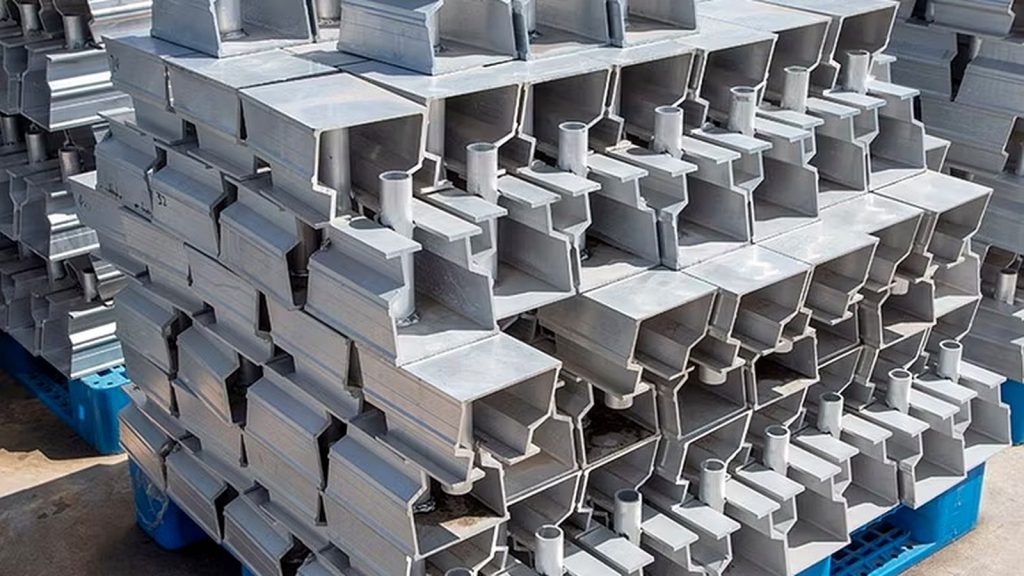

Some building materials have recorded unprecedented price levels, in an indicator that opens the door to a broader reading of construction costs and the impact of material fluctuations on the budgets of residential and commercial projects. Among these materials is “Saudi aluminum side frame” with a length of 5.8 meters, which recorded its highest historical price at 105.12 riyals, according to data from the Construction Goods Platform of the Saudi Contractors Authority, at a price peak that exceeds by many times the lowest level recorded since monitoring began in 2009, and puts the product in front of a long path of price transformations over 17 years.
According to the data, the price rose from a record low of 26.54 riyals to 105.12 riyals, a difference of 78.58 riyals, and with a cumulative growth of approximately 296.1%, reflecting a significant change in the product's price value compared to the beginnings of the monitoring series.
From levels of 26 riyals to exceeding 100 riyals
Reading the historical trajectory of prices reveals remarkable shifts that were not at a consistent pace, as the product witnessed a sharp jump at the beginning of 2010, when prices moved from levels below 30 riyals to nearly 60 riyals, in an early shift that reshaped the price level of the product.
After that jump, prices moved into a phase of relative stability that lasted for years, recording 63.47 riyals in November 2017, before gradually resuming their upward trajectory to reach the recent historical peak. This highlights the importance of reading building material prices across long time series, rather than simply comparing prices from one month to the next.
Averages and medians reveal the nature of the price trend.
Statistical indicators indicate that the average price of “Saudi side ring aluminum” during the monitoring period reached 70.15 riyals, while the median recorded 66.64 riyals. These indicators reflect the price levels that the product has gone through during the past years, and help to place the current peak within a broader historical context.
The difference between the mean and the median is important when reading data, as the median allows understanding the central level of the price distribution away from the influence of some high or low values, while the arithmetic mean reflects the sum of the readings distributed over their number, making the comparison between the two indicators a useful tool for understanding the extent of the impact of large price movements in the time series.
What does the leap mean for contractors, developers and property owners?
The recorded price peak does not necessarily mean a similar increase in the overall construction cost, as aluminum remains a cost element whose contribution varies according to the type of project, design specifications, window and facade area, volume of metalwork, and the nature of the contract with suppliers and manufacturers.
However, the continued rise in prices of some construction products places greater importance on cost management in projects, especially for contractors who rely on long-term contracts, or projects where the stages of supplying materials are delayed, which may make the prices at the time of implementation different from the initial estimates when contracting.
This path also highlights the importance of preparing construction budgets based on up-to-date price data, conducting periodic reviews of material costs, comparing supplier offers, and identifying mechanisms for dealing with price changes in contracts, especially in residential projects with multiple stages of implementation and supply.
The construction goods platform: a tool for reading the market, not just prices.
The Saudi Contractors Authority’s platform for monitoring construction commodity prices provides periodic data on 11 essential commodities in the construction sector, including aluminum, iron, cement, ready-mix concrete, blocks, tiles, gypsum, wood, sand, wires, and cables.
This data is of greater importance than simply tracking the direct price of the product, because it allows contractors, developers, and market stakeholders to build time comparisons, monitor price trends, and improve cost estimates, thereby enhancing market transparency and providing a reference when planning projects or assessing changes in implementation costs.
Read also:
Construction and demolition waste management: Solutions to reduce real estate project costs