
The customer buys the product at cost and does not bear the cost of accessing it.
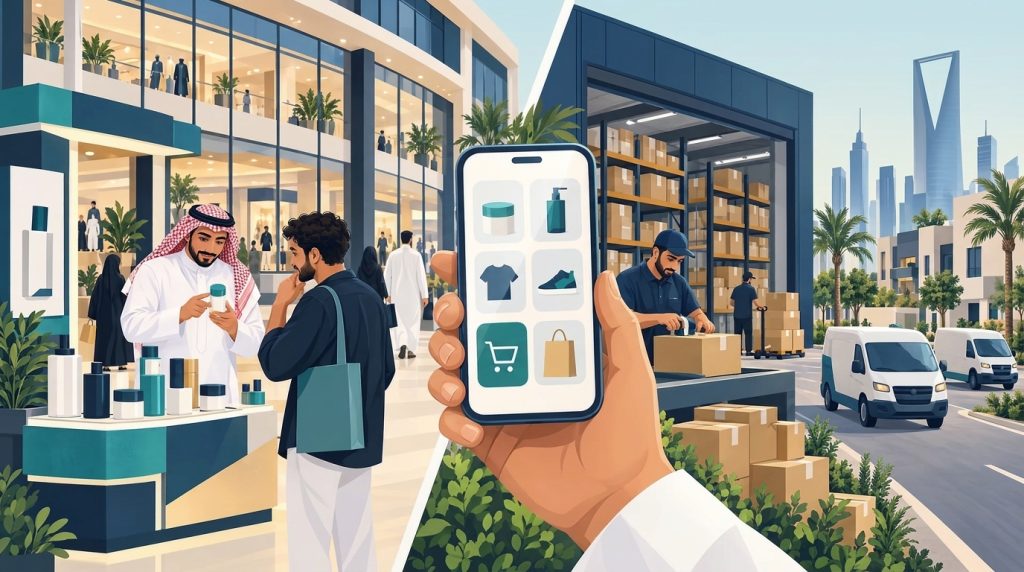
Opening a physical store used to be an almost instinctive step in building a consumer brand. Today, a brand owner can test their product and reach a wide audience without starting with a network of branches. A brand that grows digitally doesn't necessarily need more physical stores, but it does need a system that delivers the product and earns customer trust.
E-commerce payments using Mada cards reached approximately SAR 325.2 billion in 2025, a 64.71 TP3T increase compared to 2024, and then SAR 111.9 billion in the third quarter of 2026, an increase of 26.71 TP3T compared to the same quarter of the previous year. These are Mada data points and do not represent the total market or consumer goods sales alone. The number of active e-commerce records reached 52,259 by the end of the same quarter; this indicates the expansion of activity, not necessarily the number of profitable stores.
Specialization before branch network
Qovi, Hawa, Asila, Oli, and Ashkal all showcase the power of specialization and relatable messaging. Qovi focuses on the strength and softness of tissues, while Hawa addresses the problem of boxer shorts and chafing during movement. Asila presents deodorant with a care message that tackles the root cause of odor, and Oli condenses a hair styling routine into a product that combines the functions of three different products. Ashkal links socks to foot odor and nano-silver technology. These are marketing promises, not the results of medical tests or independent comparisons.
The key advantages are frequent use, clear problem-solving, and easy value explanation, but these don't translate to rapid product consumption or consistent purchase frequency. Specialized messaging is suitable for short, persuasive content that leads to a purchase, allowing smaller brands to compete on a specific problem without building a distribution network like larger corporations.
However, the Saudi label does not prove the country of manufacture. Asilah and Oli advertise Saudi manufacturing without providing sufficient details for independent verification of the factory, and sources do not confirm the current country of production for Qawfi, Hawa, and Ashkal. Building a local brand requires specification, quality control, and a consistent supply; the selling price alone is insufficient to determine manufacturing costs or profit margins.
Customer cost and inventory function
In a promotional video on TikTok, Asila stated that the marketing cost to acquire a customer is 70 riyals, before shipping, packaging, and manufacturing, and used this to justify the high price. This is a marketing statement, not an audited financial disclosure. A brand might forgo store rent, but it cannot forgo the cost of reaching the buyer, preparing the order, and delivering it; this is a comparison of cost functions, not an accounting equivalence between rent and advertising.
Explaining the price is not justifying it; the customer buys the value of the product, not the cost of the campaign. Sustainability requires a contribution from demand after its costs and the ability to repurchase funds to cover expenses. It is not appropriate to automatically pass on the cost of customer acquisition to each subsequent purchase. We do not have sufficient data to judge genuine sustainability.
Similarly, outsourcing storage and order fulfillment to a third-party logistics (3PL) operator keeps inventory in the operator's possession. In dropshipping, the store doesn't maintain pre-order inventory and ships directly to the supplier upon order placement; thus, the logistical requirements don't disappear, but rather shift some of them. This differs from outsourcing manufacturing and then storing batches under the brand name.
Ollie says her orders are shipped from a warehouse in Riyadh, without providing proof of ownership or self-operation. Sources don't confirm dropshipping for any of the five brands, nor do they confirm the existence of branches for each. The lesson is that a branch network is not a prerequisite for digital growth.
The mall: The value of experience and an alternative to negotiation
The leasing manager's question shifts to: What value does the branch add to the brand? The digital sales channel offers a negotiating alternative, allowing for a pop-up store or trial location to be tested before a large, long-term commitment. It may put pressure on spaces that offer only shelving, but it doesn't prove that rents will decrease across all malls.
According to Knight Frank, average rents for regional and extra-regional malls in Riyadh rose by 1.21 TP3T annually in the first half of 2026, with retail occupancy in the city reaching 911 TP3T. In Jeddah, rents for the same category fell by approximately 21 TP3T, while occupancy rose to 881 TP3T. These are indicators of variation, not a measure of the impact of the aforementioned brands. The response should be to provide spaces and rental formulas that are suitable for testing and experimentation, and a clear reason to visit, not to offer rent reductions for everyone.
Warehouses and shipping companies: Request for a different job
The demand for multiple brands may converge with a single operator, making order fulfillment, sorting, and distribution companies the primary tenants of the logistics property. CBRE links the demand for high-quality warehousing to the expansion of e-commerce, among other factors, and East Riyadh recorded year-on-year rent growth of 19.91 TP3T in Q2 2026; this is a sub-market performance, not the national average, and has no impact on the five market conditions.
Orders don't automatically translate into equivalent rental space; storage density, inventory turnover, and operational efficiency all influence demand. If dropshipping originates from a supplier outside the Kingdom, transportation, sorting, and delivery activities may increase without requiring a corresponding local inventory. Therefore, logistics developers consider not only sales volume but also the nature of the goods and the dynamics of demand.
The Public Transport Authority announced the delivery of over 54 million shipments and parcels in the third quarter of 2026, not all of which were e-commerce. Accuracy in execution, delivery, and returns are integral to the brand experience. For a brand that has invested heavily in customer acquisition, a poor delivery experience can jeopardize the value of that investment.
E-commerce doesn't eliminate real estate; it changes who rents it, for what purpose, and when. A brand might postpone needing a physical store, while using space with an operator and purchasing a delivery service, then return to the mall when it adds value to the experience and growth.

Read also by the author:
The final mile in business development: cost savings or loss of value?
The 15-minute city in Saudi Arabia: Is the "live, work, and play" equation sufficient?
Is a real estate appraisal sufficient to raise the rent for an office or shop in Riyadh?