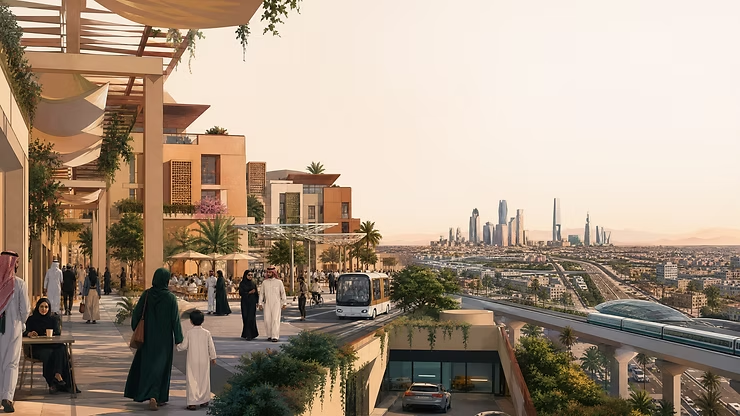
There is a recurring promise in the offerings of many new residential destinations: live here, work here, play here, and you won’t need to leave your daily range. The idea seems logical; the closer housing is to the office, services, and entertainment, the less time is wasted on the commute and the better the quality of life. But the question I’ve learned from my real-estate rental experience is that spatial proximity does not automatically equate to an economic decision.
The company is not moving to a new location because the plan is beautiful, nor because an advisory report described the environment as “integrated.” The institutional decision is more complex: Where will employees live? How will customers arrive? What space is needed today and three years from now? How many parking spaces does the company need? What are the costs of rent and equipment? Is the address appropriate for its reputation? Will the move increase or weaken its ability to attract talent?
Therefore, I do not see the question as being: Will the 15-minute city succeed? But rather: When will it succeed, for whom, and under what conditions?
The idea didn't start from number 15.
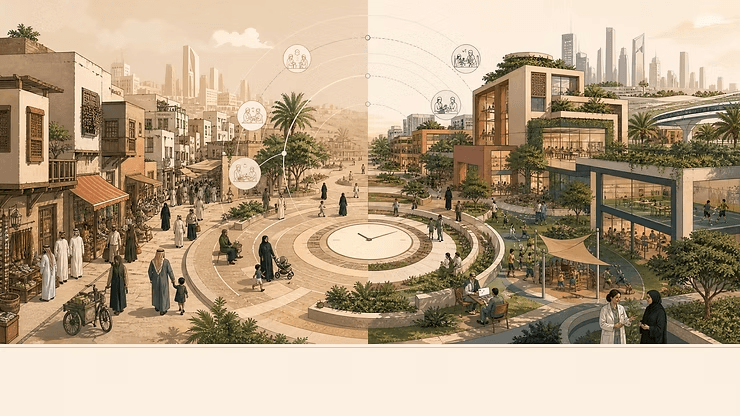
The contemporary formulation of the concept is linked to the academic Carlos Moreno, who in 2016 proposed the idea of “temporal urbanization”: organizing the city so that residents can access six essential functions by walking or cycling: housing, work, supply, enjoyment, learning, and care. His 2021 paper expanded the concept through four dimensions: proximity, density, diversity, and digitalization.
But the essence of the idea is older than the term; Gene Jacobs has advocated for mixed-use living for decades, and Portland and Melbourne developed models of “20-minute neighborhoods”; while public transport planning policies have pushed towards linking density with transport hubs. What was new about the 15-minute city was not the invention of proximity, but the transformation of daily time into a planning tool that is politically and popularly understood.
Here comes the first important observation: the 15-minute rule is not a universal engineering specification. In Melbourne, the 20-minute zone is commonly defined as a walk-and-back journey of approximately 800 meters with bike support and local transport. A study on Melbourne found that an average of approximately 36 households per hectare was theoretically associated with greater support for services, but it also confirmed that location within the city center and the type of service change the outcome, and its model only explained a limited part of the variation.
In other words, the number is not a magic formula. The hospital is not like a coffee shop, the university is not like a pharmacy, and the regional office is not like a flexible workspace. Some jobs need to be close, and some need a broader urban scope.
Where did the idea succeed?
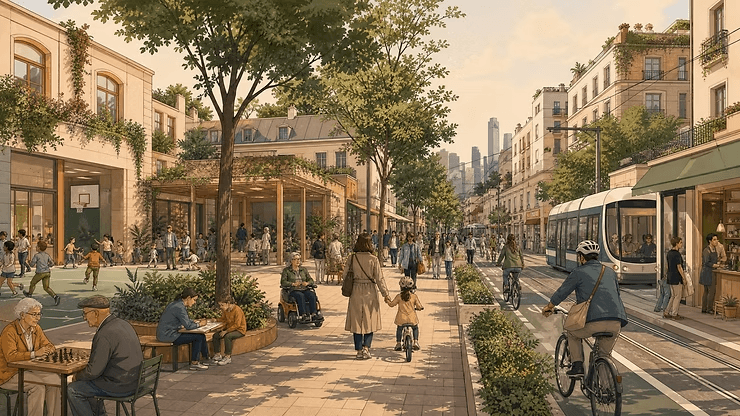
Paris offers the most famous example, but it has not built a new city from scratch. It used existing existing neighborhoods and densities, and an established transportation network, then transformed schools, squares, and streets into a near-daily infrastructure. An early assessment documents the opening of 47 schoolyards on Saturdays, the use of 204 schools on 169 pedestrian-only streets, and the opening of 70 schools and daycare centers to the public on weekends.
The value of Paris lies not in having everyone work closer to home, but in reusing existing assets and expanding local services, and in giving neighborhoods greater authority and resources closer to the population. The success here was as much administrative and operational as it was urbanistic.
Melbourne, however, dealt with "living locally" within a larger city network, not as if the neighborhood were an island self-sufficient in its own right. The literature associated with the model emphasized the need for good public transportation that connects residents to higher-ranked jobs and services outside the neighborhood.
And this is a key point: a 15- or 20-minute city does not cancel out the big city; it reduces unnecessary trips, while keeping specialized jobs and major markets connected regionally.
So, the promising cases don’t tell us: put everything in a small circle; rather, they say: bring daily necessities closer together, improve the public space, and connect the neighborhood with a larger network.
When the market precedes the plan
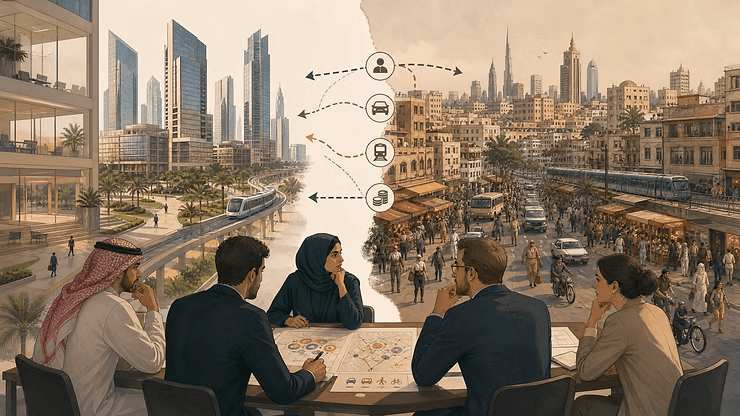
On the other hand, ambitious new cities reveal a recurring gap between the quality of the plan and the speed of economic life. In South Korea’s Songdo, an advanced smart infrastructure was built near Incheon Airport, and the ambition was to become an international business hub. But an assessment published in 2018 pointed to attracting about 70,000 jobs against an initial target of 300,000, linking the gap to the difficulty of creating an organic urban and social fabric once the construction and technology are in place.
These numbers must be read in context; they do not constitute a final verdict on Songdo today; but they remain an important lesson in the risks of top-down planning.
Models of Abu Dhabi and Malaysia
The city of Masdar in Abu Dhabi offers a different example of phased implementation; it moved from the ambition of a fully developed city quickly to a partial and gradual implementation, while the project continued to develop its assets and functions within a longer-term framework. In Malaysia, a field study on Forest City documents how the project had to modify its identity and market itself in the face of political and economic changes and sluggish sales, illustrating the risks of building a new city against the expectation of investment before a stable domestic economy has been established.
These examples are not identical, and they should not be lumped together under the label of “failure.” Songdo is part of a developed Korean economy, and the source has evolved into a platform for technology and sustainability. Forrest City operates within a different investment and political context. But the common denominator is that housing, offices, and technology do not automatically create a demand for each other.
King Abdullah Economic City
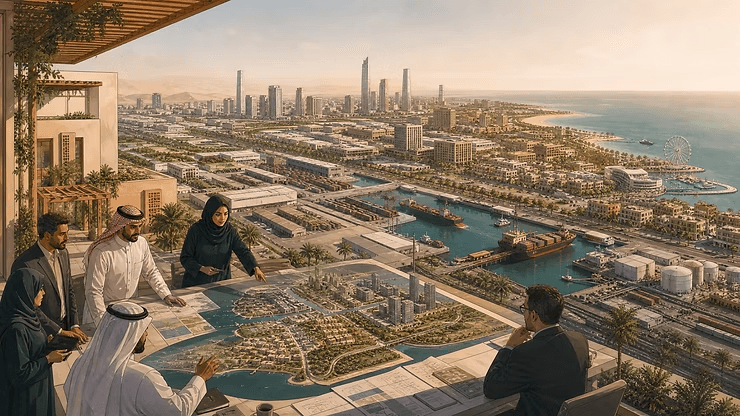
The King Abdullah Economic City is not a literal application of the 15-minute concept, but it offers the closest Saudi lesson to the idea of building a new city that combines work, housing, and leisure. It was designed as a large economic platform on the Red Sea coast, featuring a port, an industrial valley, residential neighborhoods, tourism, and services. It has succeeded in building real value in specific sectors, foremost among which are the port, logistics services, and industry.
But turning this sectoral success into an integrated urban mass of residents, companies, offices, and services was slower than the ambition of the early plan. In 2021, the Public Investment Fund acquired 25% of the Emaar City Economic Company by converting SAR 2.8 billion in debt into shares, announcing that the investment aims to accelerate development and take advantage of the synergies in real estate, manufacturing, logistics, and tourism. The developer’s investor relations page also explains that achieving the comprehensive vision remains a phased process that requires simultaneous financing, operation, and development across multiple sectors.
Restructuring does not mean that the city has not attracted any company; nor does it cancel out the success of the port or industrial valley. But it does confirm that incentives and infrastructure alone are not enough to make the decision to make a major organizational transition. Companies compare the alternative location with a city that already has employees, clients, suppliers, schools, airports, and networks of relationships. Each of these elements carries the cost of relocation and the operational risk.
In my experience, site study begins with the employee map before the project map. A company with 50 employees is not the same as a team of 2,000 employees. A company that relies on daily customer meetings is not the same as a technical team working in a sprint. Situations can be critical for one side, while connectivity via the metro is more important for another. And price is not measured solely in terms of the meter price; it is also measured in terms of the cost of setup, travel, time spent on the journey, the ability to scale, and retaining employees.
Therefore, the assumption that “if we build a good environment, companies will inevitably come” is not a rental hypothesis; it is a hope that needs to be tested.
The Saudi challenge: 15 minutes on the map may be 30 minutes in climate terms
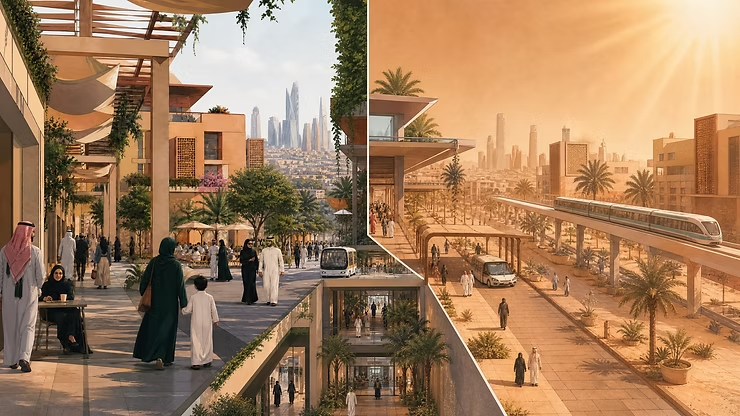
In Europe, distance can be the most obvious factor. In Saudi Arabia, distance alone does not describe accessibility. We must ask: 15 minutes in any month? At any hour? Under what cover?
A study supported by King Abdullah University of Science and Technology, published in 2025, shows that increasing levels of thermal discomfort can limit the ability to walk in the cities of the Kingdom, with the effect varying between coastal and inland areas.
A field study in three neighborhoods in Buraydah during the summer of 2023 also found a relationship between thermal comfort, walking ability, and pedestrian behavior, recommending shading, green spaces, interconnected streets, and mixed use.
But the solution is not turning every street into air-conditioned walkways, nor abandoning walking. The solution is to recognize that the Saudi city operates in two seasonal patterns: in winter and spring, walking and outdoor activities can be expanded. In summer, access should become a series of shade, short distances, cooled destinations, public or shared transportation, easy drop-off, and parking linked to buildings without long exposed paths.
Even within advanced destinations, the regional employee journey remains impactful. A study published in 2026 on mobility at the King Abdullah Economic City showed 64.7 percent of the staff sample satisfied with the pedestrian environment, while 35.3% reported severe congestion upon exiting and 33.3% reported excessive delays; the study linked the experience to location management, transit scheduling, and metro integration. Despite the small sample size, the result illustrates the point: a walking environment within the destination may succeed, while access to it remains the decisive factor.
Saudi version: The 15-minute city, not the 15-minute island
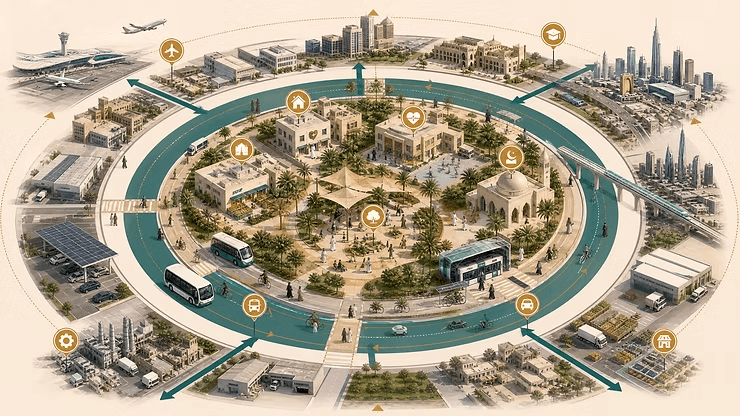
If we want the concept to work in Saudi Arabia, I suggest that we not implement it as a 15-minute radius service, but as a three-ring access system.
The first episode is "Five Minutes of Comfort"
Real daily services include quick needs, basic care, usable public space, and safe access for children and the elderly. Here, shade, landscaping, and an active facade should be part of the real estate product, not an aesthetic afterthought.
The second episode is "15 Minutes Multi-Media"
Walking when the weather permits, cycling in suitable environments, and using public transport or small air-conditioned vehicles, with clear connections to stops and stations. The standard is not to force people into a single mode of transport, but to make the journey short, predictable, and comfortable.
The third episode is "45 Minutes of Economics"
There is an actual connection with job centers, the airport, universities, suppliers, and markets. The company may like the neighborhood, but it won’t move if it becomes far from the city’s economy or its employees. This loop is what turns a beautiful island into a real hub within the market.
Proximity test
Housing: Are there daily necessities, care, and basic education available?
Offices: Do employees and clients arrive on time and at acceptable costs?
Entertainment: Is the visit easy and recurring and not tied to a single season?
Climate test
Housing: Is it possible to walk through the shade and stop along the way during the summer?
Offices: Is the journey from the car or public transport to the office comfortable?
Entertainment: Does the public space operate during the day, evening, and during the school holidays?
The test of economics
Housing: Are housing prices commensurate with the actual segments of the working population?
Offices: Are the rent, the equipment, the expansion, and the positions logical?
Entertainment: Does the volume of demand support operation after opening?
Test of flexibility
Housing: Can services be adjusted as the population grows?
Offices: Are there flexible spaces and a degree of commitment?
Entertainment: Can programming and mix be changed without a comprehensive rebuild?
How do we test the idea before we build it completely?
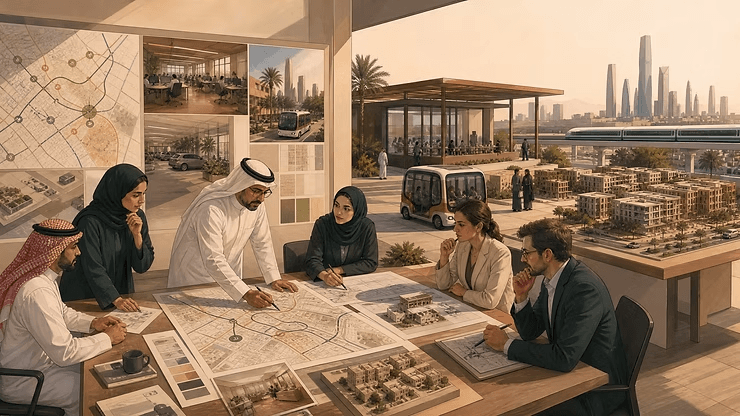
I suggest that the journey begins with contracts and data, not a slogan. Before adopting the assumptions, a decision model is built for the target companies: the employee housing map, peak-hour access times, the percentage of employees whose access will improve or deteriorate, the required positions, the cost of transportation, the specifications of the space, and competitive alternatives.
The request can then be tested gradually. Work can begin with flexible offices, a business center, or the relocation of a small operational unit instead of the entire headquarters. Partnerships can be signed with entities that represent actual drivers of demand: a university, a hospital, a logistics company, a research center, or a group of companies within a single sector. The goal is not to fill a building; but to create an economic reason for choosing the location.
In housing, announcing the proximity of the office is not enough if unit prices do not match employee salaries. In entertainment, having events is not enough if daily usage is weak. What is needed is a leadership team that connects with actual residents, actual jobs, travel patterns, tenant sales, and the use of public space across classrooms.
The conclusion
The city not only shortens distance, but also shortens uncertainty.
The 15-minute city is a successful idea when understood as a real access to everyday life, not a promise that every person will live, work, and play within a single circle. The experiences of Paris and Melbourne illustrate the value of proximity services, asset reuse, and connectivity with transportation. Meanwhile, Songdo, Masdar City, and Forest City remind us that a designed city does not become a living city by an engineering decision alone.
In Saudi Arabia, the King Abdullah Economic City offers a more practical lesson: the project can succeed in a sector like logistics, while at the same time needing different time and strategy to build an integrated population and institutional base. What is needed is not to judge the experience, but to learn from it.
The Saudi version of the 15-minute city must be seasonal, multi-media, linked to the economy of the metropolitan area, and built on the company’s decision as much as it is based on the residents’ desire. If we shorten the distance and do not shorten the cost of transportation, the risks of employment, and the difficulty of access, we will not have created a city for work, housing, and recreation; but we will have placed three adjacent uses on one plan.
And the most important question remains: Do we design the destination around the actual lives of people and the decisions of companies, or around the image that we hope the market will adopt?