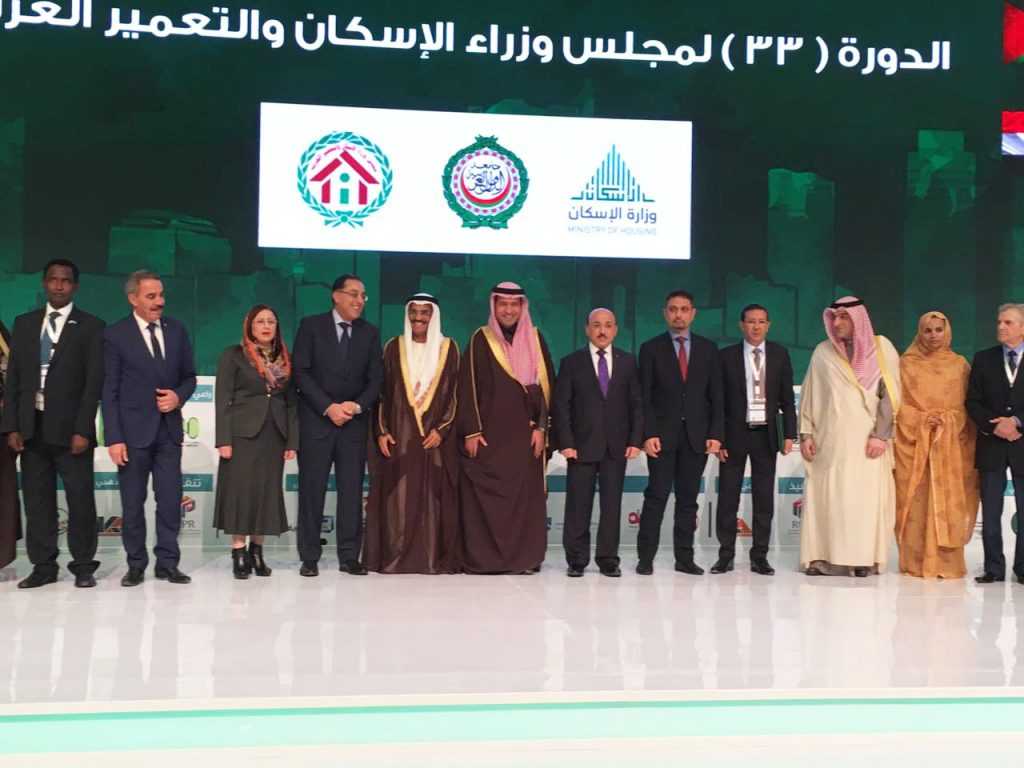


The Fourth Arab Housing Conference concluded its proceedings under the patronage of the Custodian of the Two Holy Mosques, King Salman bin Abdulaziz – may God protect him – last Thursday at the Raffles Kempinski Hotel in Riyadh under the theme «Activating Public-Private Partnerships to Develop the Housing Sector,» with the participation of Arab ministers of housing and construction, as well as government agencies, universities, organizations, companies, and researchers interested in housing issues in the Arab world.
The conference concluded with a number of recommendations, the most notable of which were a shift toward building urban communities rather than residential complexes, and establishing the infrastructure to achieve a unified Arab vision for activating the public-private partnership to develop the housing sector in the Arab world, and providing an investment environment conducive to attracting the private sector toward developing and financing housing projects by enhancing transparency and good governance in the legal, regulatory, and financial relationships between the public and private sectors.
Housing Minister Majed Al-Hogail emphasized that this session is part of a series of previous sessions aimed at deepening the bonds of fruitful and constructive cooperation among Arab countries united by Islam and Arab identity, noting that adequate housing is a top priority for all peoples, adding that the goal of all these conferences is to exchange ideas and experiences while taking into account that each country has its own regulations, and emphasizing that Arab countries" interest in the issue of housing reflects their care and appreciation for their citizens and their commitment to ensuring their comfort and stability.
Al-Hogail stated that cooperation with relevant Arab, regional, and international organizations and Arab federations presents a good opportunity to exchange ideas and proposals, enrich expertise, and contribute to the advancement of housing achievements, noting that the 33rd session of the Arab Housing Council is discussing methods of real estate financing and the exchange of information among Arab countries regarding pioneering housing projects to benefit from their experiences and the possibility of applying them on the ground, Furthermore, the management and maintenance of shared residential complexes constitute an important factor in fostering a culture of coexistence and mutual cooperation.
Leveraging local and global experiences
For his part, the chairman of the conference organizing committee, Engineer Nasser bin Abdullah Al-Ammar, said that the conference’s recommendations included developing housing policies in the Arab world to include private sector participation in the housing sector’s development during the financing, management, and implementation, and streamlining government procedures in the Arab world to incentivize developers to complete housing projects quickly and efficiently without compromising the quality of the final product, and drawing on local and global experiences in the areas of legislation, financing, and development, adding that the conference recommended establishing long-term policies aimed at supporting the cooperative housing sector under state supervision and oversight to achieve the national vision in the housing sector, and training Arab legal professionals, ensuring the development of legal and regulatory frameworks and helping to overcome obstacles that prevent the establishment of an effective relationship between the public and private sectors, as well as the activation and development of legislation and regulations to limit the presence of vacant land within urban areas.
Development of informal and old neighborhoods
The conference’s recommendations also included ensuring that urban planning policies adopt systems and procedures to limit migration in residential neighborhoods, and working to develop informal and old areas to strengthen the system for providing affordable housing, raising awareness, and fostering a culture of openness toward the private sector to leverage its financial and technological capabilities, as well as allowing development banks (industrial and agricultural) to finance affordable housing projects within the framework of major industrial project financing programs.
The conference also called for revitalizing the bond market, and the secondary market to provide the necessary financing for housing projects, and the need to overcome obstacles to government housing projects, including financing methods and the lack of rapid transportation to connect new residential areas with service and work locations, and to complete infrastructure and services, as well as to work on attracting more global investments and capital. It emphasized that the population problem cannot be solved solely by providing affordable housing units for specific groups, but must be viewed more comprehensively in all related aspects, such as limiting land prices and diversifying tenure systems.
More than 51 scientific papers
The conference discussed more than 51 scientific papers covering numerous topics related to the activation and adoption of public-private partnerships as a strategic option, most notably: Public-private partnerships in urban development in the housing sector, and the fundamentals of partnerships between government agencies and the private sector in implementing housing plans, in addition to many other topics that will contribute to achieving the desired goals in the future.