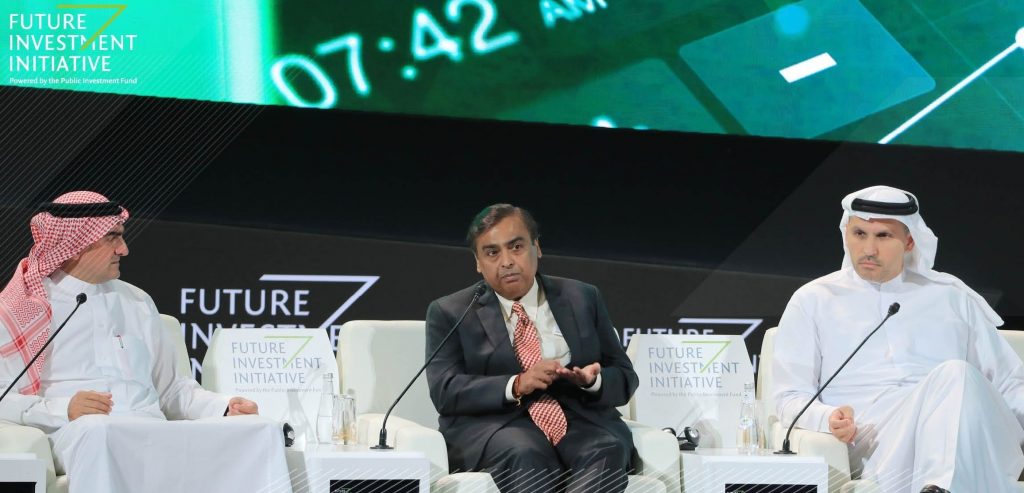

During the Future Investment Initiative, the Public Investment Fund announced its $20 billion contribution to a $40 billion fund established in partnership with the U.S. private equity firm Blackstone, Al-Rumayyan said during the first session of the initiative, which kicked off in Riyadh yesterday, that the fund will invest in the traditional economy, including sectors such as healthcare and education, He also discussed the investment strategy adopted by the Public Investment Fund, which seeks to localize modern technologies in the Kingdom and is expected to create more than 20,000 jobs by 2020.
The Future Prospects of the Global Economy
The opening session of the Future of Investment Initiative addressed the future prospects of the global economy over the coming decades, as well as the importance of artificial intelligence and data in the new information economy and smart cities, with the attendance and participation of investors, financial leaders, and business pioneers from around the world.
For her part, Christine Lagarde, Managing Director of the International Monetary Fund, said in her remarks during the first panel discussion that the current outlook for the global economy is more positive than it has been in recent times, with the global economy expected to grow by 3.7 percent. At the same time, however, she warned that the international community faces two fundamental challenges that could significantly impact development over the next 50 years: climate change and the risks arising from rising global inequality. Lagarde stated that it is essential to address these two challenges in order to ensure a positive future.
The Economy in 50 Years
Lagarde said: »If we look at the next 50 years, I believe there are some pivotal decisions that must be made. We’re talking about the future; the changes aren’t just demographic or population-related. In 50 years, society will have changed and become an aging population, with emerging markets and the rise of new economies in Asia and Africa—and these things are changing at a rapid pace, This means that 50 years from now, oil will become the second most important commodity after climate change. This is what the Kingdom of Saudi Arabia has been thinking about, and that makes me very happy. She added: The centers of power will shift, and the countries that are powerful today may not remain so in 50 years; new cities may lead the way in progress.
Alternative energy sources and energy efficiency
Meanwhile, Amin Al-Nasser, President and CEO of Aramco, said: We are delighted that the Kingdom is hosting this major global forum—the first of its kind in the region—which embodies the Kingdom’s aspirations to be the world’s leading investment power in support of economic diversification. and Saudi Aramco is proud of its important role in achieving the goals of the Kingdom’s Vision 2030, which include supporting economic diversification and strengthening the role of the private sector, and we strive to be the world’s leading integrated energy and chemicals company by achieving integration across the value chain, doubling refining capacity, creating new industries, and providing job opportunities.“ Al-Nasser highlighted Saudi Aramco’s efforts to improve the efficiency of the energy sector through localization and expansion into renewable energy, noting the significant potential offered by alternative energy sources.
The Knowledge Economy for Social Development
The second session on the first day of the Future Investment Initiative addressed the immense scale of changes and potential opportunities associated with big data in the emerging knowledge economy. Thomas Kennedy, CEO of Raytheon, emphasized that the world has only seen the beginning of the fundamental role that big data will play in the global economy, and predicted that the real takeoff of these developments will occur over the next five years.
For his part, Ajay Banga, Chairman and CEO of MasterCard, called for the development of new systems regarding safety and ethical standards to ensure that the opportunity presented by big data is not squandered due to misuse, while Mohamed Alabbar, Chairman of Emaar, emphasized the importance of using big data—not only for commercial gain but also for the benefit of society.
The success of the Kingdom’s vision is crucial for the region
Lubna Al-Olayan, CEO of Al-Olayan Financial, discussed the role that big data has played in helping her company improve operational efficiency, reduce costs, and innovate new products, She also made a positive observation about the growing sense of social responsibility among the younger generation and the importance of this in guiding the use of big data toward positive ends.
For his part, Tony Blair, former Prime Minister of the United Kingdom, said that as countries face today’s challenges, they must choose between a narrow domestic focus or embarking on reform. Commenting on Vision 2030, Blair said it is the most significant development in the region in recent years. Regarding the challenges it faces, he added: ”It is essential that the Vision succeeds because it will have an impact on the region and on security throughout the rest of the world.”