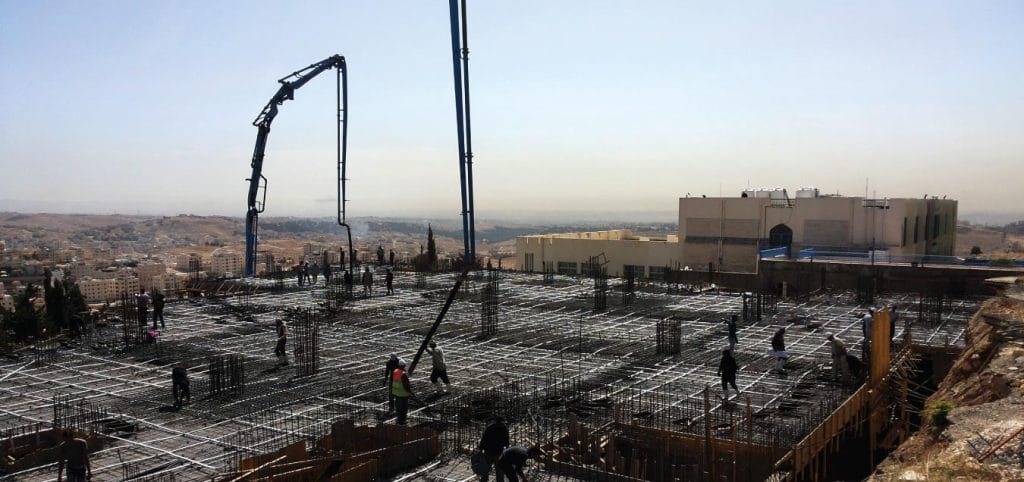

The Ministry of the Interior has issued a package of Precautionary Measures and «protocols» for various sectors, prepared by the Ministry of Health to limit the spread of the novel coronavirus, coinciding with the authorization for employees and workers to return to their workplaces so that life in the Kingdom may gradually return to normal, These measures will be in effect from 8 Shawwal 1441 AH, corresponding to May 31, 2020, to 28 Shawwal 1441 AH, corresponding to June 20, 2020, Below are the key details of the protocol for the construction sector.
Site Access
– Workers with a temperature exceeding 38 degrees Celsius shall not be permitted to enter the work site.
– Building operators and site managers must require maintenance staff to follow preventive measures to prevent infection.
– Appoint a “protocol manager” or, if possible, reorganize the security team at building entrances to conduct screenings of workers; this includes residential buildings. In commercial buildings, a specialized team should be appointed to conduct screenings (assessments) of employees.
– Restructure security teams at building entrances to conduct effective screenings of employees.
– Designate a single entrance for employees to enhance supervision of their entry and facilitate screening procedures.
– The owner or tenant must not allow workers to begin work without wearing face masks if there is no security team in the building.
– Building operators should inform workers of the screening procedures and entry policies before their arrival.
– Agree on a delivery protocol with suppliers and transportation companies; ensure they are informed of screening, safety, and preventive measures before arriving at residential buildings.
On-site Precautionary Measures for Workers at Contracting Companies
– Ensure adequate ventilation in enclosed construction and maintenance sites.
– Do not allow overnight stays at construction and maintenance sites.
– Lunch breaks must be taken indoors and staggered among workers; enclosed dining areas should be opened only in cases of extreme heat.
Common Areas
– Conduct regular health checks for workers on-site.
– Limit the number of people allowed to use elevators at the same time to avoid overcrowding (one person per 4 m, based on the maximum interior area of the elevator).
– It is recommended to ensure that ventilation systems are in good working order and to perform routine maintenance.
– Clean and disinfect the workplace after maintenance work is completed.
– Assign workers to clean frequently touched surfaces in common areas and ensure they are disinfected regularly.
– Designate restrooms in workers" areas to avoid crowding in non-residential buildings.
– Prevent construction workers from accessing open areas in residential buildings, such as parking lots, swimming pools, gyms, and others.
Worker Housing
– Conduct daily temperature checks upon entering or leaving the housing facility.
– Prohibit all unauthorized visitors from entering workers" housing.
– Prohibit the sharing of tableware or other items used on a daily basis.
Site
– Do not allow workers with a temperature exceeding [38 degrees Celsius] to enter the site
– Employees at risk of infection must work from home.
– Individuals suspected of being infected are prohibited from traveling with other passengers.
– All employees must wear cloth face masks at all times while working on construction projects.
– Prohibit all non-essential individuals from entering the site.
– Rearrange the worksite to reduce crowded areas.
– Identify and clearly mark all queue locations to maintain social distancing.
– Designate isolation areas for workers at risk of infection.
– Ensure social distancing between workers (at least 1.5 to 2 meters) in outdoor workplaces; for indoor workplaces, there must be no more than one worker per 4 m²).