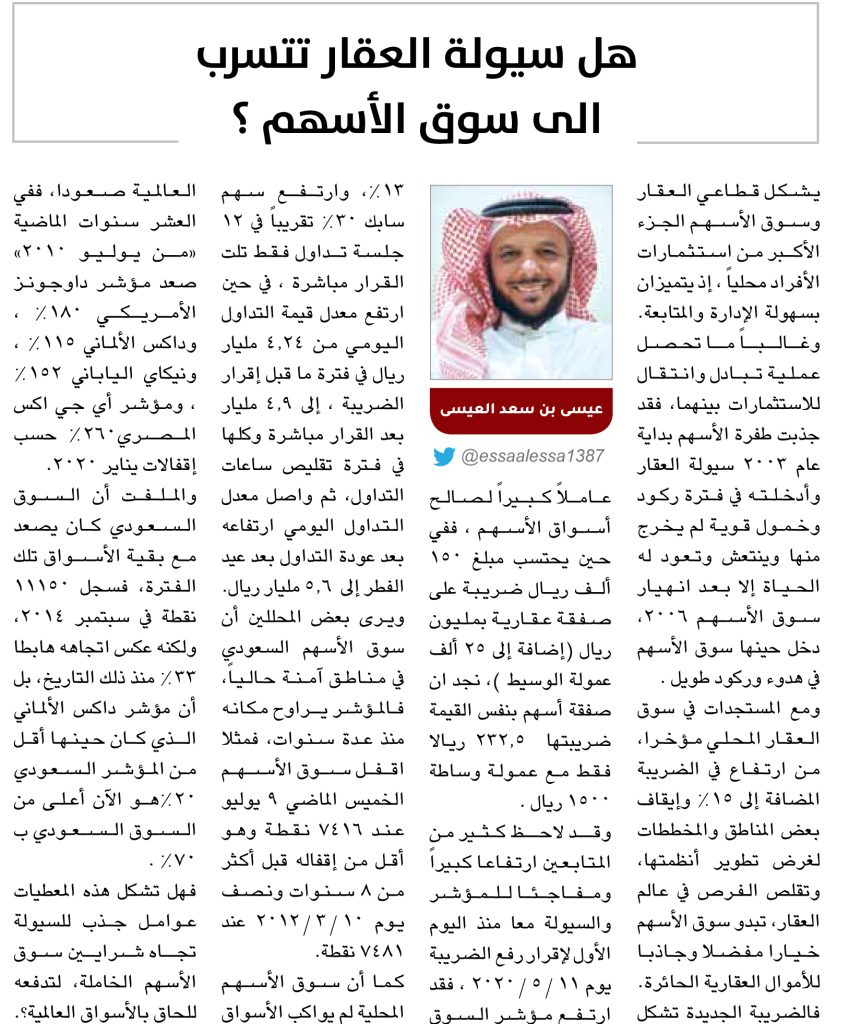

The real estate sectors The stock market accounts for the lion’s share of local retail investments, as both are characterized by ease of management and monitoring. Investments are often transferred between the two markets, as the stock market boom in early 2003 drew liquidity away from the real estate market, plunging it into a period of severe stagnation and inactivity from which it did not emerge until after the 2006 stock market crash; at that time, the stock market entered a period of calm and prolonged stagnation.
With recent developments in the local real estate market—including an increase in value-added tax to 15%, the suspension of certain areas and development plans to revise their regulations, and a decline in opportunities in the real estate sector— the stock market appears to be a preferred and attractive option for real estate capital seeking new avenues.
The new tax is a major factor in favor of the stock market. While a real estate transaction worth one million riyals incurs a tax of 150,000 riyals (in addition to a 25,000 riyal brokerage commission), a stock transaction of the same value incurs a tax of only 232.5 riyals, along with a brokerage commission of 1,500 riyals.
Many observers have noted a significant and sudden rise in both the index and trading volume since the first day the tax increase was approved on May 11, 2020. The 13% market index rose, and SABIC stock (30%) rose by approximately 30% in just 12 trading sessions immediately following the decision, while the average daily trading value rose from 4.24 billion riyals in the period before the tax was approved, to 4.9 billion immediately after the decision—all during a period of reduced trading hours. The daily trading volume then continued to rise after trading resumed following Eid al-Fitr, reaching 5.6 billion riyals.
Some analysts believe that the Saudi stock market is currently in safe territory, as the index has been ranging for several years; For example, the stock market closed last Thursday, July 9, at 7,416 points, which is lower than its closing level more than 8 and a half years ago on March 10, 2012, when it stood at 7,481 points.
Furthermore, the local stock market has not kept pace with the global markets« upward trend. Over the past ten years—since July 2010—the U.S. Dow Jones Index rose by 1,80%, the German DAX by 1,15%, the Japanese Nikkei by 1,52%, and the Egyptian EGX by 2,60%, based on January 2020 closing prices.
It is noteworthy that the Saudi market was rising along with the rest of these markets during that period, reaching 11,150 points in September 2014, but has since reversed course, falling by 33%. In fact, the German DAX index—which was then 20% below the Saudi index—is now 70% higher than the Saudi market.
Do these factors attract liquidity to the stagnant stock market, pushing it to catch up with global markets?