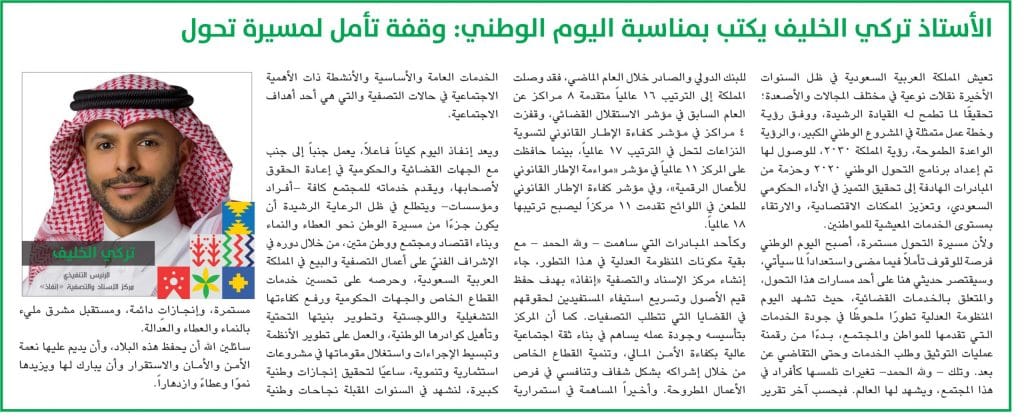

In recent years, the Kingdom of Saudi Arabia has undergone significant transformations in various fields and at all levels; in pursuit of the aspirations of its wise leadership, and in accordance with the vision and action plan embodied in the Grand National Project and the promising and ambitious Vision 2030. To achieve this, the National Transformation Program 2020 was developed, along with a package of initiatives aimed at achieving excellence in Saudi government performance, strengthening economic capabilities, and improving the quality of life for citizens.
National Day and the Journey of Transformation
As the journey of transformation continues, National Day has become an opportunity to reflect on the past and prepare for the future. My remarks here will focus on one aspect of this transformation: judicial services, where the judicial system is currently witnessing remarkable progress in the quality of services it provides to citizens and society—from the digitization of documentation and service requests to remote litigation. These—praise be to God—are changes that we, as individuals in this society, can feel firsthand, and the world bears witness to them. According to the latest World Bank report, released last year, the Kingdom ranked 16th globally—up eight places from the previous year—on the Judicial Independence Index, and jumped four places in the Legal Framework for Dispute Resolution index to rank 17th globally, while maintaining its 11th-place global ranking in the «Alignment of the Legal Framework for Digital Business» index, and in the "Efficiency of the Legal Framework for Challenging Regulations" index, it advanced 11 places to rank 18th globally.
Preserving Asset Values and Accelerating Beneficiaries« Access to Their Rights
As one of the initiatives that contributed—praise be to God – along with the rest of the judicial system to this progress—was the establishment of the »Enforcement” Support and Liquidation Center, with the aim of preserving asset values and expediting the fulfillment of beneficiaries’ rights in cases requiring liquidation. Furthermore, through its establishment and the quality of its work, the Center contributes to building high levels of public confidence in financial security and to the development of the private sector by involving it in a transparent and competitive manner in available business opportunities. Finally, it contributes to the continuity of public and essential services and activities of social importance in liquidation cases, which is one of its social objectives.
Today, the Center is an active entity that works side by side with judicial and government authorities to restore rights to their rightful owners and provides its services to the entire community—both individuals and institutions— and, under wise leadership, aspires to be part of the nation’s journey toward generosity and growth and the building of a strong economy, society, and nation, through its role in providing technical oversight of liquidation and sale proceedings in the Kingdom of Saudi Arabia, and through its commitment to improving the services of the private sector and government agencies, enhancing their operational and logistical efficiency, developing their infrastructure, and training their national workforce, as well as working to develop regulations, streamline procedures, and leverage their resources in investment and development projects, striving to achieve great national accomplishments, so that in the coming years we may witness continued national successes, lasting achievements, and a bright future filled with growth, generosity, and justice.
We ask God to protect this country, to perpetuate the blessings of security, safety, and stability upon it, and to bless it with increased growth, generosity, and prosperity.
Turki bin Khalid Al-Khalif
Chief Executive Officer
Enforcement Support and Liquidation Center “Enfaaz”