
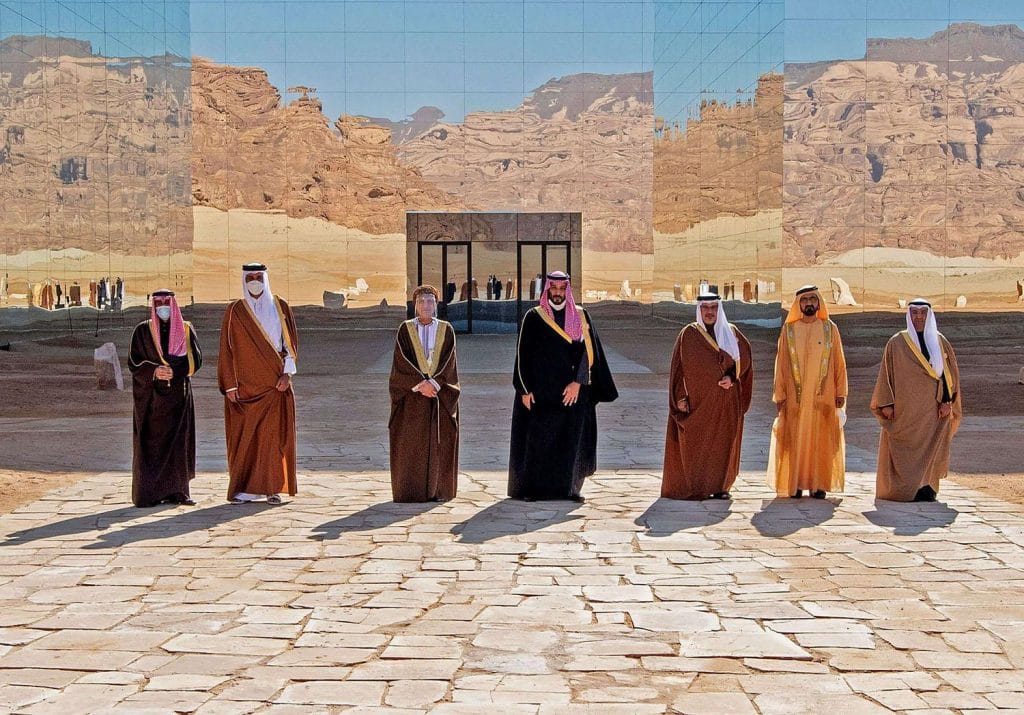

In order to achieve security, peace, stability and prosperity in the region
With great success and understanding, the leaders of the Gulf Cooperation Council (GCC) concluded their 41st summit, the "Sultan Qaboos and Sheikh Sabah Summit," which was held in Al-Ula yesterday (Tuesday), and emphasized strengthening the bonds of friendship and brotherhood among the peoples of the region.
The announcement included the establishment of the “Gulf Center for Disease Prevention and Control,” and its rapid activation to coordinate joint Gulf action to confront the “Corona” pandemic and other epidemics.
The declaration also included strengthening military integration among the GCC countries under the supervision of the Joint Defense Council, the Supreme Military Committee and the Unified Military Command of the Cooperation Council, to confront emerging challenges.
The following is the text of the statement:
The 41st Summit of the Leaders of the Cooperation Council for the Arab States of the Gulf, the “Sultan Qaboos and Sheikh Sabah Summit”, affirmed the lofty goals of the Cooperation Council, as stipulated in the Basic Law, to achieve cooperation, interdependence and integration among the member states in all fields, leading to their unity, enhancing their regional and international role, and working as one economic and political group to contribute to achieving security, peace, stability and prosperity in the region.
Citizens of the region's countries hope that the "Al-Ula Declaration," which was reached at this summit, will restore joint action to its normal course and strengthen the bonds of friendship and brotherhood among the peoples of the region.
The signing of the Al-Ula Declaration by the Arab Republic of Egypt confirms the strengthening of the fraternal relations that bind sisterly Egypt to the GCC countries, based on what the Basic Law stipulates, that coordination, cooperation and integration among the GCC countries serves the lofty goals of the Arab nation.
The COVID-19 pandemic has demonstrated the potential for global cooperation in combating this disease, with the G20 achieving unprecedented successes during Saudi Arabia's presidency. Undoubtedly, addressing the pandemic and its repercussions requires strengthening joint Gulf action, particularly in the following areas:
- The full and accurate implementation of the vision of the Custodian of the Two Holy Mosques, King Salman bin Abdulaziz, King of the Kingdom of Saudi Arabia, which was approved by the Supreme Council in its (36) session in December 2015, according to a specific timetable and close follow-up, including completing the components of economic unity, the joint defense and security systems, and formulating a unified foreign policy.
- Activating the role of the “Gulf Center for Disease Prevention and Control” which was established at this summit, based on what was included in the vision of the Custodian of the Two Holy Mosques, and enabling it quickly to coordinate joint Gulf action to confront the “Corona” pandemic and other epidemics.
- Completing the requirements of the Customs Union and the Gulf Common Market, and achieving full economic citizenship, including granting citizens of the GCC countries freedom of work, movement, investment, and equality in receiving education and health care, building the Gulf railway network, the food and water security system, encouraging joint projects, and localizing Gulf investment.
- To benefit from the advanced tools developed for cooperation within the framework of the G20, during the Kingdom of Saudi Arabia’s presidency, in all areas, including stimulating the economy, engaging the business sector and civil society institutions, empowering women and youth more in economic development, encouraging initiatives related to the digital economy, and tasking the General Secretariat of the Council with following up and developing plans and programs to implement this in cooperation with specialized centers of expertise.
Developing the technological capabilities of government agencies, including artificial intelligence, to ensure the speed and efficiency of service and procedure delivery, and developing educational curricula, healthcare, and digital commerce. Strengthening cooperation between the Council's institutions and the Digital Cooperation Organization, established in 2020, in a way that serves the interests of the GCC countries.
- Strengthening governance, transparency, accountability, integrity and anti-corruption tools through joint Gulf action and in all the GCC’s agencies, offices and specialized organizations, and benefiting from what was agreed upon within the framework of the G20 and the “Riyadh Initiative” regarding cooperation in investigations into cross-border corruption cases and the prosecution of perpetrators, given the significant impact of corruption on economic growth, sustainable development and mutual trust between governments and peoples.
- Strengthening military integration among the GCC countries under the supervision of the Joint Defense Council, the Supreme Military Committee and the Unified Military Command of the Cooperation Council, to confront emerging challenges, based on the Joint Defense Agreement and the principle of collective security for the GCC countries.
- Continuing the steps taken by the GCC countries and the G20 under the presidency of the Kingdom of Saudi Arabia to confront the pandemic and mitigate its effects locally, regionally and internationally, including assisting the least developed countries in the health and economic fields.
- To enhance the regional and international role of the Council by unifying political positions and developing strategic partnerships between the Cooperation Council and regional and international countries, groups and organizations in a way that serves common interests.


