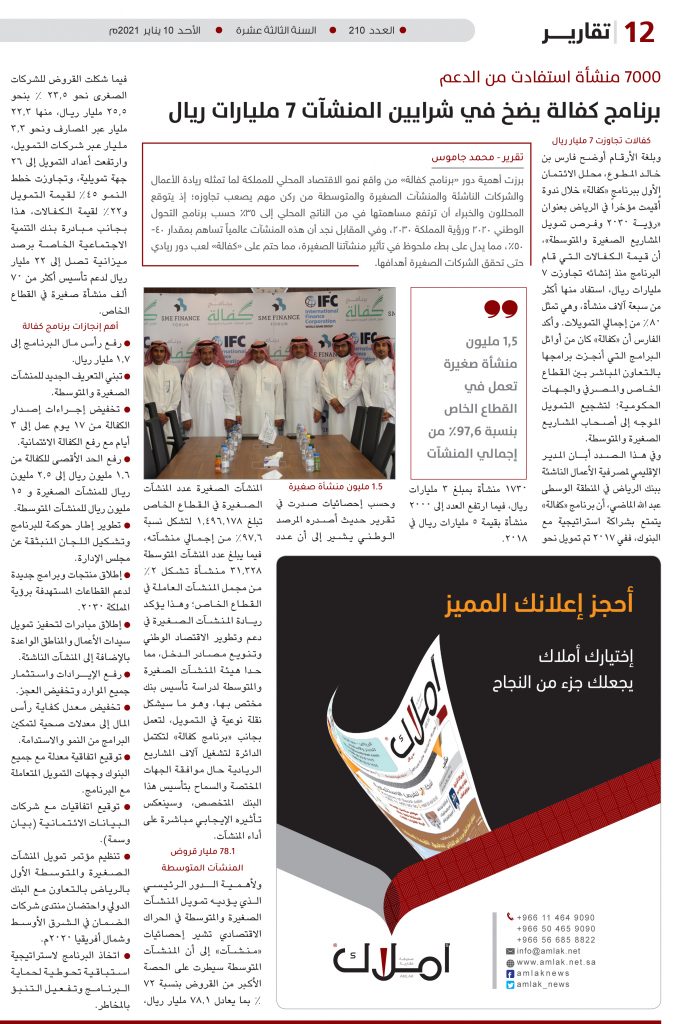

Financing – The importance of the role of «Kafalah Program» has become increasingly important in light of the Kingdom’s local economic growth, given that entrepreneurship, startups, and small and medium-sized enterprises (SMEs) represent a vital pillar that cannot be overlooked; Analysts and experts expect their contribution to GDP to rise to 35% in line with the National Transformation Program 2020 and Saudi Vision 2030, In contrast, globally these enterprises contribute 40–50%, indicating a noticeable lag in the impact of our small enterprises, which has made it imperative for «Kafala» to play a leading role in helping small companies achieve their goals.
Guarantees Exceeding 7 Billion Riyals
In terms of numbers, Fares bin Khalid Al-Mutawa, Senior Credit Analyst at the program, explained «Guarantee» During a recent seminar held in Riyadh titled «Vision 2030 and Financing Opportunities for Small and Medium-Sized Enterprises,» it was noted that the value of guarantees provided by the program since its inception has exceeded 7 billion riyals, benefiting more than 7,000 businesses, representing 80% of total financing, Al-Faris emphasized that «Kafala» was one of the first programs to be implemented through direct collaboration between the private sector, the banking sector, and government agencies to encourage financing directed toward small and medium-sized enterprise owners.
In this regard, Abdullah Al-Madi, Regional Director of Startup Banking at Riyad Bank in the Central Region, stated that the «Kafala» program enjoys a strategic partnership with banks, In 2017, approximately 1,730 businesses were financed with 3 billion riyals, while the number rose to 2,000 businesses with 5 billion riyals in 2018.
1.5 million small businesses
According to statistics released in a recent report by the National Observatory, the number of small businesses in the private sector stands at 1,496,178, accounting for 97.6% of all enterprises, while the number of medium-sized enterprises stands at 31,328, accounting for 2% of all enterprises operating in the private sector; This underscores the leading role of small enterprises in supporting and developing the national economy and diversifying sources of income, which has prompted the Small and Medium Enterprises Authority to study the establishment of a bank dedicated to them, which would represent a qualitative leap in financing, operating alongside the «Kafala Program» to complete the cycle for launching thousands of entrepreneurial projects once the relevant authorities approve and authorize the establishment of this specialized bank, and its positive impact will be directly reflected in the performance of these enterprises.
78.1 Billion in Loans to Medium-Sized Enterprises
Given the key role that financing for small and medium-sized enterprises plays in economic activity, statistics from «Munsha’at» indicate that medium-sized enterprises accounted for the largest share of loans at 72 %, equivalent to 78.1 billion riyals, while loans to microenterprises accounted for approximately 23.5 %, or about 25.5 billion riyals, of which 22.3 billion was provided through banks and approximately 3.3 billion through finance companies. The number of financing entities rose to 26, and growth targets exceeded 45% for the value of financing and 22% for the value of guarantees.
This comes alongside the Social Development Bank’s initiative to allocate a budget of up to 22 billion riyals to support the establishment of more than 70,000 small businesses in the private sector.
Key Achievements of the Kafala Program
Increasing the program’s capital to 1.7 billion riyals.
Adopting the new definition of small and medium-sized enterprises.
Streamlining the guarantee issuance process from 17 business days to 3 days while increasing the credit guarantee limit.
Raising the maximum guarantee amount from 1.6 million riyals to 2.5 million riyals for small enterprises and to 15 million riyals for medium-sized enterprises.
Developing a governance framework for the program and forming committees under the Board of Directors.
Launch new products and programs to support the sectors targeted by the Kingdom’s Vision 2030.
Launching initiatives to stimulate financing for women entrepreneurs, promising regions, and startups.
Increasing revenue, investing all resources, and reducing the deficit.
Reduce the capital adequacy ratio to healthy levels to enable the programs to grow and remain sustainable.
Signing an amended agreement with all banks and financing entities that partner with the program.
Sign agreements with credit bureaus (Bayan and SAMA).
Organizing the first SME Financing Conference in Riyadh, in collaboration with the World Bank, and hosting the 2020 Middle East and North Africa Guarantee Companies Forum.
Adoption of a proactive, precautionary strategy to protect the program and enhance risk forecasting.