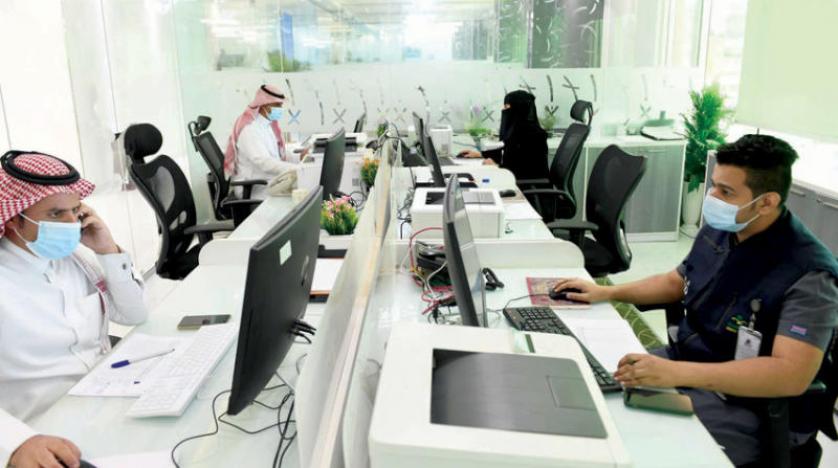

<The General Authority for Statistics (GASTAT) issued the Labor Market Bulletin for the first quarter of 2021, according to the estimates of the labor force survey that the authority conducts on a quarterly basis, as the results showed that the unemployment rate for the total Saudi and non-Saudi population (15 years and above) decreased according to the estimates of the labor force survey for the first quarter of 2021 to (6.5%) compared to (7.4%) during the previous quarter (the fourth quarter of 2020 AD), while the unemployment rate for total Saudis (males and females 15 years and over) decreased to (11.7%) in the first quarter of 2021 AD, compared to (12.The survey results showed that the unemployment rate for the total male population in the Kingdom decreased according to the estimates of the labor force survey for the first quarter of 2021, reaching (3.7%) compared to (4.0%) in the previous quarter, and the unemployment rate for the total female population decreased from (20.(2%) in the previous quarter (the fourth quarter of 2020) to (16.1%) in the first quarter of 2021, and the unemployment rate for Saudi women decreased to (21.2%) during the first quarter of 2021 compared to (24.4%) in the previous quarter (the fourth quarter of 2020), according to the estimates of the labor force survey.
The survey results revealed a slight increase in the economic participation rate in the labor force for the total population (Saudis and non-Saudis 15 years and above) during the first quarter of 2021, reaching (61.1%) compared to (61.0%) in the previous quarter.<The results indicated that the labor force participation rate for the total male population (15 years and above) decreased in the first quarter of 2021 to (79.7%), down from (80.6%) during the previous quarter, while the labor force participation rate for the total female population (15 years and above) increased during the first quarter of 2021 to (33.6%) compared to (32.1%) in the previous quarter.The survey results showed a decrease in the economic participation rate for the total Saudi population (males and females 15 years and over), reaching (49.5%) in the first quarter of 2021, while it was (51.2%) in the previous quarter (the fourth quarter of 2020 AD), as the economic participation rate in the labor force for Saudi males (15 years and over) reached (66.2%), while the labor force participation rate for Saudi females (15 years and above) reached (32.3%) according to the estimates of the labor force survey for the first quarter of 2021.
The General Authority for Statistics explained that the labor market bulletin relies on two sources of data: The first source is through the implementation of a household survey conducted by the Authority, which falls under the classification of (social statistics), in which information is collected through a representative sample of the population of various administrative regions in the Kingdom from households, and the completion of an electronic form containing a number of questions, through which estimates and indicators are provided The second data source is the labor force of the working-age population (15 years and above) residing in the Kingdom, estimating the economically active and inactive population (inside and outside the labor force), as well as calculating the most important labor market indicators such as unemployment rates, labor force participation rate, employment rates, and others.
The second data source is the data and information registered and updated by the government agencies related to the labor market, resulting from the official electronic registration and documentation processes followed in these agencies, where the Ministry of Human Resources and Social Development (MHRSD) and the Labor Market Fund (LMF): (The Ministry of Human Resources and Social Development, the Human Resources Development Fund, the General Organization for Social Insurance, and the National Information Center provide the Commission with the data registered with them periodically through electronic linkage as a main source of data on workers in the government sector and the private sector.
The survey results revealed a slight increase in the economic participation rate in the labor force for the total population (Saudis and non-Saudis 15 years and above) during the first quarter of 2021, reaching (61.1%) compared to (61.0%) in the previous quarter.<The results indicated that the labor force participation rate for the total male population (15 years and above) decreased in the first quarter of 2021 to (79.7%), down from (80.6%) during the previous quarter, while the labor force participation rate for the total female population (15 years and above) increased during the first quarter of 2021 to (33.6%) compared to (32.1%) in the previous quarter.The survey results showed a decrease in the economic participation rate for the total Saudi population (males and females 15 years and over), reaching (49.5%) in the first quarter of 2021, while it was (51.2%) in the previous quarter (the fourth quarter of 2020 AD), as the economic participation rate in the labor force for Saudi males (15 years and over) reached (66.2%), while the labor force participation rate for Saudi females (15 years and above) reached (32.3%) according to the estimates of the labor force survey for the first quarter of 2021.
The General Authority for Statistics explained that the labor market bulletin relies on two sources of data: The first source is through the implementation of a household survey conducted by the Authority, which falls under the classification of (social statistics), in which information is collected through a representative sample of the population of various administrative regions in the Kingdom from households, and the completion of an electronic form containing a number of questions, through which estimates and indicators are provided The second data source is the labor force of the working-age population (15 years and above) residing in the Kingdom, estimating the economically active and inactive population (inside and outside the labor force), as well as calculating the most important labor market indicators such as unemployment rates, labor force participation rate, employment rates, and others.
The second data source is the data and information registered and updated by the government agencies related to the labor market, resulting from the official electronic registration and documentation processes followed in these agencies, where the Ministry of Human Resources and Social Development (MHRSD) and the Labor Market Fund (LMF): (The Ministry of Human Resources and Social Development, the Human Resources Development Fund, the General Organization for Social Insurance, and the National Information Center provide the Commission with the data registered with them periodically through electronic linkage as a main source of data on workers in the government sector and the private sector.
These entities are the main source of data for the government sector and the private sector.








