
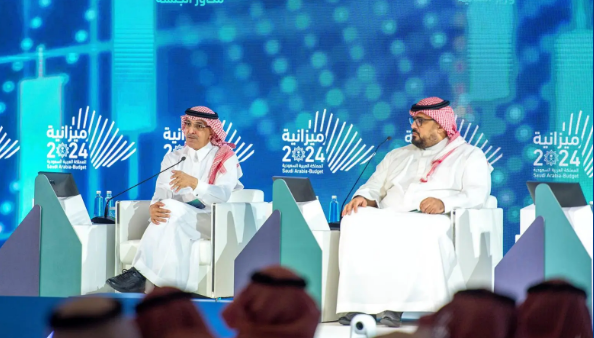

The first session of the Budget 2024 forum, entitled “Sustainable Finance”, kicked off in Riyadh today, with the participation of H.E. Minister of Finance Mr. Mohammed bin Abdullah Al-Jadaan and H.E. Minister of Economy and Planning Mr. Faisal bin Fadel Al-Ibrahim.
His Excellency the Minister of Finance explained during his participation in the panel discussion that Saudi Vision 2030 since its launch in 2016 included a wide range of sectoral and regional strategies, and a number of projects that were in the construction of their strategies. Within two years, a comprehensive review was conducted on all sectoral and regional strategies and projects to identify intersections, then appropriations, then strategies and implementation, and today we are halfway through the vision.”
H.
H.E. Mr. Al-Jadaan said: ”We are at the halfway point of the vision. <His Excellency said:" The high ambition and the size of the funds are naturally limited in revenues and resources that must be best utilized to implement the strategies and achieve the greatest return," he said, referring to the economic outlook and coming up with results for the amount of funding required for these strategies and projects.
He noted the focus of the vision of the vision. He noted the focus of Saudi Vision 2030 on economic diversification, including non-oil GDP and its generally assumed percentage, which ranges from 18% to 21%, stressing the need not to exceed the estimated percentages, because of the impact on the economy if exceeded.
Highlighting the economic outlook and coming up with results for the amount of funding required for these strategies and projects.
Providing the necessary funding
His Excellency addressed the financing capacity in the local debt markets and its considerations with the private sector, indicating that the Kingdom in its desire to borrow takes into account the need of the private sector and what is available to them from financing in banks for small and medium enterprises and consumer loans and giving funding space, pointing to the global market and loans from international markets and allocating approximate amounts to each country according to the diversification of risks and the strength of the economy of any country and its credit rating, referring to the indicators of debt service to GDP and debt service to non-oil GDP and ensuring financial sustainability.The Minister of Finance emphasized the importance of the debt service to GDP and debt service to non-oil GDP and ensuring financial sustainability.
For his part, the Minister of Economy and Planning emphasized that many of the targets of Saudi Vision 2030 have been achieved, and the institutional capabilities of government agencies and their cooperation with other sectors have become highly institutionalized and high-quality, speaking on the topics of accelerating economic diversification, economic growth and growth of the economy without oil, which reached 20% in 2016, and doubled.
The Minister of Economy and Planning emphasized that many of the targets of the Saudi Vision 2030 have been achieved.
Improved trade balance
The trade balance has improved thanks to many things, including exports, noting that services moved from 65 billion in 2016 to between 130 and 150 billion today, and the percentage of non-oil revenues to cover costs was approximately 19% and reached 35% today due to the growth of the non-oil economy base, adding that unemployment rates continue to decline systematically, and women's participation in the labor market exceeded the targets to reach more than 35%.The Minister of Economy and Planning explained that the Ministry is working on a daily basis to coordinate with different entities in a systematic manner to reach solutions, in partnership with the private sector, that result in policies that have an impact on the transformation process.
Empowering the private sector
Mr. Al-Ibrahim highlighted the importance of economic diversification and empowering the private sector to export its products to foreign markets and support it to exploit the opportunities provided by Saudi Vision 2030, highlighting the most important tools and sectors that contribute to achieving economic balance and stability, including the tourism sector, which has witnessed significant growth over the past years, as well as financial services due to the solutions provided by the real estate sector, stressing the importance of investing in the tourism sector, which contributes to economic growth, provides job opportunities and attracts many skills and investments.Mr. Al-Ibrahim spoke about the importance of investing in the tourism sector, which contributes to achieving economic growth, provides job opportunities and attracts many skills and investments. His Excellency spoke about the role of industry in providing investment opportunities and attracting investments in the manufacture of electric cars and ships, whether through national companies or through international companies such as Lucid or Hyundai, reviewing what the Kingdom has achieved in military industries and localization of complex industries and military and defense systems.
He stressed the importance of investing in the tourism sector, which contributes to economic growth, provides job opportunities and attracts many skills and investments.


