
Knight Frank, a global real estate consulting firm, revealed that since the launch of the National Transformation Plan in the Kingdom of Saudi Arabia in 2016, project budgets and the value of construction contracts in the Kingdom have exceeded approximately $1.25 trillion, according to a report published by Construction Business News.
The company confirmed that Saudi Arabia is experiencing a major boom in construction activity, with the value of construction output for the residential, institutional, infrastructure, as well as the industrial, energy, utilities, and commercial sectors, reached 141.5 billion U.S. dollars, an increase of 4.3% compared to last year, according to the 2019 report. The latest analysis released by global real estate consulting firm Knight Frank is a report reviewing the construction landscape in the Kingdom of Saudi Arabia.
In this regard, Mohamed Nabil—Regional Partner and Head of Project and Development Services for the Middle East and North Africa—says: “We are currently witnessing a historic transformation in Saudi Arabia, with construction projects standing out in terms of their scale and value. Given the size of these development projects, the government hopes to attract investments worth more than 3 trillion U.S. dollars by 2030, a figure recently confirmed by the Minister of Investment during the China-Gulf Forum on Industrial and Investment Cooperation held last month in China, noting that this significant investment is in line with the goals of Vision 2030 and will also strengthen the Kingdom’s position as a global hub for tourism and trade.
$1.25 trillion in real estate and infrastructure projects
According to Knight Frank, since the launch of Saudi Arabia’s National Transformation Plan in 2016, the total budgeted value of real estate and infrastructure projects has exceeded $1.25 trillion. This transformation is evident across the entire urban landscape, driven by Vision 2030, which aims to deliver more than 660,000 residential units, more than 320,000 hotel rooms, more than 5.3 million square meters of retail space, and more than 6.1 million square meters of new office space by 2030. End of the decade.
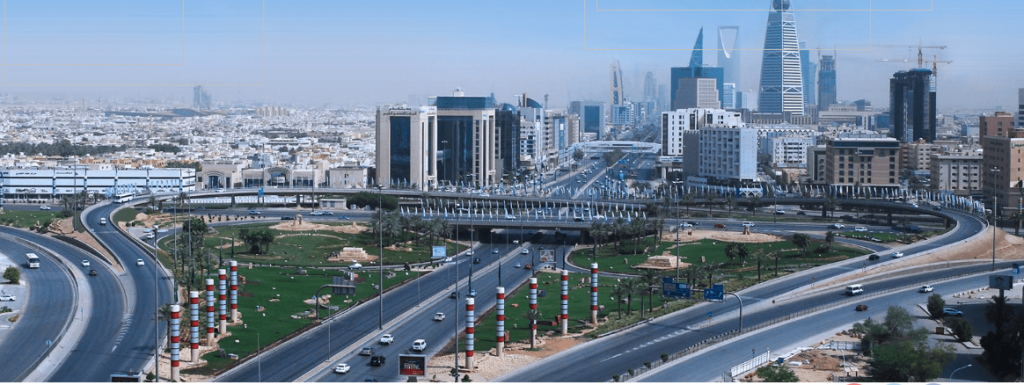
Mohammed continued: “It is worth noting that 38% of the value of current contracts is attributed to the Riyadh region, equivalent to 54 billion U.S. dollars, followed by the Makkah and Tabuk regions with US$28.7 billion and US$28.5 billion, respectively. While construction sector contracts account for 61% of the total value, the transportation sector ranks second at 33%, highlighting the significant investment in enhancing the capital’s transportation infrastructure as the population is projected to grow to 10 million by 2030.
The residential sector is the primary driver of construction output value in Saudi Arabia, accounting for 31% (US$43.5 billion) of total output value in 2023, and is expected to reach US$56.9 billion by 2028, according to Knight Frank’s analysis. The energy and utilities sector ranks second, with a value of US$35.1 billion, and is expected to rise to US$46.5 billion by 2028.
According to Knight Frank, the value of construction output in the Kingdom across all sectors is expected to reach US$181.5 billion by the end of 2028, making Saudi Arabia the world’s largest construction market.
Residential Construction Cost Index
Knight Frank also published an analysis of residential construction costs across Saudi Arabia, which illustrates the scope of building construction and fixed fit-out costs across various residential categories, including different levels of villas, and the same applies to residential buildings.
After analyzing construction rates per square meter for various residential projects in the Kingdom, Knight Frank’s data reveals that the variation in construction costs is primarily attributable to unique differences in the size, quality, and type of construction projects, which range from 3,800 Saudi riyals to 10,000 Saudi riyals per square meter. Using the lower end of this range and data on average dwelling size, Knight Frank’s analysis indicates that the delivery of 660,000 homes planned in the Kingdom by 2030 will cost at least 175 billion U.S. dollars.
Giga Projects
To date, the most visible impact of Vision 2030 has been the emergence of new megacities, particularly the Giga projects across the Kingdom, especially in the western part of the country.
Ammar Hussein, Research Partner for the Middle East, added: “With a value of over 1.25 trillion Saudi riyals already launched but not yet delivered, the Giga Projects are undoubtedly transforming the Kingdom’s urban landscape. It can be said that one of the most—if not the most—ambitious real estate development programs in the world is accelerating in Saudi Arabia as the 2030 deadline for achieving Vision 2030 approaches.
Rise in Planned Residential Units
“Nationally, the planned volume of residential units has risen to 660,000 units, an increase of 30% over the past 12 months. Meanwhile, the office pipeline remains steady at 6 million square meters. In the commercial market, plans are underway to develop 5.3 million square meters of retail space and 320,000 additional hotel rooms, contributing to Saudi Arabia’s goal of increasing its population to 40 million and accommodating 150 million visitors by 2030. This figure has risen from approximately 106 million visitors last year—including 27 million international visitors—representing a 62% increase over the previous year.»
According to Knight Frank’s analysis, there are currently 25 mega-projects in various stages of construction across the Kingdom. Western Saudi Arabia remains a focal point for development, with plans valued at 692 billion U.S. dollars, representing 55% of the total 1.25 trillion U.S. dollar development plan. The region is expected to see widespread growth in the supply of luxury residential units, hotel accommodations, retail space, and office space.