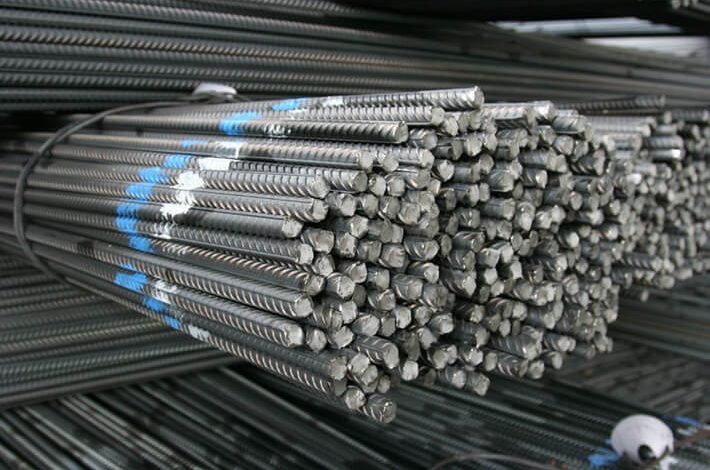

Steel prices in the Saudi market during August witnessed slight increases on a monthly basis, with the exception of one category, while the prices of most categories of electrical cables recorded varying decreases, in addition to varying wood prices. These changes came according to the Bulletin of Average Prices of Goods and Services issued by the Statistics Authority, reflecting the variation in market movement and the effects of several factors on the building and construction sector.
Details of steel prices in August
According to the report, the price of rebar (6mm) increased by 0.1% to reach SR3,929.62 per ton, continuing its slight increase on a monthly basis. In contrast, rebar (8mm) recorded a slight decrease of 0.2% to reach SR2,786.73 per ton in August.
<Rebar (10mm) increased by 0.01% to reach 2834.91 riyals per ton, while rebar (12mm) increased by 0.3% to reach 2723.58 riyals per ton. The price of rebar (14 mm) increased by 0.2% to reach 2722.61 riyals per ton, while the price of rebar (16 mm) increased by 0.3% to 2722.45 riyals per ton.
The price of rebar (16 mm) increased by 0.3% to 2722.45 riyals per ton. On the other hand, the price of rebar (18 mm) increased by 0.2%, recording 2721.14 riyals per ton in August, confirming the general trend of rising steel prices in all categories except one.
Electrical cable prices varied
In terms of electrical cables, most categories saw price decreases. The price of electrical wires (2.5mm) decreased by 1.7% to reach 1.18 riyals per meter, while the price of electrical wires (4mm) stabilized at 1.73 riyals. On the other hand, the price of electrical wires (6 mm) increased by 0.4% to reach 2.69 riyals.
Larger electrical cables saw a decline in prices. The price of 10mm cables decreased by 0.9% to SR22.29 per meter and 25mm cables decreased by 0.9% to SR48.52 per meter. The electric cable (35 mm) recorded a decrease of 0.9% to reach 63.01 riyals per meter, while the cable (50 mm) decreased by 1.8% to reach 88.38 riyals per meter.
With regard to larger cables, the price of 70mm electrical cables decreased by 1% to reach SR127.45 per meter, while 95mm electrical cables decreased by 1.9% to reach SR174.03 per meter. The prices of electrical cables (120 mm) fell by 0.4% to register 221.89 riyals per meter.
Despite these declines in electrical cables, electrical cables (300mm) witnessed a slight increase by 0.6% to reach 539.34 riyals per meter, reflecting a variation in market movement between different categories of cables. Despite these declines in electrical cables, electrical cables (300mm) witnessed a slight increase by 0.6% to reach 539.34 riyals per meter, reflecting a variation in market movement between different categories of cables.
The price changes were not only limited to steel and cable, but also to aluminum and lumber. The price of aluminum recorded a slight decline of 0.1% to reach 86.63 riyals per meter in August. Aluminum prices declined slightly by 0.1% to reach 86.63 riyals per meter in August.
<Regarding wood prices, the price of Chilean wood decreased by 0.2% to 1535.22 riyals per cubic meter. Romanian wood recorded a decrease of 0.8% to reach 1517.96 riyals. Despite these declines in the prices of some types of wood, there were some rises as well. The price of African teak increased by 0.7% to 6187.37 riyals per cubic meter, while the price of Indonesian Appalachian wood decreased by 0.4% to 3228.36 riyals per cubic meter.
These changes in the prices of building materials indicate a marked divergence in the market movement during the recent period. While steel prices have seen slight increases in most categories, electrical cable prices have continued to decline, which may reflect different impacts on the cost of building and construction in the Kingdom.
<Economists point out that these changes may be the result of global market fluctuations in raw material prices, in addition to the effects of local and global demand. Global markets have witnessed fluctuations in mineral prices as a result of various economic challenges, including trade tensions between countries, oil price fluctuations, and changes in demand globally. On the other hand, these changes may be the result of global market fluctuations in raw material prices, in addition to the effects of local and global demand.
On the other hand, declines in the prices of electrical cables and wood may have a positive impact on the construction sector in Saudi Arabia, as these declines are expected to help reduce construction costs, contributing to supporting housing and real estate development projects in the country. While the global markets have seen fluctuations in metals prices as a result of economic challenges, including trade tensions between countries, oil price fluctuations, and changes in global demand.
In light of these changes, the question remains as to whether these trends will continue over the coming months. Some analysts suggest that the Kingdom's construction market may witness further price changes in the coming period, especially with the continued volatility of global markets and their effects on raw material prices. With regard to steel prices, the outlook for the future is mixed.
In terms of steel prices, some expect prices to continue to rise slightly as a result of continued demand for major construction projects in the Kingdom, including Vision 2030 projects aimed at developing infrastructure and boosting economic growth. With regard to steel prices, some analysts expect prices to continue to rise slightly as a result of continued demand for major construction projects in the Kingdom, including Vision 2030 projects aimed at developing infrastructure and boosting economic growth.
As for electrical cable and wood prices, declines are likely to continue in some categories as global supply chains improve and demand for these materials declines in some international markets. As for electrical cable and wood prices, declines are likely to continue in some categories as global supply chains improve and demand for these materials declines in some international markets.
ConclusionThe prices of larger electrical cables continue to decline
Aluminum and wood prices declined
Market analysis and the impact of price changes
Future outlook for building materials prices
Ultimately, the changes in Saudi Arabia's steel, electrical cable and wood prices in August reflect the complexity of the market and the impact of domestic and international factors on the cost of building materials. As these changes continue, real estate investors and developers should carefully monitor market movements to ensure that they take advantage of opportunities and minimize risks related to price fluctuations.
In the end, these changes reflect the complexity of the market and the impact of domestic and international factors on the cost of building materials.