
Signs of activating undeveloped land in Saudi Arabia have begun to appear in the real estate sector, after areas exceeding 27 million square meters in the city of Riyadh entered the development phase since the implementation of the white land fees procedures last January, according to what was revealed by Abdulrahman Al-Tawil, Undersecretary of the Ministry of Municipalities and Housing for stimulating the housing supply and real estate development.
The movement of these spaces coincided with a rise in building permits by 37%, at a time when more developers are moving towards launching new real estate projects, amid efforts to increase the units available in the market and enhance its ability to meet demand and achieve a greater balance between supply and demand.
These indicators, according to Al-Taweel’s statements to Al-Arabiya Business, show that the impact of regulatory measures is no longer limited to Riyadh, as the increase in license applications has extended to other Saudi cities, reflecting the expansion of development activity and the response of investors to the facilities provided, with a growing trend towards utilizing uninvested lands and establishing residential and commercial projects on them.
2900 completed requests through the "Etmam" center
In addressing the obstacles hindering project implementation, the role of the “Etmam” Center has emerged as a coordinating body that brings together the services and procedures needed by the real estate developer, instead of having to deal separately with multiple parties to obtain the necessary approvals.
The center's work covers all stages of the project, from land preparation and planning and plan approval, through obtaining permits, to completing development and operation. This approach aims to reduce delays caused by the involvement of multiple entities responsible for approvals, whether it be the Ministry of Municipalities and Housing, municipalities, development authorities, service companies, or other ministries and government agencies.
According to figures announced by Al-Taweel, the center has processed over 2,900 applications since the program's launch, with the total area of approved developments exceeding 800 million square meters. It also addressed more than 770 challenges faced by developers, related to procedures or coordination between different entities, and successfully resolved most of them.
The center’s role is not limited to completing transactions, but extends to supporting developers in facing the challenges that hinder their investments, in cooperation with the Ministry of Municipalities and Housing and the White Land Fees Program, including studying requests to grant additional periods to complete development, and working to remove obstacles that prevent the implementation of projects on the targeted dates.
Off-plan sales add 80,000 new units
The efforts to accelerate development extended to off-plan sales projects, through joint work between the “Etmam” Center and the General Authority for Real Estate to facilitate the approval of designs and the completion of licensing requirements, allowing developers to offer their units in accordance with the procedures and regulations governing this activity.
In this context, the number of design approvals linked to licenses has exceeded 300,000 approvals since the program began, which reflects the volume of transactions that have been handled to facilitate the transition of projects from the design and regulatory procedures stage to the implementation and market launch stages.
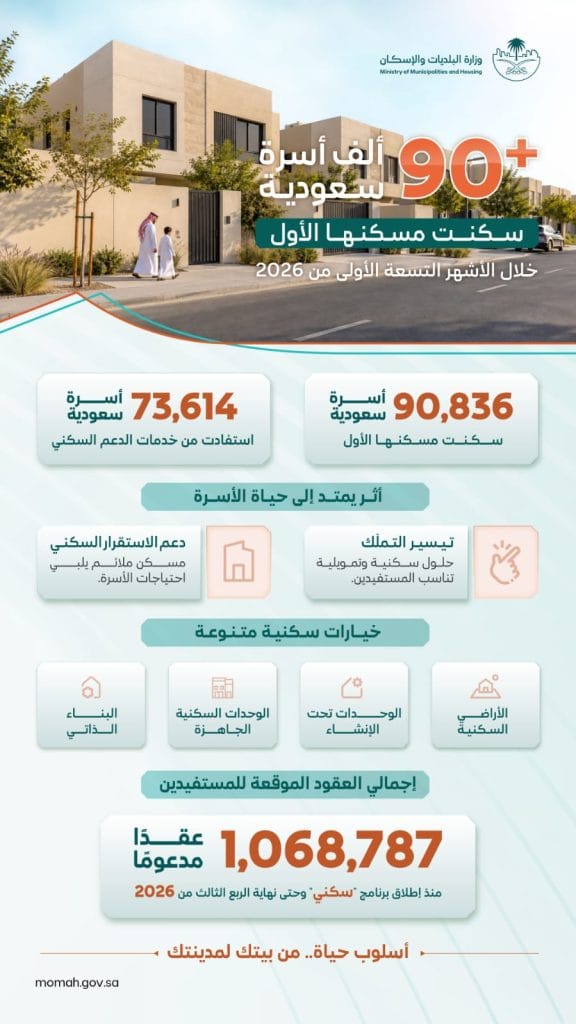
Regarding cooperation with the National Housing Company (NHC), Al-Taweel stated that over 80,000 housing units were approved in 2026 and made available for sale in the real estate market. This aligns with the trend of expanding reliance on off-plan sales as a key tool for increasing the housing supply and accelerating access to real estate products for buyers.
Land shifts and a new test of market equilibrium
The relevant authorities are placing increasing the supply of real estate at the forefront of their priorities during the current stage, based on the fact that price stability is linked to the market’s ability to provide units that match the size of the demand and the needs of the population.
In this context, Al-Taweel believes that the increase in building permits and the rise in new projects reflect a shift in the behavior of landowners and developers, with their tendency to develop real estate assets instead of keeping them without exploitation, which supports an increase in the products available to beneficiaries.
In parallel, the relevant authorities are working to monitor the housing needs of Saudi cities in the coming years and to estimate the quantities required in each region, with the aim of directing investments and projects to locations that need additional supply, and avoiding the gap between the size of the units offered and the actual demand.
The Ministry of Municipalities and Housing, the General Authority for Real Estate, and the Royal Commission for Riyadh City are all involved in implementing the real estate balance system through procedures aimed at accelerating development processes, facilitating the issuance of licenses, and encouraging landowners to convert their land into usable projects.
Regarding price movements, Al-Taweel noted the emergence of declines in some real estate values towards more balanced levels, expressing his expectation that this trend will continue with the increase in new projects and the entry of additional units into the market.
He stressed that the focus in the coming period is on converting available land into residential projects and commercial products that meet market needs, instead of leaving it outside the circle of investment and development, which will enhance supply and support the stability of the real estate market in the long term.
Read also:
7 million square meters of undeveloped land in 3 areas have entered development or trading.