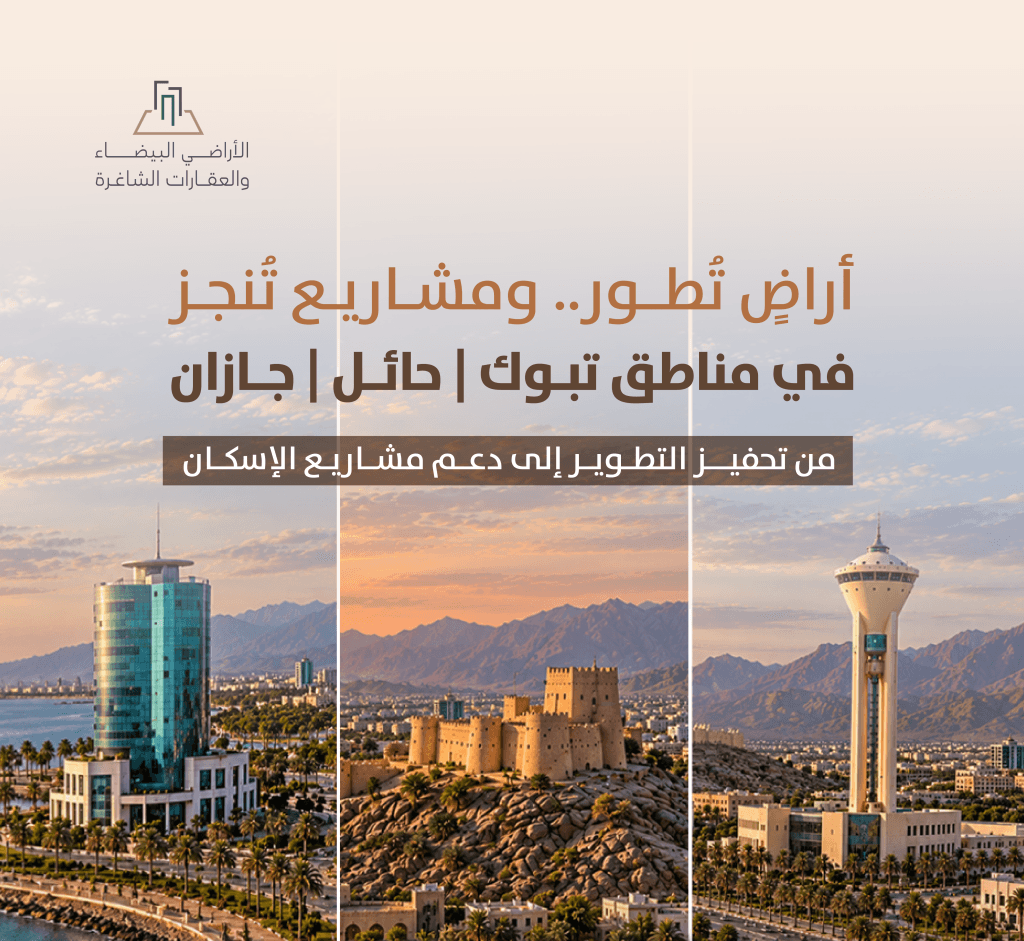

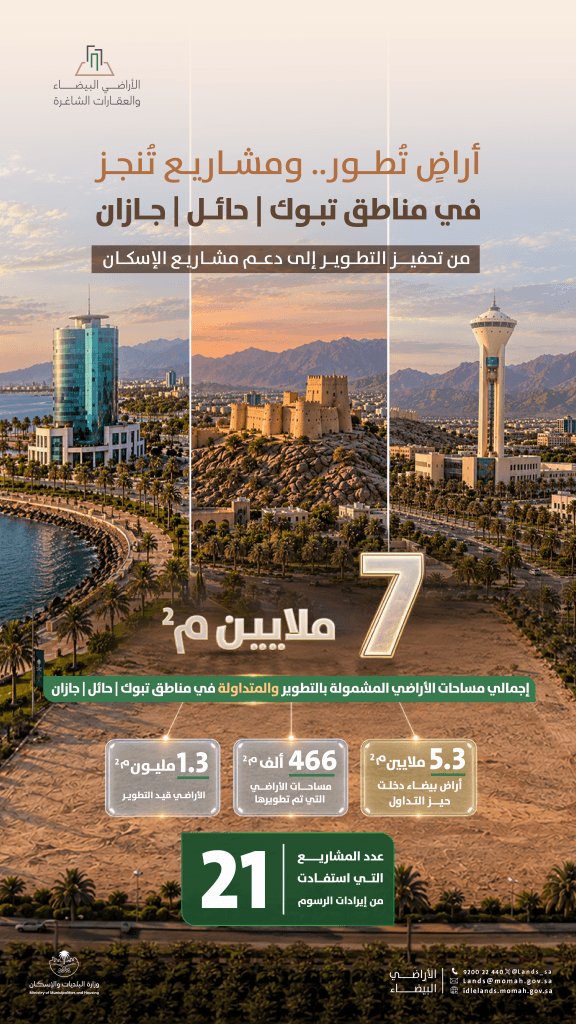
The Ministry of Municipalities and Housing revealed that the total area of undeveloped land that has entered development or trading paths in the Tabuk, Hail and Jazan regions amounted to 7 million square meters, as part of the results of applying the system of fees for undeveloped land and vacant properties, and efforts to stimulate land development and raise the efficiency of its use within urban areas.
The ministry explained that the areas included 5.3 million square meters of undeveloped land that entered circulation, 466,000 square meters of developed land, in addition to 1.3 million square meters of land under development, in results that reflect the impact of fees in stimulating the circulation and development of unexploited land.
She explained that the impact of the fees extended to supporting housing projects in the three regions, as the number of projects that benefited from the revenues of the white land fees reached 21 projects, within the framework of directing the revenues of the fees to support housing projects and raise the readiness of the infrastructure associated with them.
Stimulating land development
The ministry affirmed its continued efforts to incentivize landowners to develop and utilize their land, accelerate the entry of unutilized land into the urban development cycle, improve land use efficiency at city entrances, increase the supply of real estate and housing, and support the balance between supply and demand.
It is worth mentioning that the Ministry announced earlier the results of applying the fees for white land and vacant properties in a number of regions of the Kingdom, as the total area of land that entered development or trading amounted to about 286 million square meters, including 146 million square meters in the Eastern Region, 71 million in the Riyadh Region, 28 million in the Makkah Region, 19 million in the Madinah Region, 15 million in the Qassim Region, in addition to 7 million square meters that entered development paths in the Asir Region.
What is the white land tax system?
The vacant land tax system imposes an annual fee on undeveloped land within city limits, aiming to incentivize owners to develop or market their land instead of leaving it idle. Among the most significant recent amendments is an increase in the annual fee to 101 TP3T of the land value in the highest priority urban development bracket, 7.51 TP3T in the high priority bracket, 51 TP3T in the medium priority bracket, and 2.51 TP3T in the low priority bracket. Land outside these priority brackets is exempt from the fee but is included in the owner's total land area calculation. The minimum area subject to the fee has also been lowered to 5,000 square meters or more.
Objectives of white land fees
Increased supply of developed land and residential units.
Achieving a balance between supply and demand in the real estate market.
To reduce inflation in land and real estate prices.
Combating monopolistic practices (land monopoly without development).
Protecting fair competition in the market.
Conditions for subjecting land to the tax
To be a white land (undeveloped space).
To be located within the approved urban area.
Its area (or the total land of the owner in the city) must not be less than 5,000 m².
To be expandable or buildable.
To be within the ranges announced by the ministry.
It is worth mentioning that the system was first issued under Royal Decree No. (M/4) dated 12/2/1437 AH (November 2015), and its actual implementation began in 2017. In 2025, it was substantially amended under Royal Decree No. (M/244), to become the “White Land and Vacant Real Estate Fees System,” and its new executive regulations were issued in August 2025.
Read also
4 conditions for exempting undeveloped land from fees... What do you know about them?
Infographic | When are the white land fees invoices issued and who are the targeted groups?
Infographic | Are off-plan sales projects exempt from white land fees?