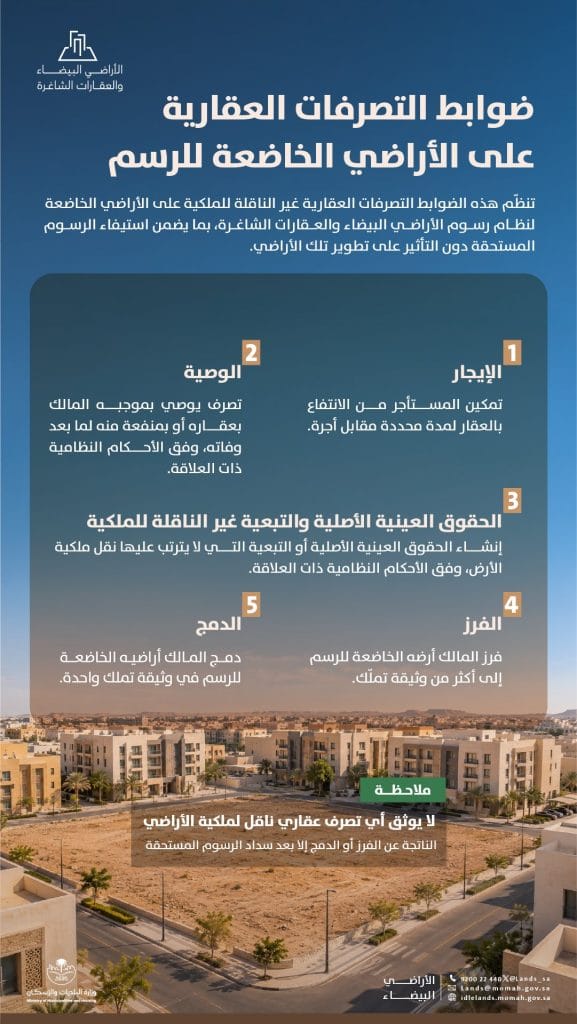

The White Land and Vacant Properties Program has imposed new controls on the documentation of real estate transactions related to lands subject to the system, stipulating that the procedures for transferring ownership of lands resulting from sorting or merging operations will not be completed before settling the financial fees due on them, in a step aimed at tightening control over real estate transactions, enhancing compliance with regulatory requirements, and supporting efforts to increase the supply of real estate.
The program identified five types of real estate transactions that do not result in the transfer of ownership, explaining that they include lease, will, original and subsidiary real rights, in addition to land sorting and merging operations, while subjecting these transactions to controls that ensure the collection of fees due in accordance with the provisions of the system.
Rental and Will Regulations
The program explained that renting falls under the category of transactions that allow another party to use and benefit from the property for a specific period of time, in exchange for an agreed-upon sum of money, without this leading to the transfer of ownership of the property from its owner to the tenant.
The list of transactions also includes wills, which allow the property owner to specify the transfer of his ownership or usufruct to another person after his death, in accordance with the applicable regulatory provisions and requirements.
Property rights, land division and consolidation
With regard to real rights, the program indicated that they include the creation of original or subsidiary legal rights over the property, without this entailing a change of its owner or the transfer of the title deed to another party.
As for the sorting process, it involves dividing the land into several independent parts, so that each part is allocated a separate deed or ownership document, while the merger process means combining more than one land into a single real estate unit and issuing a unified document for it.
The program stressed the need to review the financial and regulatory obligations related to the properties before starting the procedures for disposing of them, emphasizing that the documentation of the transfer of ownership of lands resulting from sorting or merging remains suspended until the fees due are paid in full.
These measures aim to strengthen compliance with the system of fees on white land and vacant properties, and to ensure that the associated financial obligations are not exceeded when conducting real estate transactions, in addition to reducing practices that may disrupt the application of the system.
The regulations also support the program’s directions towards raising the efficiency of land use, and encouraging landowners to develop and benefit from their land instead of leaving it undeveloped, which contributes to increasing the number of developed lands and available real estate units, and enhancing the balance between supply and demand in the real estate market.
Read also: