
The movement of licenses and the start of production reflects the expansion of the industrial investment base in the Kingdom, with the influx of new projects into diverse sectors, and the increase in the volume of capital associated with factories under establishment and projects that have entered operation.
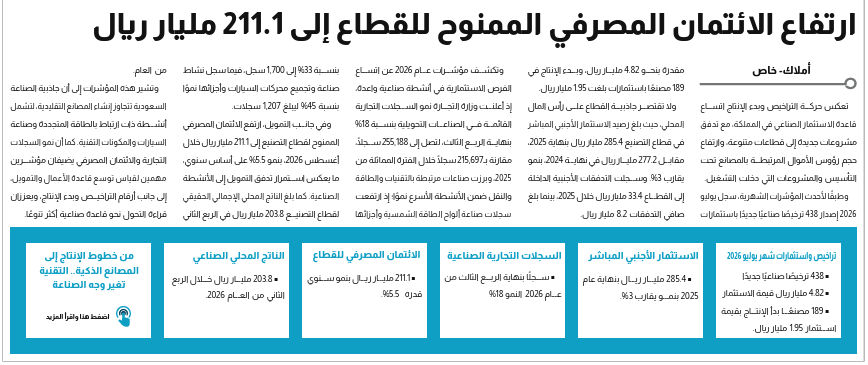
According to the latest monthly indicators, July 2026 saw the issuance of 438 new industrial licenses with estimated investments of approximately 4.82 billion riyals, and the start of production in 189 factories with investments amounting to 1.95 billion riyals.
The sector's appeal is not limited to domestic capital; foreign direct investment in the manufacturing sector reached SAR 285.4 billion by the end of 2025, compared to SAR 277.2 billion at the end of 2024, representing growth of approximately 31 TP3T. Foreign inflows into the sector amounted to SAR 33.4 billion during 2025, while net inflows reached SAR 8.2 billion.
The attractiveness of industrial investment is based on factors including the size of the local market, geographical location, the development of industrial cities and logistical infrastructure, financing programs and incentives, along with opportunities to localize products and link factories to local supply chains.
Indicators for 2026 reveal the expansion of investment opportunities in promising industrial activities. The Ministry of Commerce announced the growth of existing commercial registrations in manufacturing industries by 18% by the end of the third quarter, reaching 255,188 registrations, compared to 215,697 registrations during the same period in 2025. Industries related to technology, energy and transportation emerged among the fastest growing activities. Registrations for the manufacture of solar panels and their parts increased by 33% to 1,700 registrations, while the activity of manufacturing and assembling car engines and their parts recorded growth by 45% to reach 1,207 registrations.
On the financing side, bank credit extended to the manufacturing sector rose to SAR 211.1 billion in August 2026, a year-on-year increase of 5.51 TP3T, reflecting the continued flow of financing to industrial activities. The real GDP of the manufacturing sector reached SAR 203.8 billion in the second quarter of the year.
These indicators suggest that the appeal of Saudi industry extends beyond the establishment of traditional factories to include activities related to renewable energy, automotive manufacturing, and technology components. Furthermore, the growth in commercial registrations and bank credit adds two important indicators for measuring the expansion of the business and financing base, alongside licensing figures and production commencements, reinforcing the perception of a shift towards a more diversified industrial base.
Read also:
Saudi industry is reshaping the economic landscape.
From production lines to smart factories: Technology is changing the face of industry.