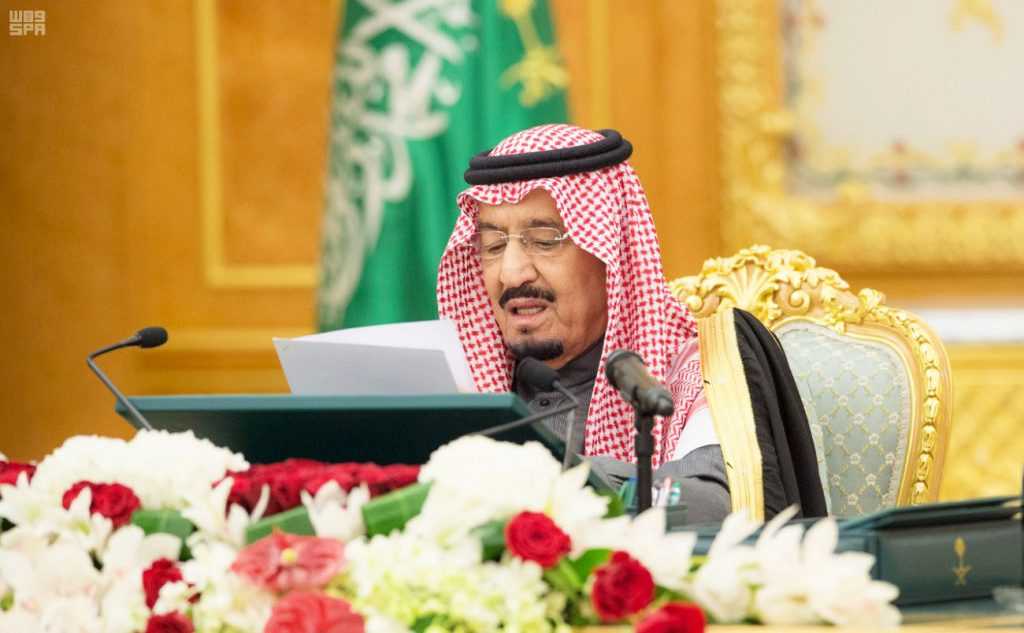

The Custodian of the Two Holy Mosques—may God support him—addressed his brothers and fellow citizens, announcing the budget.
The following is the text of the Custodian of the Two Holy Mosques" address:
In the name of Allah, the Most Gracious, the Most Merciful
Praise be to Allah, Lord of the Worlds, and peace and blessings be upon our Prophet Muhammad, his family, and all his companions
My fellow citizens,
Peace be upon you, and may the mercy and blessings of Allah be upon you:
With God’s help and guidance, we announce today the budget for the upcoming fiscal year 1438/1439 AH, which comes amid highly volatile economic conditions that have affected most countries, which have led to slow global economic growth and a decline in oil prices, both of which have affected our country. The government has sought to address these changes in a way that does not compromise the goals we aspire to achieve.
Brothers and sisters:
Our economy—by the grace of God—is robust and possesses sufficient strength to face the current economic and financial challenges. This is the result—after God’s guidance—of the prudent fiscal policies adopted by the government, and we are determined to strengthen the foundations of our national economy. To this end, we have adopted »Saudi Vision 2030" and its implementation programs in accordance with a comprehensive reform vision that will propel the Kingdom toward broader and more inclusive horizons, enabling it —by the will of God Almighty—to meet these challenges and strengthen its position in the global economy. Our vision is not merely a set of aspirations, but rather a series of implementation programs that will enable us—by God’s grace—to achieve our national priorities and provide opportunities for all by strengthening and developing our partnership with the private sector, building a system capable of delivering results, enhancing coordination and integration among all government agencies, maintaining fiscal discipline, and promoting transparency and integrity.
Through this budget and its programs, we have sought to improve the efficiency of the state’s capital and operating expenditures, strengthen the public finance position, and enhance its sustainability, and to prioritize development and service projects and programs that directly benefit citizens and contribute to activating the role of the private sector and increasing its contribution to gross domestic product.
We are optimistic about our ability to achieve this —with God’s help—and with the support of our loyal citizens to achieve the desired economic prosperity. We urge everyone to ensure that this budget is implemented with the utmost precision to realize our aspirations for comprehensive and balanced development and to improve the services provided to citizens.
We ask God that this budget be a source of good, growth, and blessing for the nation and its citizens.
Peace be upon you, and may God’s mercy and blessings be upon you.
Budget Decree
Afterward, Deputy Secretary-General of the Council of Ministers Saleh Al-Hadlaq read the Royal Decree regarding the budget.
After reviewing the proposal regarding the Fiscal Balance Program (2020), the Council of Ministers decided to approve the Fiscal Balance Program (2020) as set forth in the attached document.
The Custodian of the Two Holy Mosques, King Salman bin Abdulaziz Al Saud—may God protect him—then graciously signed the royal decree regarding the budget, saying:
In the name of Allah, the Most Gracious, the Most Merciful
We ask Allah for success in serving our religion, our country, and our citizens.
Key Features of the Budget
The Minister of Culture and Information, Dr. Adel Al-Turaifi, explained in his statement to the Saudi Press Agency following the session that the Minister of Finance, under generous guidance, presented a brief overview of the state’s general budget, during which he outlined the financial results for the current fiscal year 1437/1438 AH and reviewed the key features of the state budget for the new fiscal year 1438/1439 AH, He said that the Kingdom’s economy is one of the largest in the Middle East and North Africa region, accounting for 25% of the region’s gross domestic product, The size of the Kingdom’s economy has doubled, making it one of the world’s twenty largest economies, up from 27th place in 2003. The Kingdom’s average real GDP growth over the past decade was 4% annually, and the government invested 1.7 trillion riyals in capital projects in the infrastructure, education, and health sectors.
Gross Domestic Product
Gross Domestic Product (GDP) for the year 1437/1438 AH (2016 CE) is expected to reach, at constant prices (2010 = 100) (2.581) billion riyals, according to estimates by the General Authority for Statistics, representing an increase of (1.40%). The oil sector is projected to grow by (3.37%), the government sector by (0.51%), and the private sector by (0.11%). Oil refining activity achieved growth of (14.78%), the highest growth rate among the economic activities that make up real GDP.
His Excellency added that the GDP deflator for the non-oil private sector—which is one of the most important economic indicators for measuring inflation at the economy-wide level—is expected to rise by (0.99%) in 1437/1438 AH (2016 CE) compared to the previous year, according to estimates by the General Authority for Statistics.
Public expenditures
He noted that the Kingdom’s fiscal policy aims to strengthen the public finance position and improve the efficiency of government spending, with the goal of achieving a balanced budget by 2020 in accordance with the guidelines of the Kingdom’s Vision 2030 and its programs, including the National Transformation Program 2020 for various government agencies, thereby contributing to stimulating economic growth, attracting foreign investment, and promoting private-sector growth.
He reviewed the actual results for the fiscal year 1437–1438 AH (2016 CE) and said: Total revenues for 2016 AD are expected to reach 528 billion riyals, an increase of (2.7%) from the budget estimate of (514) billion. Non-oil revenues are also expected to reach (199) billion riyals, compared to the (181) billion riyals estimated in this year’s budget.
He added: Government expenditures for 2016 are expected to reach (825) billion riyals after excluding unbudgeted expenditures from previous years, representing a decrease of (1.8%) compared to the 2016 budget figure of (840) billion riyals. This is (15.6%) less than last year’s expenditures, which totaled (978) billion riyals, The main reason for this decrease was the slowdown in project disbursements, based on measures taken by the government during the year to control spending and review existing and new projects, while ensuring the continued payment of financial dues to contractors, suppliers, and individuals. Total expenditures, including payments for outstanding amounts—which were excluded for comparison with the budgeted figures—amount to 930 billion riyals.
He added that, given the spending measures taken—which made it possible to reduce the deficit to less than the budget estimate— the deficit for 2016 is expected to fall to 297 billion riyals, after reaching its highest level in 2015 at approximately 366 billion riyals. The deficit was financed through borrowing from domestic and international markets.
Economic Development
In his remarks regarding the budget for the upcoming fiscal year 1438/ 1439 AH (2017 AD), that it represents an important phase in the Kingdom’s economic development. Previously, the Council of Ministers, at its session held on Monday, the 18th of Rajab 1437 AH, corresponding to April 25, 2016 AD, chaired by the Custodian of the Two Holy Mosques, the Kingdom’s Vision 2030, and tasked the Council of Economic and Development Affairs with establishing the necessary mechanisms and arrangements to implement this vision and follow up on its progress, and directed the ministries and other government agencies —each within its respective purview—to take the necessary steps to implement this vision. On this occasion, the Custodian of the Two Holy Mosques addressed the citizens, affirming that this vision is intended to fulfill his hope that our country —with God’s help and guidance—to become a model for the world at all levels, and he expressed his hope that all citizens would work together to achieve this ambitious vision.
In line with the Kingdom’s Vision 2030
In line with »Saudi Vision 2030," certain ministries, agencies, institutions, and public bodies have been restructured to meet the requirements of this phase and to ensure efficiency and effectiveness in the full and proper exercise of their duties and responsibilities by state agencies, and to elevate the level of services provided to beneficiaries, paving the way for a prosperous future and sustainable development.
890 billion in spending
The Minister of Finance stated that the budget for the upcoming fiscal year 1438/1439 AH (2017 CE) is estimated at 890 billion riyals, which is 8% higher than the expected expenditure for the current fiscal year 1437/1438 AH (2016 CE), which amounted to 825 billion, The budget takes into account the initiatives of the National Transformation Program 2020, for which an amount of 42 billion riyals was allocated in the 2017 budget, in addition to projects previously approved using budget surpluses from prior fiscal years and the economy’s needs to stimulate growth, particularly in the private sector.
He explained that over the past decade, the Kingdom has achieved a strong financial position by building up reserves during the period of high oil prices to withstand fluctuations in domestic and global economic cycles, It also reduced public debt levels to preserve future borrowing capacity; public debt stood at approximately 44 billion riyals, equivalent to 1.7% of gross domestic product, at the end of 2014.
The cornerstone of public finance management is to provide greater transparency regarding medium-term public finance trends to define the strategy and path of adjustments over the next five years, with the aim of supporting economic growth, achieving fiscal stability, and mitigating the impact of oil price fluctuations on the state budget by working to achieve fiscal balance and implement a medium-term public debt strategy.
The Minister of Finance stated that the Ministry of Finance is working—in cooperation with government agencies, other relevant ministries, and its partners in the transformation process—to develop its operations and procedures.
Great optimism
We are optimistic about our ability to succeed—with God’s help—and with the support of our loyal citizens, in achieving the desired economic prosperity.
We urge everyone to ensure that this budget is implemented with the utmost precision to fulfill our aspirations for comprehensive and balanced development and to improve the services provided to citizens.
Thereafter, His Excellency Mr. Saleh bin Khalid Al-Haddalq, Deputy Secretary-General of the Council of Ministers, read the Royal Decree regarding the budget.
After reviewing the proposal regarding the Fiscal Balance Program (2020), the Council of Ministers decided to approve the Fiscal Balance Program (2020) as presented in the accompanying document.
The Custodian of the Two Holy Mosques, King Salman bin Abdulaziz Al Saud—may God preserve him—then graciously signed the Royal Decree on the budget, saying:
In the name of Allah, the Most Gracious, the Most Merciful
We ask Allah for success in serving our religion, our country, and our citizens.
His Excellency Dr. Adel bin Zaid Al-Turaifi, Minister of Culture and Information, explained in his statement to the Saudi Press Agency following the session that His Excellency the Minister of Finance, under his gracious guidance, presented a brief overview of the state’s general budget, during which he outlined the financial results for the current fiscal year 1437–1438 AH and reviewed the main features of the state’s general budget for the new fiscal year 1438–1439 AH, He noted that the Kingdom’s economy is one of the largest in the Middle East and North Africa region, accounting for 25% of the region’s gross domestic product (GDP). The size of the Kingdom’s economy has doubled, making it one of the world’s twenty largest economies—up from 27th place in 2003—and the Kingdom’s average real GDP growth over the past decade (4)% annually, and the government has invested (1.7) trillion riyals in capital projects in the infrastructure, education, and health sectors.
Gross Domestic Product
Gross Domestic Product for the year 1437/1438 AH (2016 CE) is expected to reach (2.581) billion riyals at constant prices (2010 = 100) (2.581) billion riyals, according to estimates by the General Authority for Statistics, representing an increase of (1.40)%. The oil sector is projected to grow by (3.37)%, the government sector by (0.51)%, and the private sector by (0.11)%. Oil refining achieved a growth rate of (14.78)%, the highest growth rate among the economic activities that make up real gross domestic product.